Just What Is It About Today’s Planning System that Makes Appealing So … Appealing?

On 22 September 2025 the Secretary of State allowed two recovered appeals, granting planning permission for proposals which local authority members had refused against their professional officers’ opinions. In one of those cases, a full award of costs was ordered against the authority which I guess will amount to several hundred thousands of pounds. Development was unnecessarily held up in both cases for what turned out to be no good reason, in one case the decision to refuse having been in March 2024 following submission of the application in September 2022 and the other in May 2024 following submission of the application in November 2021. Both decisions were made in accordance with the relevant inspector’s recommendation.

I’m thinking back yet again to the Lichfields May 2025 research paper for the LPDF and Richborough Estates, How Long Is A Piece Of String? which found not only that applications for major development are taking twice as long to determine as 10 years ago but that it is now on average quicker to achieve permission via appeal than via the local planning authority.

I’m also thinking of the latest 50 Shades of Planning podcast episode Who’s In Control? (27 September 2025) where a number of us discuss, amongst other things, the ethical position of officers whose advice is overturned by councillors.

And I’m thinking that neither the proposed move to an increased number of applications being determined by way of delegated powers, and increased training for members, would have been likely to change the position with these two appeals. Do awards of costs influence behaviour? I would welcome your views. From the outside I’m not sure they really register either with councillors or, perhaps most importantly , with voters.

The two decisions were as follows:

Brighton Gasworks

Planning application submitted to Brighton and Hove Council in November 2021 by St William for a scheme that, following amendments,  included 495 residential units and 2,791 square metres of commercial space. It was recommended for approval in May 2024 but in the face of significant local opposition was resolved to be refused. The reasons for refusal (1) alleged the development would represent overdevelopment of the appeal site by virtue of excessive massing, density and height thereby harming the townscape of the area including its heritage assets; (2) related to the proposed housing mix (subsequently withdrawn) and (3) concerned the effect of the appeal scheme on the living conditions of future residents with particular regard to amenity and light.

St William appealed. The appeal was recovered by the Secretary of State. The inquiry sat for six days in March 2025. The Secretary of State’s decision letter accepted the inspector’s recommendations and allowed the appeal. The Secretary of State’s conclusions are worthy of note on issues such as character and appearance, density and height (paragraph 14),; the current negative effect of the “underused and despoiled” site on the “varied and robust urban townscape of east Brighton” (paragraph 15); daylight and sunlight and living conditions more generally (paragraphs24 to 28); and acceptance of the agreed position between the appellant and the council that the development would not be able to provide affordable housing given the high cost of remediating the site (paragraph 30).

In his accompanying costs decision letter, again accepting his inspector’s recommendation, he orders a full award of costs in favour of St William, on the basis that:

* the Council prevented or delayed development which should clearly be permitted, having regard to its accordance with the development plan, national policy and all other material considerations (CR48);

* the Council failed to produce evidence to substantiate each reason for refusal on appeal, made vague, generalised or inaccurate assertions about a proposal’s impact and failed to determine similar cases in a consistent manner (CR49); and

* there were substantial procedural failings on the Council’s part including an obstructive and untimely approach to the Statement of Common Ground, the submission of a Statement of Case which was bereft of meaningful detail and a failure to review.

When it comes to any councillor training programme I hope this appeal decision will be part of the study materials, including, verbatim, these conclusions from the inspector’s costs report:

Had the Council had proper regard to its own Development Plan, the NPPF, other material considerations and carried out a proper balancing exercise, the application would most likely have been approved notwithstanding the concerns raised by Members. The Council therefore prevented or delayed development which should clearly be permitted, having regard to its accordance with the development plan, national policy and all other material considerations.

The Council’s objections did not stand up to scrutiny and therefore I find that the Council failed to produce evidence to substantiate each reason for refusal on appeal, made vague, generalised or inaccurate assertions about a proposal’s impact and failed to determine similar cases in a consistent manner. It goes without saying that a decision to refuse planning permission on an allocated site against the professional advice of officers requires very careful consideration and highly robust reasoning.

There were also substantial procedural failings on the Council’s part including an obstructive and untimely approach to the SoCG, the submission of a Statement of Case which was bereft of meaningful detail and a failure to review its case promptly following a material change in national policy.

The above unreasonable behaviour resulted in unnecessary or wasted expense, as described in the PPG. I therefore conclude that a full award of costs is justified.

While I understand that the above will come as a bitter blow to the Council, it is right that I acknowledge the important work of officers during what was a long preapplication and determination period. That work culminated in the production of a Committee Report which was of the very highest order. Officers were also beyond reproach for the way they assisted the inquiry.”

Sky Studios Elstree expansion proposal

Planning application submitted in September 2022 for a film and television production studio (use Class E(g)(ii)) with ancillary floorspace, backlot, new access arrangements, car parking, landscaping, infrastructure and associated works in the green belt north of the existing Sky Studios Elstree complex. Hertsmere Borough Council members had resolved to refuse the application in March 2024 against officers’ recommendations, concluding that the “very special circumstances” test had not been made out for inappropriate development in the green belt.

Sky Studios appealed in October 2024 and the appeal was recovered by the Secretary of State. The inquiry sat for four days in March and April 2025. The Secretary of State’s decision letter accepted the inspector’s recommendations and allowed the appeal. Following the introduction of the grey belt policy designation into the NPPF in December 2024, the Secretary of State found that the site was indeed grey belt. The only real issue was whether there was unmet need for the development, on which issue his findings were as follows:

For the reasons given at IR14.20-IR14.23 and IR14.43, the Secretary of State agrees with the Inspector that Sky Studios Limited has identified a need to enlarge its current operation at SSE, that there is a reasonable and probable outcome that if the appeal is allowed, the type of development that would take place would be for an extension of the existing studio site at SSE, and that there is an unmet need for studio space related directly to the expansion of SSE (IR14.23).

In reaching this conclusion, the Secretary of State has taken into account that the description of development does not specify that the development would be used as an extension to the existing SSE site, and no condition requiring the development to be an extension has been put forward either (IR14.17). He acknowledges that it is conceivable that the proposed development could be operated as a standalone studio business separate to SSE without any restrictions imposed by the description and any planning conditions (IR14.19). However, taking into account the matters set out at IR14.20-14.23, the Secretary of State considers that the proposal is highly likely to be brought forward as an extension and that it is appropriate to proceed on this basis. He considers on that basis that unmet need has been demonstrated and carries substantial weight in favour of the proposal, and that the requirement in NPPF155(b) is met.

The Secretary of State has also considered what the need position would be on the basis of a standalone studio. He has noted the position set out at IR14.24-14.25, but like the Inspector considers that national and local economic policy seeking to grow the sector, and an increased spend in productions, do not in themselves equate to unmet need.”

“…if considered as a standalone studio, the Secretary of State considers that unmet need has not been demonstrated. On that basis, the requirement in NPPF155(b) would not be met, the proposal would therefore be inappropriate development in the Green Belt and very special circumstances would need to be demonstrated. As set out at paragraph 21 above, in that scenario the Secretary of State considers that the harm to the Green Belt in terms of inappropriateness, harm to openness and harm to purposes would have carried substantial weight. Although he has not proceeded on that basis, for the avoidance of doubt, he considers that the harm to the Green Belt and any other harm would be clearly outweighed by the benefits of the scheme such that very special circumstances would exist and development in the Green Belt would be justified.”

A textbook application of green belt principles. (Incidentally, in the unlikely event that you need a primer on grey belt I think you can still access a webinar I gave this week on that subject via Inside Housing – see here for more details).

Perhaps the outcome of the Sky Studios appeal only became obvious once we had the December 2024 NPPF but perhaps the big question for MHCLG should be, rather than further tweaks to law or policy, how to make sure that many more appeals like these two are not needed before the message gets through as to how the current legislation and policy framework is to be applied? Otherwise, whether through members’ overturns, or through non-determination appeals, schemes will be continuing to come before the Planning Inspectorate, with all the delay, expense and unnecessary risk thereby arising, that really should be determined appropriately at a local level. It’s reassuring that the appeal route is available but the relative attractiveness of that route versus waiting for a local outcome is not good in public policy terms – as I said at a breakfast discussion that we held at Town Legal this week alongside Shared Voice and Rupert Warren KC and attended by the interim chief planning inspector Rebecca Phillips (for which thanks for her participation), it’s the equivalent of people being unhappy with the service at their local GP and instead going straight to A&E…

Simon Ricketts, 27 September 2025

Personal views, et cetera

Just what is it that makes today’s homes so different, so appealing? 1956 collage by Richard Hamilton
Pragmatic Planning Guidance: The Revised Flood Risk PPG

The application of the flood risk sequential approach to development proposals has been watered down this week.

From being part of a sensible risk-based assessment as to where it is safe to locate development, the process has (like so much that we deal with) grown over time to become a technocratic obstacle course with plenty of traps for the unwary. See for instance my 19 July 2025 blog post A PPG Change Could Easily Mop Up This Surface Water Flood Risk Sequential Test Mess. As of 17 September 2025 we now have that revised planning practice guidance.

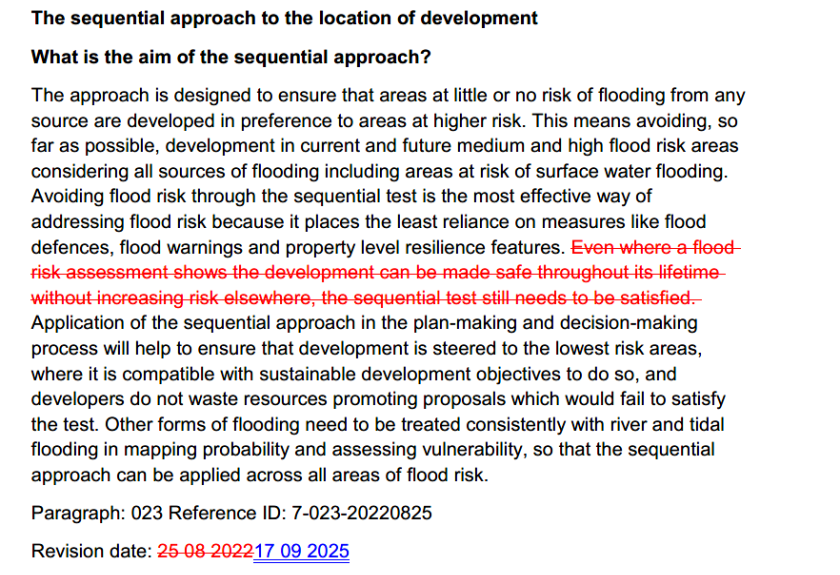
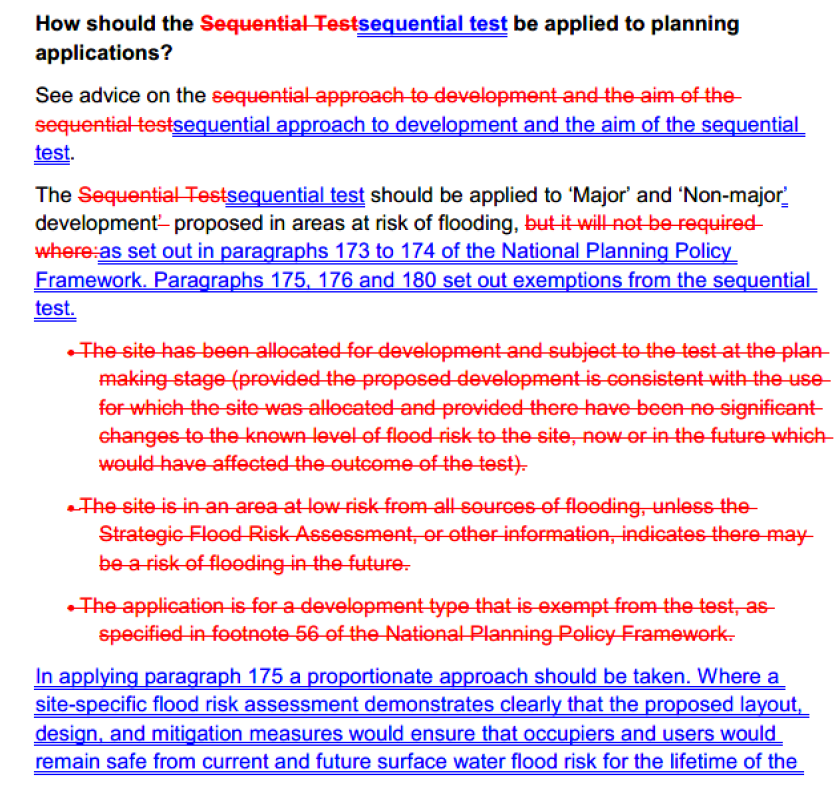
My Town Legal colleague Tom Brooks provided a mark up of the changes from the previous guidance. They are as follows:

The important change is that we move from a position where the sequential approach is still required where the site is currently at risk of flooding, even where that risk would be removed as a result of development, to a position where it is not required as long as “a site-specific flood risk assessment demonstrates clearly that the proposed layout, design, and mitigation measures would ensure that occupiers and users would remain safe from current and future surface water flood risk for the lifetime of the development (therefore addressing the risks identified e.g. by Environment Agency flood risk mapping), without increasing flood risk elsewhere.” So, if your flood risk consultant is in a position to reach such a conclusion, no longer does there need to be a wide trawl for other sites, currently at lower risk of flooding, where the development might be situated. Might developers still hedge their bets and engage in a sequential testing just in case an issue arises? I suspect so, but this change is certainly going to simplify applicants’ case as to flood risk matters in many instances – particularly, I suspect, where the only potential risk arising is by way of the accumulation on site of surface water.

Whilst not stated in the revised guidance, I note that disapplication of the need to follow the sequential approach also has the effect of relieving developers as well from complying with the two limbs of the “exception test” that have to be followed once the sequential approach has been navigated:

“a) the development would provide wider sustainability benefits to the community that outweigh the flood risk; and

b) the development will be safe for its lifetime taking account of the vulnerability of its users, without increasing flood risk elsewhere, and, where possible, will reduce flood risk overall.

The reference in the revised guidance to the fact that, if a sequential approach is followed, housing considerations, including housing supply, should be weighed in the balance against the outcome of that process, is helpful express recognition of the approach already taken by various appeal inspectors (see again my July blog post): planning permission may still be granted even if the test is failed – if there are sufficient weighty counterveiling considerations.

The other amendments to the guidance give further clarity to the parameters of the search for alternative sites to be carried out under the sequential approach:

As with MHCLG’s February 2025 planning practice guidance on grey belt, at a time where the need to simplify and rationalise our current sprawling system is so acute and urgent, isn’t it interesting how pragmatic changes can still be be made without recourse to legislation or indeed even lengthy consultation processes?

Simon Ricketts, 21 September 2025

Personal views, et cetera

The Only Way Is Ethics – What Is The Role Of The Professional Witness?

In preparing for a 50 Shades of Planning podcast episode we are recording this week on the wider subject of ethics in planning I looked back on an interesting case on the position of those who give evidence as an expert in the High Court on planning issues in circumstances where they have previously been involved as a consultant in the project.

The position under the High Court’s Civil Procedure Rules is certainly tighter than the position in relation to those giving evidence at planning inquiries, for instance, but perhaps there are still lessons, or reminders at least, for the latter. The case is Freeman & Others v Home Farm Ellingham Limited (HHJ Claire Jackson (sitting as a High Court Judge in the Business and Property Courts in Newcastle-upon-Tyne, 17 April 2025) and it was brought to my attention by a LinkedIn post by James Maurici KC who I hope I will not mind my reproducing it in full as follows:

Interesting recent judgment that I have just come across for those who give expert evidence in the High Court on planning and development related issues.

In Freeman v Home Farm Ellingham Ltd [2025] EWHC 878 (Ch) the Court was considering a claim for specific performance of an obligation to procure the adoption of an access road to a housing development. Of wider interest is the decision of the Court (HHJ Claire Jackson sitting as a Deputy High Court Judge) to rule inadmissible the evidence of one of the experts for the parties. The expert evidence for the claimant was challenged on the basis that he was partisan in his evidence and failed to therefore comply with his duties as an expert under CPR Part 35: see paras. 32 – 44 of the judgment.

The Court noted that the expert was heavily involved in the planning processes which led to the housing development in issue but that this did not in itself preclude his acting as an expert in the Court proceedings under CPR Part 35. The Court gives a useful summary of the principles applicable to the issue of independence of experts (see paras. 36 – 39). The Judge went on to rule the expert evidence inadmissible on the basis that (see para. 40) the claimant’s expert “was a partisan witness who both wrote his report and gave evidence at trial for his client in a non-impartial way” and that he (ibid) “did not act simply as an expert in the case, he acted as an advocate for the Claimant. This was obvious both from his written report and his oral testimony, where frequent criticism can be made of [the expert] for the tenor, tone and content of his evidence.” The Judge gives a list of examples of her concerns with the evidence (including among a number of matters that he “orchestrated the production of what appears to be factual evidence”). She concluded (see para. 41) he was “not impartial but rather acted to prefer the interest of the Claimant as his client and to advocate a case for it. This lack of impartiality affected both the preparation and presentation of [his] evidence, his assessment of the evidence and his findings” and (see para. 42) that the “partiality and desire to act as an advocate for the Claimant” had “permeated his entire report and his oral evidence and therefore it is not on this occasion appropriate to admit [his] report or oral testimony as admissible“.  

So an important case for those who give expert evidence in the development field at High Court level. And it is a reminder that the requirements of CPR Part 35 are perhaps more stringent than those that apply to the giving of expert evidence at planning inquiries and similar processes: see PEBA’s “Good Practice Memorandum 2: Guidance for barristers on dealing with experts at Planning and Other Similar Inquiries“.

The issue is a practical one: the local planning authority’s expert witnesses will often have been heavily engaged in the matter at application stage and sometimes may have publicly given advice to councillors on the issues, only for the advice to have been overturned. But it is potentially no easier for the appellant’s expert witnesses: the planning witness may have been heavily engaged in advising their client initially on the suitability of the site, perhaps making representations through the local plan process, coordinating the preparation of the application and so on – often having a long term relationship with the client, which may be affected by the outcome of the appeal (and of course may indirectly benefit from a successful outcome by way of follow-on work in relation to the project). In a system where professional, objective, opinions are at a premium, how to ensure that the inspector or Secretary of State gives weight to the evidence which professionals give on relatively subjective matters, where they are not coming at the issues from a fresh, entirely independent, perspective?

The Planning Inspectorate’s Planning Appeals Procedural Guide has only brief advice:

15. Expert evidence

15.1. Expert evidence is evidence that is given by a person who is professionally qualified to express an opinion on a particular subject. It can be used in all appeals.

15.2. It is the duty of an expert to help the Inspector. This duty overrides any duty the expert may have to the party that involved them in the appeal or that is paying them.

15.3. The evidence should be accurate, concise, and complete and should represent the expert’s honest and objective opinion. If the expert belongs to a professional body that has a code of practice on professional conduct dealing with giving evidence, the expert is expected to comply with the code.

15.4. Expert evidence should include an endorsement such as that set out below or similar (such as that required by a particular professional body):

“The evidence which I have prepared and provide for this appeal reference APP/xxx (in this proof of evidence, written statement or report) is true [and has been prepared and is given in accordance with the guidance of my professional institution] and I confirm that the opinions expressed are my true and professional opinions.” This will enable the Inspector and others involved in an appeal to know that the material in a proof of evidence, written statement or report is expert evidence.

15.4.1. Giving expert evidence does not prevent an expert from acting as an advocate so long as it is made clear through the endorsement or otherwise what is expert evidence and what is not.”

For the purposes of this post I am just focusing on expert planning evidence, rather than other professional disciplines (but the same holds true right down the expert witness batting order).

RTPI members are subject to its code of conduct which includes the following:

“Independent professional judgement

11. Members must exercise fearlessly and impartially their independent professional judgement to the best of their skill and understanding.

12. Members must not make or subscribe to any statements or reports which are contrary to their own genuine professional opinions, nor knowingly enter into any contract or agreement which requires them to do so.

13. Members must base their professional advice on relevant, reliable and supportable evidence and present the results of data and analysis clearly and without improper manipulation.”

There is also more specific practice advice on ethics and professional standards, within which section 5 specifically deals with giving evidence at inquiries:

The Code requires RTPI Members to act with integrity and express their own professional view.  As an ‘expert witness’ at a planning inquiry or hearing, you are there to give evidence in the form of facts and professional opinion. Facts must be true and professional opinion must be first hand. If the evidence is someone else’s opinion e.g. an assistant planning officer giving evidence of a chief officer’s recommendation to the local authority they can only do so as evidence of a matter of fact. There may be times where you must deal with a situation where your professional view is under scrutiny.

For RTPI Members employed by a public body (such as a local planning authority) in particular, you may be asked to defend a decision that differs from the public report you wrote recommending an alternative view. This can sometimes be referred to as a ‘committee overturn’. For RTPI Members employed in a private consultancy, a client may commission you to represent or ‘advocate’ their interests where, on balance, in your opinion the proposal that is being tabled at appeal needs improvement.

Dealing with committee overturns

When appearing as an expert witness you must disclose your independent professional opinion and should endorse this upfront in your witness statement or report. Advice from the Planning Inspectorate on ‘what is expert evidence’ and how to endorse the evidence you give is a useful guide for any professional planner regardless of which legal system you work within.

RTPI Members representing a decision that is a committee overturn and therefore contrary to their officer report should take care to avoid giving the impression any evidence they are presenting is their own professional view. Instead you may feel comfortable stating information as the ‘council’s view’ and therefore acting as an advocate for the case.

Clearly the RTPI Member whose professional opinion does not conform with recommendations the evidence is supposed to support is unlikely to be the best witness in such circumstances. You should discuss this possible situation with your manager who will want to consider the consequences for the employer if any difference in professional judgement comes to light during the appeal process. Concerns should be raised in good time to allow for any changes in personnel to be arranged.

The authority may still consider asking the officer to give technical evidence at the inquiry, but call someone else who is in the position to speak with conviction of the planning reasons for the authority’s decision. This could be either another council employee who is quite appropriately able to form a different professional view or, in some instances, the local politician who, as Chair of the Planning Committee, made the decision.

An authority may alternatively employ a planning consultant to undertake the task who can weigh up the information, development plan policy and other material considerations and also form a different professional view.

Planners as advocates

The role of an advocate is quite different from acting as an expert witness and involves taking the wider role of presenting to the inquiry or hearing what the authority or client would say for

themselves. An RTPI Member who takes on the role of advocate will need to have skills in advising on case content and presenting a case, and may need to seek further legal advice.

It is possible that you may be asked to act as an advocate and appear as an expert witness at a hearing or inquiry. You must decide whether the two roles are reconcilable, possibly after discussion with colleagues. You must have confidence that you are able to retain professional integrity, whilst serving the best interests of your client or employing organisation.

RTPI Members may still act as an advocate in cases where their professional views differ from the evidence being advanced, provided that they do not wilfully mislead the inquiry or fail to give the inspector or other officer the help they are entitled to receive.”

Still quite brief.

RICS members are subject to more detailed professional requirements, set out in a practice statement and guidance note for expert witnesses. I’ve previously noted – see my 20 October 2018 blog post Planning Inquiries: Expert Witnesses & Success Fees that was written on the back of a judgment of Holgate J (as he then) was in relation to a business rates case- that, unlike with the RTPI, the RICS professional guidance expressly prohibits success fees tied to the relevant dispute outcome, although surely this impliedly applies across the board.

It seems to me that transparent, enforced, rules governing the conduct of professional expert witnesses are essential given the nature of our system where ultimately most decisions on appeals turn upon issues of professional judgment. And in practice surely the more that the expert can demonstrate their professional independence and integrity and that their evidence is not influenced by any desire to advocate the client’s position, the more likely it is that the decision maker will give due weight to that evidence.

Sorry, that was all a bit dull. Hashi Mohamed is chairing our podcast chat – it will be much better. Stay tuned.

Simon Ricketts, 13 September 2025

Personal views, et cetera

The Stressful & Sadly Often Necessary Task Of Keeping Planning Permissions Alive

At a time when political focus is on the actual delivery of development projects, sadly much of our time as planning lawyers is still spent on keeping planning permissions alive ready for some future time when the particular project may be viable or otherwise able to proceed.

Planning permissions take an age to secure. My 14 June 2025 blog post Why Does Negotiating Section 106 Agreements Have To Be Such A Drag? referred to the May 2025 Lichfields research work How long is a piece of string? which found that the average determination period for outline planning applications for ten or more dwellings in 2024 was 783 days (up from 284 days in 2014).

So, maybe two or three years after scheme design freeze, the developer achieves its planning permission. By which time the market and/or technical requirements may have changed. If a full planning permission it may well have the default implementation deadline of three years, failing which it will lapse. If an outline planning permission it may well have the default reserved matters submission deadline of three years and a default implementation deadline of the later of five years from grant and two years from the last reserved matters approval to be secured.

The Planning and Compulsory Purchase Act 2004 tightened the screw on developers in two ways:  first by removing the ability to use section 73 applications to extend the deadline for implementation and the submission of reserved matters applications (subject to temporary extensions first allowed for in the wake of the financial crisis and secondly in the light of the Covid pandemic) and secondly by reducing the default implementation deadline to three years from five.

I would argue that those measures have not served to increase or speed up the delivery of development, nor has it cleared the system of planning permissions which are no longer ever likely to be built out. All it has done is increase the extent to which developers, when they are not ready to proceed with development, are driven to carry out a limited implementation strategy simply to keep the planning permission alive.

After all, relatively minor works pursuant to the planning permission may serve to keep it alive;  a list of “material operations” is included in section 56 of the Town and Country Planning Act 1990:

“(a) any work of construction in the course of the erection of a building;

(aa) any work of demolition of a building;

(b) the digging of a trench which is to contain the foundations, or part of the foundations, of a building;

(c) the laying of any underground main or pipe to the foundations, or part of the foundations, of a building or to any such trench as is mentioned in paragraph (b);

(d)  any operation in the course of laying out or constructing a road or part of a road;

(e)  any change in the use of any land which constitutes material development.”

However, care is needed, because the works carried out must not be in breach of any pre-commencement conditions on the planning permission (unless particular exceptions apply that have been established by case law). Often therefore, prior to works being carried out, it will be necessary to discharge various conditions or to vary them so as to allow for the implementation works to be carried out pre-discharge.

The Building Safety Act has given rise to an additional complexity in the case of “higher-risk buildings”, namely (in basic summary) buildings that are to contain at least two residential dwellings and which are either at least 18 metres in height or at least seven storeys. Under regulation 3 of the Building (Higher-Risk Buildings Procedures) (England) Regulations 2023, works can’t start to construction until building control approval has been secured, meaning that what may have been a straight-forward implementation strategy – perhaps digging a trench for part of the foundations of the building – may need to be ruled out given the current delays in the Building Safety Act gateway checks processes. (What is and isn’t determined to be a start to construction is left a little hazy, given that HSE guidance states that “carrying out of site set up, demolition of previous buildings, stripping out works or the excavation of trial holes or installation of test piles would not be considered as starting work“).

Thought will also need to be given to whether the implementation works trigger any onerous section 106 agreement obligations, bearing in mind that the agreement is likely to have excluded certain types of preliminary works from the definition of “commencement of development” in the agreement.

If the scheme is in an area where a CIL charging schedule is in effect, thought will also need to be given to the extent to which a community infrastructure levy payment is triggered and for how much: is this a phased permission where CIL for the relevant phase will be triggered, or will these limited works trigger payment of CIL for the entire development?

Lastly, how to have a document trail that can be relied upon in the future to demonstrate that the planning permission has been kept alive? There are well-trodden strategies for securing a certificate of lawfulness under section 191 or 192 of the 1990 Act (the two processes entail different strategies, with different risks and indeed even sometimes very different application fees).

Does it all have to be quite like this? What public policy purpose is served? I was interested recently to learn that in Northern Ireland, for instance, the position is different:

First, rather than the long list of material operations within section 56 of the 1990 Act, section 63 (2) of the Planning Act (Northern Ireland) 2011: “development shall be taken to be begun on the earliest date on which any of the following operations comprised in the development begins to be carried out—

  1. where the development consists of or includes the erection of a building, any work of construction in the course of the erection of the building;
  1. where the development consists of or includes alterations to a building, any work involved in the alterations;
  1. where the development consists of or includes a change of use of any building or other land, that change of use;
  1. where the development consists of or includes mining operations, any of those operations.”

Decisions of the Planning Appeals Commission in Northern Ireland have determined that for instance the laying out of an access or the digging of a trench is not sufficient to meet this test.

Secondly, there is a specific procedure in Northern Ireland for renewing planning permissions: Regulation 3 of the Planning (General Development Procedure) Order (Northern Ireland) 2015 , with Department for Infrastructure advice as follows:

As a general rule, such applications should be considered and refused only where: (a) there has been some material change in planning circumstances since the original permission was granted (e.g. a change in some relevant planning policy for the area, or in relevant highway considerations, or the publication of new planning policy guidance, material to the renewal application); (b) continued failure to begin the development will contribute unacceptably to uncertainty about the future pattern of development in the area; or (c) the application is premature because the permission still has a reasonable time to run. This is not an exhaustive list and each application must be considered on a case by case basis.”

Is this a better approach? What do we think?

Simon Ricketts, 7 September 2025

Personal views, et cetera