How Do You Solve A Problem Like…Speeding Up Planning Appeals Without Being Unfair Or Counter Productive?

One of Rodgers and Hammerstein’s best.

MHCLG and the Planning Inspectorate this week announced that they would be imposing additional discipline on the parties to planning appeals which proceed by way of written representations. Regulations are to be introduced, to come into effect by the end of 2025, which will (according to accompanying detailed guidance):

  • expand the use of the simplified written representations procedure currently used for householder and minor commercial appeals (“part 1 appeals”) so that it will also apply to appeals in relation to the refusal of planning permission or reserved matters, the imposition of conditions on approvals and the refusal of prior notification or prior approval.
  • retain the six months’ appeal time limit for these appeals and allow PINS to transfer an appeal to the traditional written representations process where the simplified process “is not best suited for handling the appeal”.
  • not permit any further documents to be submitted by an appellant with their appeal beyond a copy of their application, the local planning authority’s decision notice and “a brief statement responding to the LPA’s decision and why they disagree.”
  • not permit an appeal statement or any other comments to be submitted by the local planning authority other than a copy of the information that they considered when deciding the application. “If members overturn an officer recommendation at committee, it’s important that meeting minutes and refusal reasons are robust and fully address any issues. LPAs should update their notification templates to communicate that any comments made by interested parties at the application stage will be shared with the Planning Inspectorate in the event of a part 1 appeal and that they cannot comment on the appeal.”
  • not permit any comments by third parties (although representations made during the application process will be made available to PINS by the local planning authority).

The procedure will apply to appeals in relation to applications submitted after the new system comes into force.

If this results in a crisper appeal process, without any loss of quality, there is much to like here, although care will be needed:

  • This makes it all the more important that applications when submitted are “appeal ready”, particularly as there is always a risk that the local planning authority may not allow amendments or additions to the application documentation to be submitted during the application process.
  • Local planning authorities’ reasons for refusal will need to carefully considered – and the reasoning within officers’ reports.
  • Third parties will also need to be careful to make their views known at application stage, without the ability to supplement them subsequently.
  • It seems that scope will be lost for parties to narrow down the points at issue during the appeal process.
  • The Planning Inspectorate recently changed its guidance to require completed section 106 agreements and unilateral undertakings to be provided when the appeal is lodged. The expansion of the simplified written representations procedure will make it even more important that the completed document has been agreed with the local planning authority and is robust.
  • There is usually uncertainty, when an appeal is lodged, as to what procedure the Planning Inspectorate will adopt: inquiry, hearing or written representations. What where the appellant is seeking an inquiry or hearing but the Planning Inspectorate determines written representations to be appropriate? That is already procedurally problematic (for instance when an inquiry is sought and the appellant ends up with a hearing).

Of course, some muscularity is needed on the part of the Planning Inspectorate to ensure that appeal timescales continue to reduce. That has been a successful aspect of the reforms to inquiry procedure, for instance as to the setting of dates for inquiries where we no longer have such a merry dance driven by counsel availability. But there are dangers, as demonstrated by this week’s ruling by the High Court in Tiwana Construction Limited v Secretary of State (Eyre J, 24 June 2025).

This related to a hearing into an appeal against West Suffolk District Council’s proposed development of 10 self-build houses in Burwell. As a result of comments by the inspector at the hearing, the appellant decided to submit a section 106 agreement committing to the provision of three of the dwellings as affordable housing. The inspector gave a deadline for submission of a completed section 106 agreement, and then extended it, but due to complications it could not complete an agreement by the inspector’s extended deadline and instead submitted a completed section 106 unilateral undertaking together with a note from the appellant’s solicitors setting out why it should be taken into account and was satisfactory but that an agreement would take longer.

The judgment makes interesting reading, showing that by the deadline the inspector had already prepared a draft decision letter, with a draft conclusion that the appeal should be dismissed. The judgment is revealing as to the correspondence that then ensued within the Planning Inspectorate between the inspector and her professional lead. The inspector was minded not to take into account the unilateral undertaking because she had some concerns about the drafting and she had been told she would be receiving an agreement rather than an undertaking and that a further extension would be needed for completion of an agreement. The inspector gave a written statement to the court hearing: “The Professional Lead advised me that as I was already going to dismiss the appeal for other reasons and the Claimant had not met my deadline for the provision of a S106 agreement, I should side-step the issue of affordable housing in my Decision Letter because it was not a determining factor in my decision…”

The Planning Inspectorate refused the request for a further extension (“This extension for the agreement has been rejected by the inspector. The inspector gave a deadline and was accommodating by agreeing to an extension. The agreement was not submitted in accordance with that extended deadline, so she will make her decision accordingly“) and the inspector then duly dismissed the appeal.

The decision was quashed:

The position can be stated shortly. The Inspector made a deliberate decision to side-step the question of affordable housing in the Decision Letter. She took, therefore, a deliberate decision not to explain either why she was not taking the proffered affordable housing into account as a positive factor in favour of the appeal nor why she had no regard to the Unilateral Undertaking. This was not the result of inadvertence or of reasons being expressed in a clumsy or abbreviated form. It was a choice deliberately made by the Inspector. It had the effect that the Claimant was not given even the briefest of explanations as to why the affordable housing, for which the Unilateral Undertaking made provision, had not been taken into account. There was a failure to provide the reasons for the decision on a contentious matter of importance.”

Furthermore, “provision of affordable housing was obviously a matter of weight in the planning balance in this case. It was, therefore, to be taken into account even though doing so might not have changed the ultimate outcome.”

It is at least possible that if the Inspector had considered the Unilateral Undertaking and had taken account of that provision she would have increased the weight she attached to affordable housing as a positive factor in favour of the appeal. It cannot, therefore, be said that the outcome would necessarily have been the same and relief is not to be refused on that basis.

I’m sure we all have these procedural dilemmas on appeals from time to time. Completing the section 106 agreement or unilateral undertaking may be taking more time than anticipated for reasons outside the parties’ control, or further evidence comes to light which the inspector is refusing to receive. How far do we push it? This judgment repays careful reading.

Until next week, So Long, Farewell…

Simon Ricketts, 28 June 2025

Personal views, et cetera

AI Will Add To, Rather Than Reduce, Planning Delays Unless We Do Something About It

There was that boosterish press statement from the prime minister, PM unveils AI breakthrough to slash planning delays and help build 1.5 million homes: 9 June 2025. I’ve read it a few times, along with, for instance, the more detailed MHCLG Digital blog post, Extract: Using AI to unlock historic planning data (12 June 2025).

The “Extract” tool is targeted to be available for local authorities by next Spring to enable the easier digitisation of old planning documents and maps. Useful as it may be (“revolutionary”! “breakthrough”! “cutting-edge technology”!):

  • to talk this up as the way to “slash planning delays and help build 1.5 million homes” is, shall we say, pushing it; and
  • for the avoidance of doubt it should not be at the expense of us all being able to interrogate copies of the original documentation (memories of the transfer of authorities’ planning records to microfiche files – many an unhappy hour spent at those dreaded microfiche machines -and of whole swathes of planning records that have mysteriously disappeared as a result of, for instance, past waves of local government reorganisation).

In my 20 October 2024 blog post, Together In Electric Dreams I referred to some of the other technical advances which may help, and of course the legislation now enacted via the Levelling-up and Regeneration Act 2023 to set common data standards. The submission deadline has also just closed for MHCLG’s Geovation PropTech Innovation Challenge, where up to 12 companies will share in £1.2 million to develop solutions “to accelerate the delivery of 1.5 million homes in England through scalable PropTech solutions, and make a measurable impact on the yearly target of 300,000 new homes”.

However, are we sufficiently focused on the risks that AI ends up adding to, rather than, reducing planning delays, in particular though enabling submission by applicants and objectors alike of over-long and sometimes inaccurate material?

Lawyers will be well aware of the salutary case of R (Ayinde) v London Borough of Haringey (Dame Victoria Sharp and Johnson J, 6 June 2025), where a junior barrister, Sarah Foley, prepared grounds for judicial review which cited five cases which do not exist. Her evidence to the court was that “when she drafted the grounds she “may also have carried out searches on Google or Safari” and that she may have taken account of artificial intelligence generated summaries of the results (without realising what they were)”. The barrister was instructed by the Haringey Law Centre, whose solicitor and chief executive, Victor Amadigwe, gave evidence that: “Haringey Law Centre relies heavily on the expertise of specialist counsel. It has not been its practice to verify the accuracy of case citations or to check the genuineness of authorities relied on by counsel. It had not occurred to either Ms Hussain or Mr Amadigwe that counsel would rely on authorities that do not exist. When Haringey Council raised concerns about the five authorities, Ms Hussain and Mr Amadigwe wrote to Ms Forey and asked her to provide copies of the cases. Ms Forey did not do so, but she did provide the wording for the email that Ms Hussain sent on 5 March 2025. In the light of that wording, Ms Hussain and Mr Amadigwe did not appreciate that the five cases that had been cited were fake – they wrongly thought that there were minor errors in the citations which would be corrected before the court. Ms Hussain denies that Ms Forey told her that she had been unable to find the cases. It was only at the hearing before Ritchie J that they realised that the authorities did not exist. Mr Amadigwe has now given instructions to all his colleagues within Haringey Law Centre that all citations referred to by any counsel must be checked.”

The court decided not to instigate contempt proceedings against those involved but set out matters which required further consideration by the lawyers’ respective regulatory bodies.

The court’s judgment has these important passages on the use of artificial intelligence in court proceedings:

4. Artificial intelligence is a powerful technology. It can be a useful tool in litigation, both civil and criminal. It is used for example to assist in the management of large disclosure exercises in the Business and Property Courts. A recent report into disclosure in cases of fraud before the criminal courts has recommended the creation of a cross-agency protocol covering the ethical and appropriate use of artificial intelligence in the analysis and disclosure of investigative material. Artificial intelligence is likely to have a continuing and important role in the conduct of litigation in the future.

5. This comes with an important proviso however. Artificial intelligence is a tool that carries with it risks as well as opportunities. Its use must take place therefore with an appropriate degree of oversight, and within a regulatory framework that ensures compliance with well-established professional and ethical standards if public confidence in the administration of justice is to be maintained. As Dias J said when referring the case of Al-Haroun to this court, the administration of justice depends upon the court being able to rely without question on the integrity of those who appear before it and on their professionalism in only making submissions which can properly be supported.

6. In the context of legal research, the risks of using artificial intelligence are now well known. Freely available generative artificial intelligence tools, trained on a large language model such as ChatGPT are not capable of conducting reliable legal research. Such tools can produce apparently coherent and plausible responses to prompts, but those coherent and plausible responses may turn out to be entirely incorrect. The responses may make confident assertions that are simply untrue. They may cite sources that do not exist. They may purport to quote passages from a genuine source that do not appear in that source.

7. Those who use artificial intelligence to conduct legal research notwithstanding these risks have a professional duty therefore to check the accuracy of such research by reference to authoritative sources, before using it in the course of their professional work (to advise clients or before a court, for example). Authoritative sources include the Government’s database of legislation, the National Archives database of court judgments, the official Law Reports published by the Incorporated Council of Law Reporting for England and Wales and the databases of reputable legal publishers.

8. This duty rests on lawyers who use artificial intelligence to conduct research themselves or rely on the work of others who have done so. This is no different from the responsibility of a lawyer who relies on the work of a trainee solicitor or a pupil barrister for example, or on information obtained from an internet search.

9. We would go further however. There are serious implications for the administration of justice and public confidence in the justice system if artificial intelligence is misused. In those circumstances, practical and effective measures must now be taken by those within the legal profession with individual leadership responsibilities (such as heads of chambers and managing partners) and by those with the responsibility for regulating the provision of legal services. Those measures must ensure that every individual currently providing legal services within this jurisdiction (whenever and wherever they were qualified to do so) understands and complies with their professional and ethical obligations and their duties to the court if using artificial intelligence. For the future, in Hamid hearings such as these, the profession can expect the court to inquire whether those leadership responsibilities have been fulfilled.”

The internet is becoming increasingly unreliable – and the introduction of Google AI at the top of any set of search results, certainly doesn’t help

Surely, much of this advice is equally relevant to the planning system. As referred to in my  20 October 2024 blog post we have the Planning Inspectorate’s guidance on the use of artificial intelligence in casework evidence. How is this being policed in practice? And what of submissions made by applicants and objectors at application stage? I was pleased to see this piece: Local authorities need to ‘get wise’ to residents using AI to object to planning applications, warns GLA digital lead (Planning Resource, 12 June 2025 – behind paywall):

The GLA’s head of change and delivery Peter Kemp told Planning’s Planning Summit yesterday (Wednesday 11 June) that “part of really successfully planning towns and cities is having the confidence of our residents”.

While digital planning brings a variety of “really exciting and positive” benefits , unless authorities start to think about the risks of AI they are “going to lose the confidence of their residents”.

One example of this is “how many people are using AI to produce objection letters to planning applications and misquoting case law as a result”, said Kemp.

“As local authorities, we need to get really wise to this and we need to start thinking about the impact of that in how we operate and how we build the confidence of junior officers to really operate in that space as well”, he added.

Kemp also noted that as a result of digital planning, the role of monitoring officers across London over the last five years “has fundamentally changed”.

Historically, monitoring officers would be responsible for manually supplying data on thousands of applications a year, but “now that stuff happens automatically, so their role has changed to check the quality of the data”, he said.”

I wonder how many authorities have followed the approach of North Norfolk Council which now has specific reference to the use of artificial intelligence in its local validation list?

The reality is surely that we are all collectively sleepwalking.

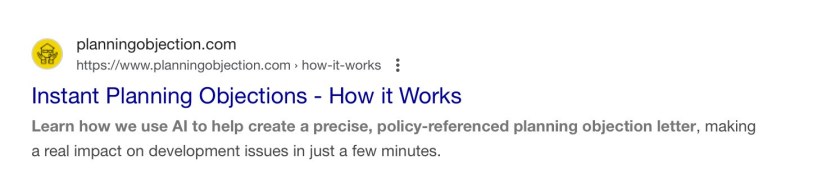
Worryingly, there is a cottage industry in online firms offering AI platforms to generate planning objections:

Or people can obviously use the tools themselves, generating lengthy, superficially well-written prose, with numerous legal, policy and/or factual references to be verified. This ultimately helps no-one, least of all those putting their trust in these tools.

And the issue is not just with text but of course images too – see Iceni’s Rebecca Davy’s 10 June 2025 blog post AI tools are reshaping how we read the past – how can heritage consultants help to keep the records straight?

Rather than relying on authorities individually to set out guidance for anyone submitting documents for reliance in the operation of the planning system, wouldn’t it be better for firm guidance to be set down centrally by MHCLG, using as a basis the Planning Inspectorate’s current guidance?

  • When should use of AI be declared in relation to any submitted material?
  • What is and isn’t AI for these purposes? (Predictive text,  proof reading and document transcription tools? More traditional web searches?)
  • What is the responsibility of person submitting the material to check the accuracy of the material, including underlying sources relied upon, and what should be the potential consequences if this is not done?
  • In any event, as I have been saying for so long, why do we not have indicative word and file size limits for different categories of material? Nearly every document submitted by anyone is simply too long and AI will exacerbate the issue. Now is the opportunity!

NB as always, in preparing this post I have had to avoid, for instance, WordPress’s “writing assistance” tool and, in uploading the images, the opportunity offered by Microsoft to “create an image using AI“. I get it why tools like this are increasingly popular but, without guardrails as to their use in connection with every element of the planning system, one thing is for sure: our jobs are going to become harder, not easier.

Simon Ricketts, 22 June 2025

Personal views, et cetera
Why Does Negotiating Section 106 Agreements Have To Be Such A Drag?

The HBF’s May 2025 research piece What is the timeframe for local authorities to agree community investment? shows what a huge drag on planning permission timescales is represented by the process of negotiating a section 106 agreement (which of course needs to have been completed before planning permission can be issued).

Read this:

To better understand the current state of S106 agreement timelines, the Home Builders Federation (HBF) submitted a Freedom of Information (FOI) request to local planning authorities across England. These results are based on the data from more than 2,500 S106 agreements across over 50 local authorities.

The FOI exercise found that the average S106 approval timeline was:

2022/23: 425 days

2023/24: 459 days

2024/25: 515 days

In just two years, the average time required to finalise an S106 agreement has increased by 90 days – a 20% increase.

The responses also highlight the extremities that developers in some local authorities are facing. The maximum recorded timescale was 2,679 days, or more than seven years, for a single S106 agreement to complete the agreement process. The shortest average timescale reported by any of the respondent councils was 192 days.

Additionally, 35% of all S106 agreements took longer than 12 months to finalise. Across all responses, 76% of local authorities reported average timelines that exceeded a year, and over a third of councils had an average timeframe of over 500 days.

In 2024/25, 45% of LPAs had agreements finalised that had taken over 1,000 days to complete.”

The document doesn’t specify the scale threshold of applications considered (I’m assuming by the number of agreements that this is in relation to developments of any scale, not just complex schemes where we know that specific issues requiring bespoke solutions and substantive negotiations may required to unlock solutions). Nor does the document specify when these time periods are measured from:  validation of the application, instruction of the LPA’s solicitor or the resolution to grant. Whatever, the statistics are appalling as is the relentlessly worsening trend.

The work is of a piece with the equally depressing Richborough/LPDF research carried out by Lichfields, How long is a piece of string? (16 May 2025). The average determination period for outline planning applications for 10 dwellings or more was 284 days in 2014. In 2024 it was 783 days. Given improvements in the performance of the Planning Inspectorate in relation to planning appeals (particularly appeals determined by way of public inquiry), it is now substantially quicker to secure a decision by way of appeal than by waiting for a final decision from the local planning authority.

This reflects our own anecdotal experience; we are seeing far more appeals on the basis of non-determination within the statutory period, and (tying back into that HBF work) one factor for clients is that with an appeal there is an external discipline upon the parties to agree and complete the section 106 agreement or unilateral undertaking within a specific, externally set, timescale.

Stepping back, this is all crazy and contrary to the efficient operation of the public sector. It’s equivalent to the use of A&E departments by those who find it faster, easier or more effective than going to their GP. Something is massively wrong with the operation of the planning system and it’s nothing that the Planning and Infrastructure Bill or indeed in the government’s December 2024 changes to the NPPF will fix. MHCLG’s proposed alterations to the system in relation to “minor” and “medium” residential development (summarised in my 31 May 2025 blog post Small Changes). Indeed I referenced in that post what was said in relation to section 106 agreements for “medium” residential development (less than 50 dwellings – although why stop at that size cap?):

We … welcome views and evidence on:

1. the specific barriers facing SMEs in agreeing s.106 obligations – including availability of willing and suitable Registered Providers

2. what role national government should play in improving the process – including the merits of a standardised s.106 template for medium sites

3. how the rules relating to suitable off-site provision and/or appropriate financial payment on sites below the medium site threshold might be reformed to more effectively support affordable housing delivery, where there is sufficient evidence that onsite delivery will not take place within a suitable timeframe and noting the government’s views that commuted sums should be a last resort given they push affordable housing delivery timescales into the future.”

The lack of a standardised template is one issue. We end up having frustrating arguments over what should be uncontentious and standard wording, for instance to protect mortgagees in a way which is institutionally acceptable, or simply over our attempts to make a particular LPA’s “standard” drafting operate as the parties intend. The failure of the Law Society to update its June 2010 template (which never really achieved sufficient support and was not well used) is disappointing. Without drama we need a national template on the MHCLG website asap for smaller schemes, expressly supported by local government, the development industry and professional bodies (including those representing banks), with specific guidance as to the circumstances in which there can be departures.

But the problems go much wider than that:

Many LPA legal teams are woefully under-resourced, without a lawyer with the necessary experience, project management focus or internal clout to do more than act as a post-box with those instructing them, adding pressure and unfair responsibility on planning case officers or allowing other internal or external consultees to drive their particular agendas. There is often a reluctance on the part of the in-house legal team to outsource to an external law firm (even though the applicant pays and is usually eager to pay more if that results in faster delivery of the completed agreement) because of internal pressures not to de-skill further the in-house team or lose the ability to recoup costs.

I suspect that LPA lawyers (some of whom are true unsung heroes) would equally point the finger at some applicants’ solicitors – and indeed some applicants – who may be unprepared to back down from unreasonable negotiating positions or may introduce new points post committee resolution – or who may start ghosting them when something commercially is happening in the background.

Negotiations often start way too late. The government’s planning practice guidance on planning obligations  (1 September 2019) says this:

When should discussions on planning obligations take place?

Discussions about planning obligations should take place as early as possible in the planning process. Plans should set out policies for the contributions expected from development to enable fair and open testing of the policies at examination. Local communities, landowners, developers, local (and national where appropriate) infrastructure and affordable housing providers and operators should be involved in the setting of policies for the contributions expected from development. Pre-application discussions can prevent delays in finalising those planning applications which are granted subject to the completion of planning obligation agreements.”

So often though, this isn’t happening.

There also no easy answer if negotiations genuinely hit a brick wall – for instance as to whether a particular contribution is justified or as to the precise drafting of a particular clause. Section 158 of Housing and Planning Act 2016 specifically inserted section 106ZA and Schedule 9A (“resolution of disputes about planning obligations”) into the 1990 Act, to provide for a system where an independent expert could be called upon where there are sticking points in section 106 negotiations, but it was never brought into force. It’s sitting there just waiting to be fleshed out by an SI and switched on! Whether the third party were to make a binding determination or, more practically, gave non-binding guidance that would still carry some weight if an appeal were subsequently required, in my view this needs to be dusted off!

Section 106 agreements are also of course lumbering beasts of burden, the legal mechanism for delivering so many strands of public policy – affordable housing, affordable workspace, carbon reduction measures, social infrastructure (eg education, health), transport infrastructure, local employment and training,  affordable workspace, air quality, the complexities of viability review processes. What can we deal with by way of other mechanisms (eg conditions), or standardise? What should be left to other legislation? The financial weight of the obligations in a section 106 agreement in relation to any large scheme is huge – in some ways, it is no surprise that the agreement may take as long or longer to negotiate than it took for the application to get from validation to committee resolution, but what can we simplify, speed up, twin-track?

The Planning Inspectorate also has its Planning obligations: good practice advice  (updated 5 February 2025), which is more specific than the government’s planning practice guidance and has its more prescriptive timing requirements (completed planning obligation at the time the written representations appeal is lodged is a tough one…). This is the sort of thing (with suitable adjustments) we need for the application stage, with real consequences for those who do not follow it.

Going back to the HBF work, several suggestions for improvements were made, various of them overlapping with what I have been saying:

  • Increase resourcing for planning departments: Local planning authorities are currently under significant resource constraints, which affect their capacity to process planning obligations in a timely manner. To alleviate these challenges, government should allocate targeted funding to increase staffing levels within planning departments. By investing in dedicated S106 teams and offering professional development opportunities, councils can improve both the speed and quality of agreement processes.
  • Develop national standard templates and best practices: A lack of standardisation in the drafting of S106 agreements often leads to protracted negotiations and inconsistencies across councils. The government, in collaboration with planning authorities and the development sector, should produce standardised procedural guidelines and clauses to minimise the need to draft agreements from scratch. In lieu of official standardisation, there could be clearer guidance and expectations on good practice.
  • Encourage a more flexible use of cascade agreements where necessary to ensure homes can be built and give reassurance to the developer that if an RP cannot be found, that the Affordable Homes can be changed to an alternative tenure or as last resort, a payment made to the LPA in lieu of the Affordable Housing.
  • Introduce statutory timelines for S106 agreements: Consideration should be given to implementing statutory or guideline-based timescales into the application and pre-application process for handling Section 106 negotiations and the drafting and signing of agreements.
  • Monitor, benchmark, and report performance: Introducing monitoring and reporting of S106 performance metrics could drive improvements. Local authorities should publish data on average timescales, agreement outcomes, and compliance rates as part of the general reporting on S106 agreements through Infrastructure Funding Statements. This information could be used to benchmark performance across regions, highlight best practices, and identify areas needing intervention. Increased transparency can also build trust among stakeholders and help developers better plan and budget projects.”

I’m sure this can be cracked, easily. Look what Bridget Rosewell’s recommendations on the planning appeal process achieved. If in a couple of years colleagues are still spending much of their time chasing for progress on draft agreements and having to explain to frustrated clients why there is no progress, I’ll be pointing you back to this blog post.

I know most of us have all grown up with this section 106 run-around – indeed some of us are in fact part of Generation Section 52 – hard-copy travelling drafts sent by post, marked up in a sequential series of colours, by pen – yes it was, despite all that, a faster process than present – but, in the words of the Blow Monkeys from that period:  it doesn’t have to be this way.

Simon Ricketts, 14 June 2025

Personal views, et cetera

Not Sure Why The Media Was So Focused On Musk v Trump This Week Given What Has Been Happening In Sussex

The gloves are off in Haywards Heath.

Let’s start with a 2 June 2025 press statement: Mid Sussex District Council to Challenge Secretary of State:

Mid Sussex District Council has launched a legal challenge against the Secretary of State for Housing, Communities and Local Government after being advised by the Planning Inspectorate that it is considering failing the area’s District Plan. 

After examination of the Plan in November, the Council has waited five months to hear from the Inspector.

The Inspector’s findings are that the Council has failed in its Duty to Cooperate with neighbouring Councils, simply because it did not say specifically which neighbouring Councils would benefit from the 1,000 additional houses Mid Sussex will build to help them meet their housing needs.

The Council considers this to be an extraordinary response to a technical matter that could easily be remedied another way.

Mid Sussex is the only council in West Sussex to meet its housing targets, whilst also agreeing to build extra houses to help its neighbours, Horsham and Crawley.

The Council has also delivered an unprecedented number of new houses in recent years – over 1,000 per year.

The effect of the Inspector’s findings could be to leave Mid Sussex unprotected from speculative development. This is because, if the Council followed the Inspector’s findings, it would need to start its plan making from scratch. This would take at least 30 months and over £1m. Mid Sussex is due to be dissolved, under the Government’s plans for reorganisation, in 2028.

It is for these reasons that the Council feels it must legally challenge the Inspector’s views.”

Bring on strategic planning! Bring on simpler local plan processes!

By her letter dated 4 April 2025 the inspector examining the Mid-Sussex District Plan, Louise Nurser, concluded that the council had not met the duty to co-operate – fatal to the progression of the plan.

78. In sum, MSDC is surrounded by local authorities who either have an undefined or defined quantum of unmet housing needs and these needs are significant.

79. Crawley, [Brighton and Hove] and other neighbouring authorities have long acknowledged significant and extensive unmet housing needs. Indeed, these were recognised by the previous Inspector. Moreover, other neighbouring local authorities such as Horsham have grappled with issues of water neutrality and potential impacts on their ability to meet their own and other’s needs.

80. The review of the adopted Plan envisaged under Policy DP5 was to ensure that additional sites could come forward in sufficient time to contribute to the sub-region’s unmet housing need. This process was to be planned effectively and strategically. Clearly, it would have been an easier task for the Council if one of the wider sub-regional organisations actively took the lead in addressing unmet needs. However, this was not the case during the preparation of the plan.

81. Nonetheless, your officers will have been aware of this considerable unmet need and the Council’s legal obligations, well before the significant milestones in the preparation of the Plan. Consequently, in practical terms the lack of active engagement by the two sub-regional groups has meant that in practice, MSDC needed to co-operate with its neighbours directly to ensure that it addressed its legal obligations in relation to the DtC. These obligations are not discretionary.

82. The Council has an obligation to maximise the effectiveness of plan preparation in a wider sub region where there are significant unmet needs. It has not provided the evidence to demonstrate that it has engaged constructively, in an active and on-going way to do so.

83. In considering this obligation, I am aware that Mid Sussex has its own constraints, such as the North Downs National Landscape, the setting of the South Downs National Park and the limitations to development relating to the Ashdown Forest SPA/SAC and that the water neutrality issue affects a relatively small strip of land on the western edge of Mid Sussex. Nevertheless, the presence of constraints does not obviate the necessity for MSDC to explore the possibilities of doing more to help address the unmet needs of the wider sub- region. The failure here is that the Council has not adequately considered the requests of its neighbours – namely Crawley, Horsham and Brighton and Hove, in a constructive, active and ongoing way.  The Council has, consequently, not maximised the effectiveness of plan preparation

This might be seen as harsh given that, for instance, the adjoining authorities had not in fact objected to the position taken by Mid-Sussex.

And, incidentally, bring on a solution to that water neutrality issue! See my 9 October 2021 blog post Development Embargos: Nitrate, Phosphate & Now Water – it’s been almost four years!!

MSDC sent a letter of complaint to the Planning Inspectorate dated 17 April 2025 alleging that decisions by the inspector had been fettered by pre-determined views; alleging that she had not behaved at the examination with courtesy, patience and understanding (e.g. “the Inspector frequently cut-off participants mid-sentence, displayed negative body language when listening to responses, and at one point admitted she had “switched off” whilst the Council’s Counsel was responding to a question. The Inspector made remarks such as being tetchy because she “needs some food” and that she is “not a morning person”” – there is in fact a 22 page appendix to the letter setting out extracts from the inspector’s interactions at the examination, cross-referenced to a YouTube video), and alleging that she had delayed unreasonably in reaching a decision about the plan following the conclusion of the stage 1 hearing sessions. At the same time, MSDC sent a pre-action protocol letter to the Government Legal Department (“The purpose of this letter is to seek to avoid the unnecessary expense and delay to which such action would give rise by asking the Secretary of State (a) to agree that the Inspector’s reasoning is legally erroneous, (b) to remove her from the role of examining the Plan and (c) to appoint a new Inspector to re-start the examination of the Plan in her stead.”). The letter included a request for all communications between the inspector/PINS and the Secretary of State/MHCLG in relation to drafts of the inspector’s 4 April 2025 letter.

The Planning Inspectorate  (via its local plans professional lead Simon Berkeley) and the Government Legal Department separately responded to the correspondence on 15 May 2025 but what is perhaps most interesting for those of us who like to see what goes on behind the curtain in these situations is to see the detailed file of correspondence that was released in response to the information request: have a look at the scrutiny given to some draft inspectors’ letters and the editing process that took place (which, subject of additional complaint by MSDC, includes input from Simon Berkeley).

MSDC has now separately responded to the Government Legal Department and to the Planning Inspectorate in letters dated 2 June 2025.

From the letter to the Government Legal Department:

For the reasons set out above, the Council remains of the view that the Inspector’s reasoning is legally flawed, and that if it requests her to issue a final report which (as she has said is likely to be the case) is similarly reasoned, it would have good grounds for seeking judicial review.  However, it is possible to avoid that, and to the keep the Plan “on track” so as to help the Government meet its commitments.  Consequently, in order to inform its decision on how it should respond to the Inspector’s letter, the Council seeks your response within 14 days.”

From the letter to Simon Berkeley at the Planning Inspectorate:

Given the multiple concerns the Council has regarding how our complaint has been addressed, we request that it is provided to an alternative, suitably qualified individual within the Planning Inspectorate, who should be tasked with undertaking a full, independent review of our original complaint.”

“The correspondence provided to us, extracts of which is included at Appendix A, demonstrates that you took a leading role in the quality assurance of the Inspector’s letter. You provided over 40 comments on a draft of the letter as well as making substantial textual amendments. In addition, you supported the Inspector in the conclusions that she was drawing; namely that the Council had failed the DtC. In your email dated 17 February 2025 to the Inspector you say: “I think you’re right to follow the path you have – from what you’ve said, it does appear to me that they have failed the DtC.” and that “it’s [the letter] all about remaining as safe as possible from challenge”.

Given your involvement in the quality assurance of the Inspector’s letter, the Council is at a loss to understand how it could be deemed appropriate for you to respond to our complaint.”

“…the language and tone used by the Inspector did not, in our opinion, create ease at the hearings or bring levity to the proceedings. Indeed, her behaviour had the contrary impact. Following the comments around who should read the Council’s opening statement and the Inspector’s reference in her opening comments to the need for ‘legal eagles’ to remember that they were “mere mortals”, our own Counsel, and Counsel instructed by other parties were reluctant to take the lead making representations on behalf of their clients because of the Inspector’s evident hostility to barristers.”

[NB (and, gulp, this is really going to kick things off) I endorse that “mere mortals” comment and indeed the recommendation in the Strategic Planning Group’s May 2025 report on planning positively for the future, that for examination processes for the new spatial development plans “Whilst from time-to-time participants may choose to have legal representation, the clear expectation should be that those attending will be giving their views directly and not via advocates.”]

Not to personalise this post too much but others in Sussex may remember the same inspector concluding in 2020 that the Wealden local plan be withdrawn due to failure of the duty to cooperate, together with other soundness issues. The authority is only back at regulation 18 draft stage with its revised plan.

Is PINS or the Government Legal Department going to yield in response to all of this? We shall see. Of course, in local plan making everything connects. Adjoining authority Horsham District Council, with its unmet housing needs partly down to its long-standing water neutrality issue, has been the recipient of a preliminary findings letter dated 22 April 2025 from its local plan inspector Luke Fleming, also concluding that there had been a failure of the duty to cooperate as well as issue over soundness:

In my assessment, at the very least, for engagement to be constructive, active and ongoing between February 2024 and July 2024 on the strategic matters of housing and water supply, the ability to deliver any water neutral development without needing to rely on [the Sussex North Offsetting Water Scheme] or a strategic resolution to water neutrality should have been considered in some detail by all the relevant [North West Sussex Housing Market Area] local authorities before the Plan was submitted.”

93. The Council’s affected by water neutrality should be commended for their efforts in trying to develop a local authority led water supply offsetting scheme. However, this has clearly proved more challenging and resource demanding than originally anticipated.

94. It is also my view, that the supply of water as a constraint to much needed new homes for people to live in the area, should have been addressed by bodies other than the Council long before now, especially given CC08 was issued in 2021.  Because, it hasn’t, the circumstances upon which the Council has had to prepare the Plan have been extremely challenging, with significant Council time and resources needing to be directed at assessing and understanding issues associated with the supply of water to new homes.  This is not usually an issue that local plan’s need to be concerned with in any extensive detail given the responsibilities of statutory water undertakers.

95. However, even so, under the circumstances I have outlined above, I can only recommend that the Council withdraw the Plan under S22 of the PCPA and focus its resources on rapidly preparing a new Local Plan.  In doing so the Council could utilise much of the good and comprehensive work already undertaken before components of the evidence base become out of date.”

[Not a letter that appears to have been subject to quality assurance, if the misuse of apostrophes in paragraphs 93 and 94 is anything to go by].

Horsham District Council has responded, complaining that “it has been treated unfairly with regards [sic] the approach taken to examining its Local Plan due to delays, poor communication and lack of transparency”, alongside publishing an inevitable press statement, Council rejects Inspector’s flawed assessment of Local Plan  (22 April 2025).

Look, I’m a mere mortal, but whatever the rights and wrongs of these specific situations, partly exacerbated by continued failures to resolve the water neutrality issue in northern Sussex: can anyone defend such a slow, uncertain, unstrategic and bureaucratic system?

Simon Ricketts, 7 June 2025

Personal views, et cetera