
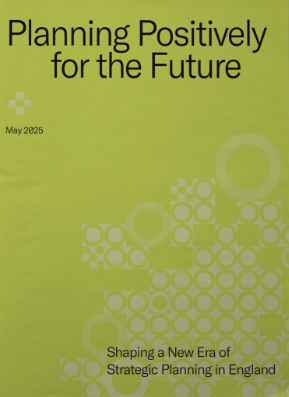
I’m preparing to speak at a couple of events at UKREiif this week, I’m trying to finish reading a book, I’m pleased that the Strategic Planning Group’s report Planning Positively for the Future has now been published (16 May 2025) and I’ve been dipping into the Mayor of London’s Towards a New London Plan consultation document (9 May 2025)
And the over-arching theme for me is Keep It Simple, Stupid.
The book is Abundance: How We Build A Better Future by Ezra Klein and Derek Thompson. A few people have mentioned it but what caused me finally to reach for my wallet was when Strategic Land Group’s Paul Smith recommended it on a 50 Shades of Planning podcast – he’s a good reader is Paul.

You might get the basic ideas from this Guardian review from which I quote the following passages:
Abundance for all of us, via an entirely possible techno-optimistic “future is behind schedule – and Abundance holds late 20th‑century liberalism responsible. (Klein and Thompson critique the right, too – they are themselves liberals – but this book speaks only to their co-partisans, with the downside of artificially telling just half the story). Liberals, Klein and Thompson say, nobly fought to redistribute what we have to those without, while losing sight of the goal of creating more to redistribute in the first place. Meanwhile, they sought to protect the public from the unchecked consequences of growth: the bulldozers of urban renewal and the pollution of industrialisation. They succeeded, but left the state too constrained to solve the challenges of today.”
“For example, they tell how California began studying high-speed rail, a clean and congestion-free alternative to cars and planes, more than 40 years ago. It took a decade for planning to begin in earnest; another decade-and-a-half to get funded; 16 years after that, it still doesn’t exist. High-speed rail has been swallowed by procedures erected to prevent every conceivable harm to every conceivable stakeholder. The environmental reviews needed just to describe the project’s impacts began in 2012; they still aren’t done. All the while, costs keep increasing.”
“In everything from planning regimes that block badly needed housing and solar farms, to the ossified processes for writing federal regulations and hiring civil servants, they see systems attuned to the harms of action and not its benefits, and convincingly argue that the rewards of reform are immense.”
“Klein and Thompson’s story of sclerosis is of a “system so consumed trying to balance its manifold interests that it can no longer perceive what is in the public’s interest.”
The sorry story of the Californian High Speed Rail project reads across precisely to HS2 and the book’s description of the sometimes-unintended sometimes-intended obstacles to housing development and green energy projects in many US states are only too familiar here.
The book makes a telling point about how “a complex society begins to reward those who can best navigate complexity”. Doesn’t that apply to many of us at UKREiif – not really a conference about how to build, but rather a conference about navigating the regulatory and other complexities to be sorted before anyone gets near an actual construction contract?
And, uncomfortable for me and other lawyers (already well rewarded for navigating complexity), there’s much in addition about the dead hand of “adversarial legalism”.
The KISS mantra was certainly front of mind for me when I was participating as the only lawyer member of the Strategic Planning Group. In designing for the reintroduction of strategic planning, via spatial development strategies, how to reduce the scope for mission creep in the documents, how to reduce ambiguity, duplication and delay, and how to arrive at a proportionate evidence base and examination process. Developing the 17 recommendations in the report was a superb, thoughtful but practical project, by way of six half day workshops and much work by chair Catriona Riddell and by the Prior + Partners team between the sessions and in writing it all up. Do let us know what you think.
I hope that once the National Development Management Strategies take shape we have a much more logical and non-duplicative cascade of NDMPs, SDSs, local plans and neighbourhood plans with as little duplication, gold plating and unnecessary text as possible – and that one day soon the whole cascade will be available at the click of a button in relation to any site. Will we get there or, as a “complex society”, is simplicity beyond us?

The London Plan is of course an awkward example of a spatial development strategy. This is not what the new breed of SDSs should look and feel like at all. Indeed, my personal vision is that the key diagram for an SDS should tell the main story, as to broad locations for strategic growth, infrastructure and the scale of housing development required in local plan areas. With previous iterations of the London Plan being so all-encompassing, is it really possible for the next version to be radically stripped back? I doubt it. But if it is not to be, could we at least avoid London Plan policies being duplicated (often in slightly different terms) and gold-plated in boroughs’ local plans? If a trade-off for the scale of the London Plan were to be much shorter borough plans that would be something. It will also be interesting to see what the new regime of NDMPs will mean for the London Plan.
Maybe see you in Leeds, KISS KISS.
Simon Ricketts, 18 May 2025
Personal views, et cetera


 SIMONICITY
Dear Simon,
As a regular reader of your weekly emails, thank you for this topic today. I will look at your strategic report and âAbundanceâ. One aspect you have not mentioned is who carries out the works, their motivation, and who controls them.
I am responding with other Suffolk residents to National Gridâs live DCO application for converter stations for power coming ashore from the North Sea wind farms. NG (a private company) is in effect a toll-booth monopoly for any power connection to the national electrical grid. They are motivated by profit and have not seriously looked at designing the infrastructure to reduce the cost to the taxpayer and generators who are paying them.
Another aspect is the ability of the approved documents and drawings used to control development. So many have clauses relying on design development to alter the design which are either unnecessary or could be controlled by condition. From my experience assessing unauthorised harm to heritage assets, an LPA can only approve with what has been submitted. The subsequent implementation is also relevant and should be controllable.
There are parallels with water regulation. Ofgem have not been holding them to account for a decade. The COIN agreements are redacted so we cannot assess financial probity. The consequences are permanent harm in every ES topic. Furthermore, Sizewell C will require all the capacity of the 2 400kV pylons and NG will have to erect their own. There is no mention of this in the cumulative assessment. The Governmentâs justification will be that the development is in the national interest. One must question the validity of this planning balance.
We are all in favour of the green agenda, but not this way, and benefitting shareholders disregarding taxpayers. To portray objectors as NIMBYs is ignoring the bad decisions which have precipitated our responses.
I entirely agree with a simplification of the planning system, but only if the planning balance is controlled from the outset.
Very happy to brief you further on this if you have the time and inclination!
Regards,
Nick
Nicholas Bridges, RIBA FRSA
Partner
[cid:image002.png@01DBC7FF.10AF1860]
Telephone 020â7837â1008
Mobile 07932 015 747
[cid:image004.png@01DBC7FF.10AF1860]nb@bridgesassociates.co.uk [cid:image006.png@01DBC7FF.10AF1860] http://www.bridgesassociates.co.uk/ [cid:image008.png@01DBC7FF.10AF1860] http://www.bridgesassociates.co.uk/news [cid:image009.png@01DBC7FB.14FCEB80] https://www.linkedin.com/company/bridgesassociates [cid:image011.png@01DBC7FF.10AF1860] https://www.instagram.com/bridgesassociatesllp/
Registered in England and Wales. Partnership No. OC 383122,
Registered Office: 15 Whitehall, London SW1A 2DD.
LikeLike
Thanks Nick. The NG upgrades is an interesting real life example of how difficult the political choices here are as to what protections and checks and balances are necessary etc. I can’t say much, because I act for an affected land owner, other than that I hear you.
LikeLike