Small Changes

I’ve mainly called this blog post “small changes” because that is the name of a beautiful, calming and rather lush album by Michael Kiwanuka released last year. Perhaps your social media timeline needs that sort of cleanse? Mine does regularly.

But I was also thinking of that old David Brailsford British Cycling philosophy about marginal gains (“The whole principle came from the idea that if you broke down everything you could think of that goes into riding a bike, and then improved it by 1%, you will get a significant increase when you put them all together”) and of the successive incremental changes that the government has been making to the planning system, most recently those measures flagged in the 28 May 2025 MHCLG press release as Government backs SME builders to get Britain building, measures which were the subject of three consultation documents published that day:

All of this follows last Sunday’s Speeding Up Build Out consultation (consultation closing 7 July 2025), which I summarised that day in my blog post Now Build.

It is an interesting, maybe theoretical, question as to whether system changes are better announced and delivered in one go (soaking up all the political heat at once) or in the current lapping waves. It is also interesting to see the political heat rising from different quarters in relation to different elements.

Concern has been expressed from environmental interest groups and a number of firms providing ecological services, as to Part 3 of the Planning and Infrastructure Bill (nature recovery – see my 11 May 2025 blog post Nature Recovery Position where I tentatively suggest a middle ground).

The Speeding Up Build Out announcement then led to an outcry from many in the development world – how dare the government threaten developers with being blacklisted, fined or having land compulsorily acquired if they delayed unreasonably in building out planning permissions etc etc? I explain in my 25 May 2025 Now Build piece why I don’t think that should be a real concern and why, if only for pragmatic political reasons, the government has to have basic protections along these lines in place. But that was based on me focusing on the working paper and consultation document, not on the government’s PR spin, which I think was unnecessarily overblown, particularly:

  • That tweet from the prime minister (NB what is the government doing still being on X in any event? Full marks to Matthew Pennycook and others for using Bluesky).
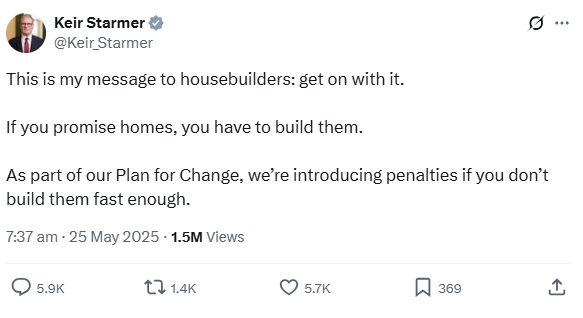
All that developer-demonisation (“Developers who repeatedly fail to build out or use planning permissions to trade land speculatively could face new ‘Delayed Homes Penalty’ or be locked out of future permissions by councils”), whereas I’m not sure anyone would disagree with what is actually said in the working paper itself:

The Competition and Markets Authority (CMA) and others have concluded that most homes in England are not built as fast as they can be constructed, once permission is granted, but only as fast as the developer expects to sell them at local second-hand market prices. This leads to a build out rate for large sites which can take decades to complete. While it is commercially rational for developers to operate in this way, the systemic impact is a lower level of housebuilding than we need. The government is therefore committed to taking firm action to ensure housebuilding rates increase to a level that makes housing more affordable for working people.  

In the public debate on housebuilding rates, 3 related concepts are often confused.

a. Land banks are, for the most part, a normal part of the development system. Developers hold a pipeline of sites at all stages of the planning process, to avoid stop/starts between schemes. In its 2024 study, the CMA found no evidence of current land banks systemically distorting competition between housebuilders. We do, however, have concerns that certain types of contracts over land prior to its entry into the planning system (which can be part of ‘strategic’ land banks) can be a barrier to entry for SME developers. We are therefore legislating to make Contractual Control Agreements (‘option agreements’) more transparent, to help diversify the industry and reduce barriers to entry for SME builders. 

b. Delayed or stuck sites are those at all stages of the planning and building process (including with full planning permission) that are delayed, not building out, or only building out very slowly due to a problem that the developer or landowner is struggling to resolve themselves. Often this is due to the discharge of a planning condition, an issue raised by a statutory consultee, a newly discovered site issue, or the developer running into financial difficulties. We have created the New Homes Accelerator to tackle this sort of blockage … and get stuck sites moving. In wider cases, sites may be stuck in negotiations over suitable S106 contributions, sometimes because the promoter has overpaid for the land not fully factoring in the policy requirements set out in planning policy. In this paper we consider further reforms to the Compulsory Purchase Order (CPO) process, relevant to stalled sites. 

c. Slow build out is where sites have full planning permission, are being built, but the pace of building is slower than it could be under different development models and incentives. Multiple market studies have found that most large housing sites are built at the pace the homes can be sold at current second-hand market prices, rather than the pace at which they could be constructed if pre-sold (i.e. to an institutional landlord). The rate of building consistent with selling at local second-hand market prices is known within the industry as the ‘absorption rate’. The Letwin Review concluded that local absorption rates were a “binding constraint” on build out rates. The CMA observed, that “the private market will not, on its own initiative, produce sufficient housing to meet overall housing need, even if it is highly competitive”.

So that was the furore earlier this week. And then when Wednesday’s announcements were made, environmentalists focused on the potential rolling back of the statutory BNG regime from smaller projects and opposition politicians turned on the (not new, but in my view improved) proposals to ensure that more applications are determined through use of planning officers’ delegated powers rather than Planning Committee.

You can’t please all the people all the time…

What is the thrust of the latest changes?

The starting point is to change the current categorisation of planning applications for residential development from those for “minor” development” and those for “major” development, so as to introduce a “medium” development category.

The categories would be:

  • Minor Residential Development – fewer than 10 homes /up to 0.5 ha (and within that a sub-category of 1b. Very small sites – under 0.1ha)
  • Medium Residential Development – between 10-49 homes/up to 1.0 ha
  • Major Residential Development – 50+ homes / 1+ hectare

In due course, consideration would be given to appropriate categories for non-residential development.

The following would apply to each category:

Minor

  • streamlining requirements on Biodiversity Net Gain (BNG) including the option of a full exemption
  • retaining the position that affordable housing contributions are not required on minor development
  • retaining the position that sites of fewer than 10 units are exempt from paying the proposed Building Safety Levy (BSL)
  • retaining the shorter statutory timeframe for determining minor development at 8 weeks “however we will take steps to improve and monitor performance so SMEs can expect a better service”
  • reducing validation requirements “through setting clearer expectations in national policy on what is reasonable, which could form part of the forthcoming consultation on national policies for development management”
  • requiring that all schemes of this size are delegated to officers and not put to planning committees as part of the National Scheme of Delegation.
  • reviewing requirements for schemes of this size for consultation with statutory consultees “instead making use of proportionate guidance on relevant areas. This forms part of our review of statutory consultees

On the “very small sites” sub-category:

The government will consult on a new rules-based approach to planning policy later this year through a set of national policies for development management. This will include setting out how the government intends to take forward relevant aspects of the proposals contained in the previous ‘Brownfield Passport’ working paper.”

The government is therefore proposing to further support the delivery of very small sites through:

  • providing template design codes that can be used locally for different site size threshold and typologies – which will take a rules-based approach to design to help identify opportunities and enable faster application processes
  • using digital tools to support site finding and checking compliance of design requirements on specific sites.

Medium

  • simplifying BNG requirements “reducing administrative and financial burdens for SME developers and making it easier for them to deliver BNG to help restore nature on medium sites by consulting on applying a revised simplified metric for medium sites. Further details are set out Defra’s consultation on potential BNG changes offering stakeholders the opportunity to give their views on this issue.”
  • exploring exempting these sites from the proposed Building Safety Levy “we intend to lay regulations for the Building Safety Levy in Parliament this year (as set out in our response to our technical consultation) and the Levy will come into effect in Autumn 2026. As part of this working paper, we are keen to explore whether, if introduced, medium sites should also be exempt from paying the Levy”
  • exempting from build out transparency proposals
  • maintaining a 13-week statutory time period for determination “in line with major development – but specifically tracking performance of these types of developments directly so SMEs can expect a better service”
  • including the delegation of some of these developments to officers as part of the National Scheme of Delegation
  • ensuring referrals to statutory consultees are proportionate “and rely on general guidance which is readily available on-line wherever possible. This forms part of our review of statutory consultees”.
  • uplifting the Permission in Principle threshold “allowing a landowner or developer to test for the principle of development for medium residential development on a particular site without the burden of preparing an application for planning permission. We recognise take up of Permission in Principle by application for minor residential development has been relatively limited since its introduction in 2017, and we would therefore like to gauge the appetite for this reform before exploring further”
  • minimising validation and statutory information requirements “through setting clearer expectations in national policy which could form part of the forthcoming consultation on national policies for development management”

There is also an important reference to streamlining section 106 agreement negotiations:

We … welcome views and evidence on:

1. the specific barriers facing SMEs in agreeing s.106 obligations – including availability of willing and suitable Registered Providers

2. what role national government should play in improving the process – including the merits of a standardised s.106 template for medium sites

3. how the rules relating to suitable off-site provision and/or appropriate financial payment on sites below the medium site threshold might be reformed to more effectively support affordable housing delivery, where there is sufficient evidence that onsite delivery will not take place within a suitable timeframe and noting the government’s views that commuted sums should be a last resort given they push affordable housing delivery timescales into the future.”

(I will be doing a separate blog post on that one).

Major

This working paper primarily considers targeted changes and easements to sites below 50 homes. Sites above 50 will benefit from overall government reforms to the planning system – including those set out in the revised National Planning Policy Framework published in December, the Planning and Infrastructure Bill, and future reforms to statutory consultees and through emerging national policies for development management.

Nevertheless – the government is interested in views in response to this working paper on:

  • applying a threshold for mixed tenure requirements on larger sites – as set out in the government’s working paper on speeding up build out, we are considering a range of options to set a threshold whereby mixed tenure development should apply – including at 500 units. We welcome further views on the right threshold – and on whether and how there should be some discretion for Local Planning Authorities – ahead of consulting on the policy as part of a consultation on national policies for development management and a revised National Planning Policy Framework later this year.”

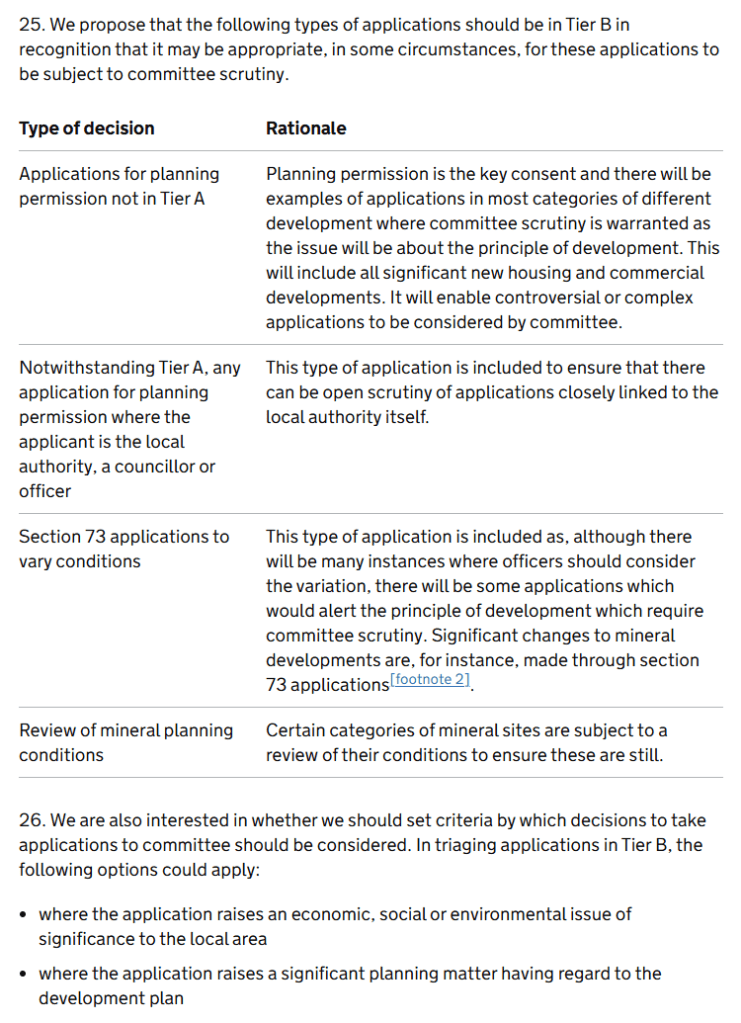
Turning to the paper on reforming planning committees, thankfully the thinking has moved away from taking into account whether or not a proposal is in compliance with the development plan (which would have led to endless arguments and disputes). Instead, the proposal is that a scheme of delegation would be introduced which would have two tiers:

Tier A which would include types of applications which must be delegated to officers in all cases; and

Tier B which would include types of applications which must be delegated to officers unless the Chief Planner and Chair of Committee agree it should go to Committee based on a gateway test.”

We propose the following types of applications would be in Tier A. This is in recognition that they are either about technical matters beyond the principle of the development or about minor developments which are best handled by professional planning officers:

  • applications for planning permission for:
    • Householder development
    • Minor commercial development
    • Minor residential development
  • applications for reserved matter approvals
  • applications for s96A non-material amendments to planning permissions
  • applications for the approval of conditions
  • applications for approval of the BNG Plan
  • applications for approval of prior approval (for permitted development rights)
  • applications for Lawful Development Certificates
  • applications for a Certificate of Appropriate Alternative Development

Note: “we are keen for views whether there are certain circumstances where medium residential developments could be included in Tier A. For instance, given the scale and nature of residential development in large conurbations such as London, we could specify medium residential development in these conurbations should be included in Tier A (as well as minor residential development), while in other areas, only minor residential development would fall within Tier A.”

Tier B:
There is also a proposal to limit the number of members of a planning committee to 11 and to introduce a national training certification scheme for planning committee members.

I will do a separate blog post on the BNG changes at some point but in the meantime Annex A to the DEFRA consultation paper is a good summary of the various proposals.

I think that’s enough for now…

Simon Ricketts, 31 May 2025

Personal views, et cetera

Small changes
Solve the problems
We were revolving in your eyes
Wait for me
All this time, we
Knew there was something in the air

(c) M Kiwanuka

Extract from album sleeve

Now Build

Another MHCLG planning reform working paper this fine Sunday morning (25 May 2025), Speeding Up Build Out together with accompanying technical consultation (deadline for responses: 7 July 2025).

After the various policy changes and measures in the Planning and Infrastructure Bill aimed at seeking to encourage local planning authorities to plan for more homes and to encourage decision makers (whether local planning authorities or planning inspectors) to grant planning permission for more homes, this paper turns the spotlight onto developers.

We know that slow build out is of great frustration to many local planning authorities and communities that rightly expect homes, infrastructure and services that have been promised as part of a planning approval to be delivered as quickly as possible. We also know that developers are responsive to commercial incentives and build out homes at a rate that is beneficial to their business and reflective of the wider economic environment. 

This paper therefore invites views on options the government could pursue to ensure the right incentives exist in the housing market, and local planning authorities have the tools they need, to encourage homes to be built out more quickly. In addition to the transparency and accountability measures set out in the technical consultation, this includes incentivising and supporting models of development that build out faster, such as partnership models, greater affordable housing, public sector master-planned sites, and smaller sites. We also invite views on giving local authorities the ability – as a last resort – to charge developers a new ‘Delayed Homes Penalty’ when they fall materially behind pre-agreed build out schedules.”

The paper unpacks the issues; land banks (to the limited extent that option agreements may be a barrier to entry for SME developers); delayed or stuck sites (to which the New Homes Accelerator initiative is aimed, as well as further potential reforms to the CPO process) and slow build out. The paper focuses on how to:

a) overcome absorption constraints to get more homes built more quickly

b) continue to strengthen the local authority toolkit to unblock stalled and stuck sites.

The government intends to bring into force various provisions contained in the Levelling-up and Regeneration Act 2023, namely:

  • The requirement to submit a build out statement (in LURA a “development progress report” –  section 90B Town and Country Planning Act 1990 as introduced by section 1154 of LURA) with prescribed categories of planning applications
  • To notify LPAs before development is commenced through a commencement notice (section 93G of the TCPA as introduced by section 111 of LURA)
  • To report annually to LPAs on housing delivery via a development progress report (see above)
  • To give LPAs the power to decline to determine planning applications made by persons who applied for, or who are connected to, an earlier planning permission for the development of land in the LPA’s area which has not been built out at a reasonable rate (section 70D of the TCPA as introduced by section 113 of LURA)
  • To simplify the process for LPAs to issue completion notices “to require developers to complete their development within a certain period of time if the LPA considers it will not be completed in a reasonable time, otherwise the planning permission will cease – a form of “use it or lose it”.” (section 93H of the TCPA as introduced by section 112 of LURA).

The government is consulting on introducing in policy a “site size threshold above which sites must deliver on a mixed tenure basis”.

On CPO, the government intends to bring forward secondary legislation later this year to implement provisions in LURA “to allow the conditional confirmation of CPOs. This will allow the compelling case for use of CPOs to be established earlier in the land assembly process on sites where alternative proposals have been put forward by landowners.

The conditional confirmation of CPOs could be used to ensure landowners progress their alternative proposals within certain timescales, which would be made clear when an individual CPO is conditionally confirmed. Where they fail to do so, CPO powers could then be switched on. We believe the conditional confirmation power will de-risk use of CPOs on stalled sites because the existence of alternative proposals will no longer carry the same weight in the decision-making process.”

So far, the above proposals go no further legislatively than was proposed by the previous government.

However, the government has announced in today’s documents that it is “exploring the possibility of introducing a new tool for local authorities: the “Delayed Homes Penalty”. This would effectively be a last resort measure, which we hope not to have to implement, but may be needed if industry does not sufficiently adapt and fulfil their commitment to deliver homes more quickly. 

The Delayed Homes Penalty would be available to local authorities for development which falls materially behind pre-agreed build out schedules, as set out through the transparency measures. While subject to further work, including drawing on responses to this working paper, we are considering the following framework for the Delayed Homes Penalty.

a. The Penalty would apply only to sites over a threshold size and only where there is evidence of a developer falling substantially behind a build out schedule, pre-agreed with the LPA. 

b. Agreement and monitoring of build out rates would be aligned to the new transparency measures, which will require developers to pre-agree a build out schedule with the local planning authority before consent, provide a commencement notice before the development begins and then annual development progress reports.

c. If a site falls substantially behind the pre-agreed build out schedule in a given year (to 90% or less of the agreed delivery), then the developer would be required to justify the slower build out rate to the planning authority. If this cannot be shown to have been caused by an external factor – such as unusually severe weather, or an unexpected site issues – the developer could become liable for the Delayed Homes Penalty.

d. The relevant external factors would be nationally set out in guidance and could be informed by those already used in contracts between Homes England and developers under the ‘build lease’ model. 

e. If the Delayed Homes Penalty were applied, the relevant party (developer or landowner) would be charged for each home behind the pre-agreed build out schedule. Penalties could be based on a percentage of the house price, or via reference to local Council Tax rates, given the loss of income that a local authority incurs when homes are not built and occupied at the expected rate (although this would not be applied via the Council Tax system itself). 

It would be important in the introduction of any Delayed Homes Penalty that industry was confident in when and how this would be applied, to ensure that they did not disincentivise land being brought forward for development. We therefore intend to use all views expressed in response to this working paper to inform further policy development, and if the government decided to take this proposal forward, we would propose to undertake further consultation.”  

In my personal view, none of this should be regarded as controversial by the private sector. The quid pro quo for the policies and initiatives introduced to seek to ease the allocation of land for housing, and the approval of development proposals, has to be a recognition on the part of those who promote development or seek planning permission that this is not a one-way street and that participation in the system brings with it certain responsibilities. Of course, we do need to make sure that measures of last resort (compulsory purchase of stalled sites, penalties) do not unnecessarily spook funders and investors so as to ensure that the measures are not counter-productive – which will need for there to be appropriate protections in the legislation and clear communication from ministers as to the limited circumstances in which the government envisages that these sticks should actually be applied.

It was disappointing to read, in the BBC’s online coverage this morning, New rules may take unfinished housing sites off developers (in itself a bit of a tabloid-style headline – not a new rule, just the previous government’s legislation being brought into force), the quoted response from Conservative shadow Secretary of State Kevin Hollinrake. Being charitable, perhaps he hadn’t had time to be briefed or understand the policy context or indeed read his previous government’s legislation) but what about this for dogwhistle politics (and nothing on what is actually proposed)?

Shadow housing secretary Kevin Hollinrake claimed that “many hardworking Brits will be shut out of the housing market forever” as “Labour’s open door border policy” meant “many of these houses will end up going to migrants”.

He added: “In the same week that Angela Rayner has been caught red-handed plotting to raise everyone’s taxes, it’s clear she doesn’t have the interests of working people at heart.”

(This in a week where net migration was reported to have halved in 2024).

What planning reform needs so desperately is cross-party consensus. This week’s 50 Shades of Planning Shades of Planning podcast episode , Sam Stafford’s recent 45 minutes long interview one-on-one with Lord Michael Gove is a must-listen – not just for Gove’s honest and detailed reflection on what went wrong under his tenure but also for his fair assessment as to the current government’s direction of travel in terms of planning reform. Does every policy proposal really have to be a pawn in a now multi player chess game?

I hope that there is wide engagement with the government’s technical consultation, particularly: “Are there wider options you think worth worthy of consideration that could help speed up build out of housing?”

Until this morning’s announcement I was going to focus on various discussions I had in Leeds this week, which were exactly on the theme as to the nature of some of those “wider options”. Sam Stafford (now as of this week the new LPDF chief executive – congratulations) has been calling for a development management “snagging list”. There are so many incremental improvements to be made – now is the opportunity with that 7 July 2025 response deadline – and wouldn’t it be good if there were as much private/public sector consensus as possible in coming up with that list. Watch this space for some of the items on mine…

Simon Ricketts, 25 May 2025

Personal views, et cetera

The Perfect KISS

I’m preparing to speak at a couple of events at UKREiif this week, I’m trying to finish reading a book,  I’m pleased that the Strategic Planning Group’s report Planning Positively for the Future has now been published (16 May 2025) and I’ve been dipping into the Mayor of London’s Towards a New London Plan consultation document (9 May 2025)

And the over-arching theme for me is Keep It Simple, Stupid.

The book is Abundance: How We Build A Better Future by Ezra Klein and Derek Thompson. A few people have mentioned it but what caused me finally to reach for my wallet was when Strategic Land Group’s Paul Smith recommended it on a 50 Shades of Planning podcast – he’s a good reader is Paul.

You might get the basic ideas from this Guardian review from which I quote the following passages:

Abundance for all of us, via an entirely possible techno-optimistic “future is behind schedule – and Abundance holds late 20thcentury liberalism responsible. (Klein and Thompson critique the right, too they are themselves liberals but this book speaks only to their co-partisans, with the downside of artificially telling just half the story). Liberals, Klein and Thompson say, nobly fought to redistribute what we have to those without, while losing sight of the goal of creating more to redistribute in the first place. Meanwhile, they sought to protect the public from the unchecked consequences of growth: the bulldozers of urban renewal and the pollution of industrialisation. They succeeded, but left the state too constrained to solve the challenges of today.”

“For example, they tell how California began studying high-speed rail, a clean and congestion-free alternative to cars and planes, more than 40 years ago. It took a decade for planning to begin in earnest; another decade-and-a-half to get funded; 16 years after that, it still doesn’t exist. High-speed rail has been swallowed by procedures erected to prevent every conceivable harm to every conceivable stakeholder. The environmental reviews needed just to describe the project’s impacts began in 2012; they still aren’t done. All the while, costs keep increasing.”

“In everything from planning regimes that block badly needed housing and solar farms, to the ossified processes for writing federal regulations and hiring civil servants, they see systems attuned to the harms of action and not its benefits, and convincingly argue that the rewards of reform are immense.”

“Klein and Thompson’s story of sclerosis is of a “system so consumed trying to balance its manifold interests that it can no longer perceive what is in the public’s interest.”

The sorry story of the Californian High Speed Rail project reads across precisely to HS2 and the book’s description of the sometimes-unintended sometimes-intended obstacles to housing development and green energy projects in many US states are only too familiar here.

The book makes a telling point about how “a complex society begins to reward those who can best navigate complexity”. Doesn’t that apply to many of us at UKREiif – not really a conference about how to build, but rather a conference about navigating the regulatory and other complexities to be sorted before anyone gets near an actual construction contract?

And, uncomfortable for me and other lawyers (already well rewarded for navigating complexity), there’s much in addition about the dead hand of “adversarial legalism”.

The KISS mantra was certainly front of mind for me when I was participating as the only lawyer member of the Strategic Planning Group. In designing for the reintroduction of strategic planning, via spatial development strategies, how to reduce the scope for mission creep in the documents, how to reduce ambiguity, duplication and delay, and how to arrive at a proportionate evidence base and examination process. Developing the 17 recommendations in the report was a superb, thoughtful but practical project, by way of six half day workshops and much work by chair Catriona Riddell and by the Prior + Partners team between the sessions and in writing it all up. Do let us know what you think.

I hope that once the National Development Management Strategies take shape we have a much more logical and non-duplicative cascade of NDMPs, SDSs, local plans and neighbourhood plans with as little duplication,  gold plating and unnecessary text as possible – and that one day soon the whole cascade will be available at the click of a button in relation to any site. Will we get there or, as a “complex society”, is simplicity beyond us?

The London Plan is of course an awkward example of a spatial development strategy. This is not what the new breed of SDSs should look and feel like at all. Indeed, my personal vision is that the key diagram for an SDS should tell the main story, as to broad locations for strategic growth,  infrastructure and the scale of housing development required in local plan areas. With previous iterations of the London Plan being so all-encompassing, is it really possible for the next version to be radically stripped back? I doubt it. But if it is not to be, could we at least avoid London Plan policies being duplicated (often in slightly different terms) and gold-plated in boroughs’ local plans? If a trade-off for the scale of the London Plan were to be much shorter borough plans that would be something. It will also be interesting to see what the new regime of NDMPs will mean for the London Plan.

Maybe see you in Leeds, KISS KISS.

Simon Ricketts, 18 May 2025

Personal views, et cetera

Nature Recovery Position

Part 3 of the Planning and Infrastructure Bill is possibly facing the most criticism. Do its provisions with regard to the preparation of environmental delivery plans, enabling a nature restoration levy to be set which is to be paid by developers in lieu of some of the site-specific assessment and mitigation measures they currently have to carry out, go too far and amount to a regression in environmental protection?  

First, as a way into the issues, I do recommend my colleague Susannah Herbert’s summary and initial critique of the provisions published the week that the Bill was introduced into Parliament:  PI Bill Guest Post – Some Early Thoughts On The Bill’s Nature Recovery Provisions (13 March 2025)

The government has published a fact sheet.  It summarises the five key phases of the nature recovery fund as follows:

  1. Framing the EDP – EDPs will define the environmental impacts they cover, such as nutrient pollution or the impact development might have on a protected species. EDPs will be spatially specific with clear maps setting out where development is covered by an EDP and what scale of development the EDP can support.
  2. Designing the measures – EDPs will set out the suite of conservation measures that will be deployed to more than address the impact of development across a given area. For example, an EDP covering nutrient pollution will set out how the combined effect of the conservation measures will go beyond the current expectations of nutrient neutrality and lead to an improvement in water quality.
  3. Setting the levy rate – A simple charging schedule, sufficient to cover the costs of the conservation measures, will be payable by developers to meet the relevant legal obligation associated with the impacts addressed by the EDP.
  4. Consultation and approval – in developing an EDP, Natural England will benefit from views captured through consultation before the EDP is submitted to the Secretary of State for approval. When considering the EDP, the Secretary of State will be bound by a new legal test to ensure that the conservation measures outweigh the negative effect of development.
  5. Delivering on the EDP – once the EDP is in place, Natural England will the necessary powers to use funds collected to implement the conservation measures. They will then monitor the impact of the measures to ensure they are working as expected and make any amendments to the EDP that may be necessary.

The Bill is currently at Committee stage. Marian Spain, chief executive of Natural England, gave evidence on 24 April 2025, supportive of the proposals in the Bill. However, there are many who are expressing concern.

Instructed by NatureSpace Partnership, which delivers strategic licensing in relation to great crested newts and other species, David Elvin KC has provided a masterly and detailed (45 page) opinion dated 23 April 2025. He concludes that the proposals as they currently stand would amount to a weakening or reduction in current levels of environmental protection: the proposed test of “overall improvement” in environmental protection is “lax” and “generalised”.

The Office for Environmental Protection’s advice to the government on the Bill  (2 May 2025) echoes this concern: The OEP is “concerned by several aspects of the bill which undermine its potential to deliver intended win-win outcomes. We recognise that the EDP system is intended to be a different approach, not a direct comparator to existing environmental law. There are, though, fewer protections for nature written into the bill than there are under that existing law. Creating new flexibility without sufficient legal safeguards could see environmental outcomes lessened over time. And aiming to improve environmental outcomes overall, whilst laudable, is not the same as maintaining in law high levels of protection for specific habitats and species.

In our considered view, the bill would have the effect of reducing the level of environmental protection provided for by existing environmental law. As drafted, the provisions are a regression. This is particularly so for England’s most important wildlife – those habitats and species protected under the Habitats Regulations.

We summarise two particular concerns below, and provide further detail on these matters and other aspects of the bill in the annex to this letter.

A principal area of concern lies with the framing of the bill’s ‘overall improvement test’ for adopting EDPs. This test rests on a balancing exercise to decide whether negative environmental effects of development are likely to be outweighed by conservation measures taken under an EDP. As drafted at the moment, that exercise would allow considerably more subjectivity and uncertainty in decision-making than under existing environmental law. We advise that the overall improvement test should be strengthened to address this.

The bill as drafted also allows for conservation measures to be located away from the protected sites affected by development. Currently, this is only permissible in limited circumstances and where the overall coherence of the protected site network is maintained. Such safeguards are absent from the bill. Undermining the network of protected sites could affect the Government’s ability to meet its legally binding biodiversity targets and ‘30 by 30’ objectives. We advise that the lack of safeguards for the overall sites network is rectified, given the role they play in efforts to meet statutory nature targets.”

The OEP sets out, in an Annex to the letter, various detailed recommended changes to what is proposed.

More recently, the government has now published its impact assessment  in relation to the Bill (6 May 2025).  Section 7.2 is relevant for our purposes (NPSV = “Net Present Social Value (NPSV) in 2025 prices with 2026 base year across the 10-year appraisal period 2026-35”), EANDCB = “Equivalent Annual Net Direct Cost to Business” and EANDCH = “Equivalent Annual Net Direct Cost to Households”):

Incidentally, some groups and media pieces (eg UK government admits almost no evidence nature protections block development (The Guardian, 7 May 2025)) have misconstrued that reference to “limited data availability”. I agree that the statement is somewhat of a cop-out (and the range given absurdly wide) but the footnote makes it clear that the figure is expected to be a significant underestimate. For the real effects arising from nutrient neutrality alone see eg the work by the HBF and as for water neutrality see the recent failure at examination for instance of the Horsham local plan and many individual stalled schemes.

Is there a middle ground here? Should EDPs and the nature restoration funds, rather than ambitiously seeking to remove the need for developers to assess and address the specific effects likely to arise as a consequence of the species and habitats on their development sites themselves, in fact focus on those off-site issues which have indeed been causing so much delay and uncertainty: nutrient neutrality, water neutrality and issues relating to recreational pressure?  After all it is these aspects which the impact assessment focuses on:

The Nature Restoration Fund is expected to deliver benefits to areas where particular environmental obligations apply, for example, nutrient neutrality catchment areas. While some urban areas are in nutrient neutrality catchments (Southampton, Portsmouth, Norwich and Middlesborough), the majority of land area covered by nutrient neutrality catchments is rural. In some cases entire LPA areas are within nutrient neutrality catchments, where obligations limit ability to deliver those LPAs’ housing targets. The largest nutrient neutrality catchments (by hectare) are Solent, River Eden Special Area of Conservation (SAC), Somerset Levels & Moors Ramsar. The location of the interventions secured under the NRF will be determined by the scale of the delivery plan area.” (Paragraph 69)

I can see that in some circumstances nature recovery objectives can be secured more efficiently and effectively on a coordinated basis. The impact assessment says this:

“…the Nature Restoration Fund measures aim to improve environmental outcomes by requiring developers to contribute towards nature recovery. By shifting to a strategic approach to addressing environmental obligations, coordinated by a single delivery body, action will be more efficient and effective – achieving more with the same cost to developers. It is therefore expected that these measures will contribute to meeting the Government’s wider environmental targets and help secure the benefits derived from biodiversity and ecosystem services more effectively. For example: wetlands can effectively regulate flow of water which enhances resilience to flooding; forests, oceans and healthy soils sequester carbon, reducing greenhouse gases in the atmosphere; peatlands act as carbon stores; restored vegetation stabilises soils reducing erosion and improving water quality; and natural landscapes offer spaces for outdoor recreational activities like hiking and birdwatching. These activities promote physical and mental well-being and provide benefits through tourism-related revenue. This policy is also designed to speed up the delivery of net zero infrastructure (alongside other development), and in doing so support decarbonisation.” (paragraph 77)

But should any of this replace on-site assessment and on-site mitigation, save where it can be shown that off-site mitigation will in fact be as effective? And wouldn’t this also be fairer, rather than, presumably, some developers having to over-pay to compensate for others seeking to develop more ecologically sensitive sites?

Simon Ricketts, 11 May 2025

Personal views, et cetera

Bank Holiday Weekend Special: Mayors, Oxford Street, Stag Brewery

The election for the first London Mayor took place 25 years today, 4 May 2000. I learned this via a piece by Nick Bowes in LCA’s latest LDN newsletter.

It is a topical weekend to think back as to the influence of the three very different political figures who have been London Mayor: Ken Livingstone, Boris Johnson and Sadiq Khan. Even without the extent of devolved powers available to their counterparts in other world cities, they have been able to exert significant influence over the shape and operation of our capital city, particularly in relation to transportation and in relation to strategic planning, including in relation to individual development projects of “potential significant importance”.

As Labour rolls out its vision for Mayoral strategic authorities across the country, what are going to be the political consequences over time and for the shaping of those areas? My 18 January 2025 blog post Viva La Devolution sought to summarise what lies ahead in terms of devolution and the introduction of strategic planning, modelled (in legislative form at least) on the spatial development strategy (aka London Plan) model, with equivalent intervention powers to the London Mayor in relation to applications of potential strategic importance (the power to direct refusal or to take over as decision maker).

For example, Greater Lincolnshire is now of course a combined county authority, covering the Lincolnshire County Council, North East Lincolnshire Council and North Lincolnshire Council’s areas. On 1 May 2025, Reform party politician Dame Andrea Jenkyns was elected Mayor and will lead the authority, the other members being:

Constituent members: Six members appointed by the constituent councils. Agreed at the first GLCCA meeting on 6 March, these are:

  • Councillor Martin Hill OBE – Leader of Lincolnshire County Council
  • Councillor Patricia Bradwell OBE – Lincolnshire County Council Councillor
  • Philip Jackson – Leader of North East Lincolnshire Council
  • Councillor Stan Shreeve – North East Lincolnshire Council
  • Councillor Rob Waltham MBE – Leader of North Lincolnshire Council
  • Councillor Richard Hannigan – North Lincolnshire Council

Non-constituent members: Four people nominated by the district councils within the area. Agreed at the first GLCCA meeting on 6 March, these are:

  • Councillor Richard Wright – Leader of North Kesteven District Council
  • Naomi Tweddle – Leader of City of Lincoln Council
  • Craig Leyland – Leader of East Lindsey District Council
  • Nick Worth – Leader of South Holland District Council

Additional non-constituent or associate members: Up to two further members, including one of the police and crime commissioners for the area and another from a business background. Agreed at the first GLCCA meeting on 6 March, these are:

  • Marc Jones – Police and Crime Commissioner for Lincolnshire
  • Neal Juster- Interim Associate Member

What will all this mean for planning?

I had a brief look at Reform UK’s policy documents:

Aside from a whole page on scrapping the government’s net zero policies, this is all there is on planning, on housing:

Review the Planning System

Fast-track planning and tax incentives for development of brownfield sites. ‘Loose fit planning’ policy for large residential developments with pre-approved guidelines and developer requirements.

Reform Social Housing Law

Prioritise local people and those who have paid into the system . Foreign nationals must go to the back of the queue. Not the front”.

It will be interesting to see how the new authority engages with the process of preparing a spatial development strategy in due course and the extent to which the process will be used a wider political platform. Social media posts from Reform’s deputy leader and MP for Boston and Skegness (Lincolnshire of course) and from Dame Andrea Jenkyns perhaps give a flavour of what is in store:

  • Conflict with the government on national policy issues:
  • Influence in relation to wider political/cultural issues:

Of course it must be said that each of our London Mayors have used their role from time to time in equivalent ways!

Turning back to London, one long-running east-west scar across the centre of the capital has been Oxford Street. I wrote in my 21 September 2024 blog post Street Robbery about the Mayor’s 17 September 2024 announcement that he is to create a Mayoral Development Corporation to “transform Oxford Street, including turning the road into a traffic-free pedestrianised avenue” so that it can “once again become the leading retail destination in the world”. Since then a public consultation process was launched on 28 February 2025 which closed on 2 May 2025. For a detailed, authoritative account of the last hundred years of managing transport on Oxford Street, which puts the current proposals into context, I strongly recommend you read an On London blog post published today, 4 May 2025, by Paul Dimoldenberg, long serving Westminster City Council member.  How much progress will be made towards at least partial pedestrianisation before the end in 2028 of Sadiq Khan’s current term? One to watch.

We are also watching and waiting for the Mayor’s high level Towards a London Plan consultation document, initially expected last month but now delayed to May. Adoption is not expected of the final document until 2027, a year from the next Mayoral election. These slow time periods are crazy.

We are also still waiting for the final versions, following consultation in May 2023 (see my 6 May 2023 blog post New Draft London Guidance On Affordable Housing/Viability) of non-statutory London Plan Guidance on affordable housing and on development viability. All we have had so far is a December 2024 “practice note” on accelerating housing delivery (see my 11 January 2025 blog post Is The London Mayor Doing Enough In Practice To Accelerate Housing Delivery?)

As we wait for those documents, the inspector’s decision letter dated 2 May 2025 in relation to the Stag Brewery proposed development in Mortlake, Richmond-on-Thames, makes for interesting reading – and a reminder of how financially challenging it is to bring forward large-scale brownfield development. I need to declare an interest in that my Town Legal colleagues Elizabeth Christie and Aline Hyde acted for the successful appellant, Reselton Properties Limited. The proposals entail the redevelopment of the site for residential and mixed use purposes (including up to 1,075 new homes), together a new secondary school. The decision letter follows a lengthy saga, with a previous scheme on the site having been the subject of refusal by the Mayor in May 2021 following resolution to grant by the London Borough of Richmond-on-Thames in January 2020. The local planning authority had similarly resolved to approve this latest scheme; the main issue, again, was with the Mayor, primarily in relation to viability and the approach to affordable housing.

The appellant and local planning authority agreed that viability testing had demonstrated that the viable position would be zero affordable housing, and that, against this technical position, the offer of 7.5% affordable housing (split 80% social rented, 20% intermediate), with viability review mechanism to capture future uplifts in viability, was a benefit. The Mayor disagreed that this represented the maximum viable provision required by policy, questioning some of the viability inputs, namely on private residential sales values, developer return (appellant’s and council’s position: 17.2%, Mayor’s position 15%) and growth and review potential. However, the inspector accepted the appellant’s and council’s position, indeed rejecting an alternative offer by the appellant of 12% affordable housing if the inspector were to have found against the appellant and council on elements of the viability case. In the context of the council having marginally less than five years’ housing land supply; the additional presumption to be given to brownfield development, and other benefits including the opportunity for delivery of a new secondary school as required by the local plan allocation and wider economic benefits flowing from the development, planning permission was granted.

Simon Ricketts, 4 May 2025

Personal views, et cetera