DCO JR Changes, #silkyplanoraks

Congratulations to those in our planning world who have been recommended to be appointed as King’s Counsel in the latest round – Zack Simons (presumably now #silkyplanoraks), Sasha Blackmore and Harriet Townsend.

It occurs to me that belated congratulations are also due to Sarah Sackman KC MP, who many of us know primarily as a superb planning and public law advocate, first at Francis Taylor Building and then Matrix Chambers, but who of course became MP for Finchley and Golders Green in July 2024. She took silk on being appointed as Solicitor General on entering the House of Commons and since 2 December 2024 has been Minister of State in the Ministry of Justice.

I mention Sarah’s background because it is important: we have one of our own, who understands the practical nuances of planning and public law and the operations of the judicial review process, at the heart of government.

There has been much press attention this week on the Prime Minister’s announcement on 23 January 2024, Prime Minister clears path to get Britain building as to changes to be made to procedures governing legal changes of development consent order decisions in relation to nationally significant infrastructure projects, following first the report by Lord Banner KC and subsequent consultation that I summarised in my 28 October 2024 blog post Banner Review Into Legal Challenges of NSIPs.

However, the proposals themselves were announced in more detail in a written statement to the House of Commons that day by Sarah Sackman: Infrastructure Planning and Judicial Review Reform. Working through that statement, first of all the background is set out:

The delivery of major infrastructure projects is central to the Government’s mission to drive growth and unlock clean power. The largest and most complex of these projects currently require a Development Consent Order (DCO) under the Nationally Significant Infrastructure Projects (NSIPs) regime established by the Planning Act 2008.

The number of legal challenges against DCOs has spiked in recent years, with 58% of decisions being subject to legal challenge. Delays to these major projects have serious implications, including holding back the delivery of essential benefits to the country and imposing considerable additional costs on development.

Despite 30 challenges being brought against major infrastructure projects, only four decisions to approve a project have been overturned by the courts. It comes as research shows that, on average, each legal challenge takes 1.4 years to reach a conclusion and the courts have spent over 10,000 working days handling these cases. Such cases impact upon the use of public money, with major road projects paying up to £121 million per scheme due to delays in legal proceedings. Whilst it is fundamental that the public can challenge the lawfulness of government decisions, there is scope for rebalancing the judicial review process to improve efficiency and reduce delays to NSIPs.”

Few of us would disagree with this.

The statement then sets out the specific changes that are to be introduced in relation to claims for judicial review in relation to DCOs:

  • Once the claim is made, there will not be an initial High Court stage where a judge considers “on the papers” whether the case is arguable, instead the issue of arguability and as to whether the case should proceed to a full hearing will be considered by a judge at a short hearing. (This is already the case in relation to applications to challenge inspectors’ decision letters in relation to enforcement notice appeals under section 289 of the Town and Country Planning Act 1990, where indeed there is no subsequent right to apply to the Court of Appeal for permission to proceed if the High Court judge finds the challenge to be unarguable,. Indeed, the deadline for bringing such challenges is four rather than six weeks!).

This change follows Lord Banner’s recommendation. The government’s consultation paper had floated the possibility of extending the change to all judicial reviews but this week’s announcement is entirely limited to DCO judicial reviews.

  • If the judge at that short permission hearing deems the case to be “totally without merit” (i.e. bound to fail), it will not be possible to ask the Court of Appeal to reconsider. At present if the judge considers “on the papers“ that a case is totally without merit, the claimant cannot renew its application for permission before a judge at a short hearing, but can only appeal to a Court of Appeal judge who will determine the appeal on the papers. So, there will be one bite at the cherry – at a short hearing before a High Court judge – rather than two paper stages with no hearing. Given that “totally without merit” grounds are not difficult to identify, is this really very radical?
  • non-mandatory” case management conferences will be introduced – sensible and reflecting one of Lord Banner’s recommendations.
  • All DCO judicial reviews will be designated as significant planning law claims. This is important because specific timescale targets then apply at the High Court stage (not the Court of Appeal) as to how speedily they should be dealt with. However, the issue is somewhat academic given that according to Lord Banner’s report all DCO judicial reviews to date have in practice been treated as significant planning law claims!
  • The government will “work with the judiciary to introduce target timescales for NSIP judicial reviews in the Court of Appeal and in the Supreme Court”. Given the delays that do happen at these later stage this would be very welcome.

Unsurprisingly the announcement has generated flak on the one hand from those who see the changes as reducing access to justice (see e.g. the Law Society’s position, Society counsels caution over JR curbs (25 January 2025), with comments from Law Society president Richard Atkinson that “Removing the paper permission stage could increase both the cost and length of permission hearings”. “‘It is possible that the certainty of higher costs – especially so early in the case, before permission is even granted – could discourage a claimant to the extent that it raises concerns for access to justice”. “Requiring oral hearings for all permission applications may also lengthen these proceedings, as it prevents those that could be easily dealt with from progressing more quickly.”) and on the other hand from those primarily acting for promoters who see the measures as not going far enough (see e.g. Judicial review reform ‘one step’ to enabling UK infrastructure development (24 January 2025) where infrastructure planning law guru Robbie Owen is quoted as saying that “these changes to judicial review are a step in the right direction but they are relatively minor and do not move the dial nearly enough. The government should be providing for any nationally significant infrastructure project that is a critical national priority to be immune from judicial review altogether, by the DCO for the project being confirmed by parliament through a one clause bill after it has been through the DCO process successfully”)

I don’t agree with either extreme. Mr Atkinson is wrong in what he says: any judicial review claimant at the moment needs to factor in the likely need for a permission hearing in any event (of the 27 challenges determined at the time of the Banner report, only 7 had received permission on the papers – and only 2 did not renew after being refused on the papers. 8 proceeded to a full or rolled-up hearing in any event). Robbie’s approach in my view goes too far the other way and takes away the necessary backstop that is needed by way of judicial review.

However, I do think there is more that could be done by way of changes in due course, in some cases not limited to DCO judicial reviews:

  • Why not reduce the challenge deadline for DCO judicial reviews from six weeks to four weeks, but at the same time take the opportunity to rectify the issue frequently arising on statutory challenges of all kinds as regards the current need to serve on the parties within that period, by allowing claimants seven days to serve on the defendant and interested parties, after the claim has been filed? By the time the DCO decision has been issued, any claimant will have been engaged for a long time in the process and will have secured access to legal advice. All that remains to be scrutinised is the Secretary of State’s reasoning for the decision – follow the precedent set in the case of enforcement notice appeals.
  • In the case of non DCO judicial reviews within the remit of the Planning Court, tighten up the requirement for pre-action protocol letters, such that the guidance makes clear that they should be sent as soon as grounds for potential judicial review are considered by a potential claimant to arise, for instance when a local planning authority has resolved to grant planning permission but ahead of the permission being issued. Presently, most potential claimants store up their potential grounds of challenge until the permission has been issued and there is nothing in practice that the local planning authority can do to remedy the position even if it accepts the position set out in the PAP letter. There could be the warning that non-compliance with this guidance may be taken into account in decisions as to the award of costs and as to cost-capping.
  • Much litigation in this field nowadays is crowdfunded. The Government might give thought as to whether greater controls are required as to the use of crowdfunding in relation to litigation and particularly whether sufficient information is given to potential contributors as to the precise nature of the action contemplated, its prospects of success and the implications of a successful outcome (i.e. usually simply resulting in redetermination) and how funds are used if no action is lodged.
  • More information should be made available by the courts, particularly the orders made at permission stage so as to inform decisions taken by subsequent claimants and as to the High Court’s and Court of Appeal’s performance as against timescale targets.

Lastly, what possible basis is there for not extending the changes announced to cover legal challenges to the adoption of local plans and in due course spatial development strategies?

There is always a need for judicial overview of decision making. But there is also always a need for speed – justice delayed is justice denied. Bridget Rosewell’s review was an important catalyst for improvement in relation to the Planning Inspectorate’s administration of planning appeal inquiries, at no cost to the quality or fairness of the process itself. The DCO judicial review changes announced this week to my mind are in a similar vein, although I do agree with Robbie that they are relatively minor. Let’s not give up looking for those incremental gains.

Simon Ricketts, 25 January 2025

Personal views, et cetera
Viva La Devolution!

Perhaps it’s more like revolution, certainly rapid evolution, and possibly even in some respects the reverse of devolution…

In my 21 December 2024 blog post And Now Take A Deep Breath… I set out what there was in the 16 December 2024 English Devolution White Paper as to the proposed introduction of spatial development strategies across the whole of the country by the end of this Parliament with which local plans will need to be in general conformity. Aside from setting minimum housing requirements for each member authority, SDSs will identify infrastructure needs and strategic locations for development, presumably including where appropriate high level reviews of green belt boundaries.

SDSs will be produced by strategic authorities and in some instances, to begin with, other groupings of local authorities directed by the Secretary of State via powers to be included in the Planning and Infrastructure Bill which is to be published in March.

Strategic authorities will fall into one of two categories:

  • Foundation Strategic Authorities: these include non-mayoral combined authorities and combined county authorities automatically, and any local authority designated as a Strategic Authority without a Mayor.
  • Mayoral Strategic Authorities: the Greater London Authority, all Mayoral Combined Authorities and all Mayoral Combined County Authorities will automatically begin as Mayoral Strategic Authorities. Those who meet specified eligibility criteria may be designated as Established Mayoral Strategic Authorities. This unlocks further devolution, most notably an Integrated Settlement.

The government’s strong preference is for partnerships that bring more than one local authority together over a large geography. In exceptional circumstances the Secretary of State will have the power to designate an individual local authority as a Foundation Strategic Authority only. Our ambition remains for all parts of England to ultimately have a Mayoral (and eventually Established Mayoral) Strategic Authority.”

Much of the detail is yet to emerge, for instance:

  • What will be the necessary evidence base to support these SDSs and how will they be examined and will there be a refined version of the current “soundness” test?
  • Will SDSs have to divide out for the constituent member authorities as minimum housing requirements the collective total local housing need for the SDS area and will each local plan need to accept that figure as its minimum housing target?
  • What will be the tramlines as to what may, must and must not and may be included in SDSs?
  • How will internal political differences between member authorities be contained where real tensions arise over, for instance, the allocation of housing numbers?
  • How and to what extent will strategic authorities be required to coordinate with their neighbours?

Of course, core to the government’s reform proposals is not just the universal coverage of the country by strategic authorities (the default assumption being for each to have a combined population of 1.5 million or above), but, below that level, unitary rather than two tier authorities:

We will expect all two tier areas and smaller or failing unitaries to develop proposals for reorganisation. We will take a phased approach to delivery, taking into account where reorganisation can unlock devolution, where areas are keen to proceed at pace or where it can help address wider failings. However, we are clear that reorganisation should not delay devolution and plans for both should be complementary.

New unitary councils must be the right size to achieve efficiencies, improve capacity and withstand financial shocks. For most areas this will mean creating councils with a population of 500,000 or more, but there may be exceptions to ensure new structures make sense for an area, including for devolution, and decisions will be on a case-by-case basis.”

In terms of the creation of strategic authorities, many councils have already expressed interest in becoming part of the Government’s Devolution Priority Programme, which is for areas wishing to pursue establishment of a Mayoral Strategic Authority. This will be with a view to inaugural mayoral elections in May 2026. The Local Government Association has published a list.

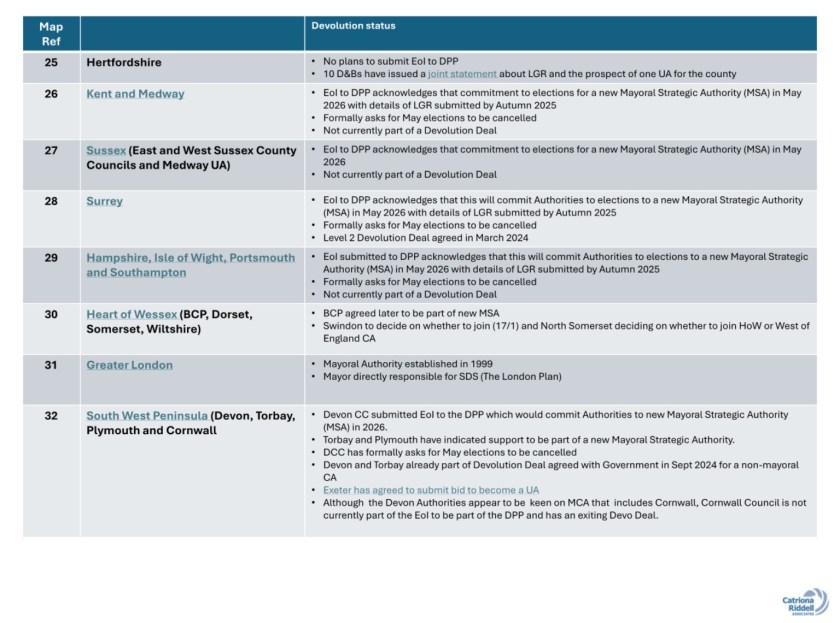
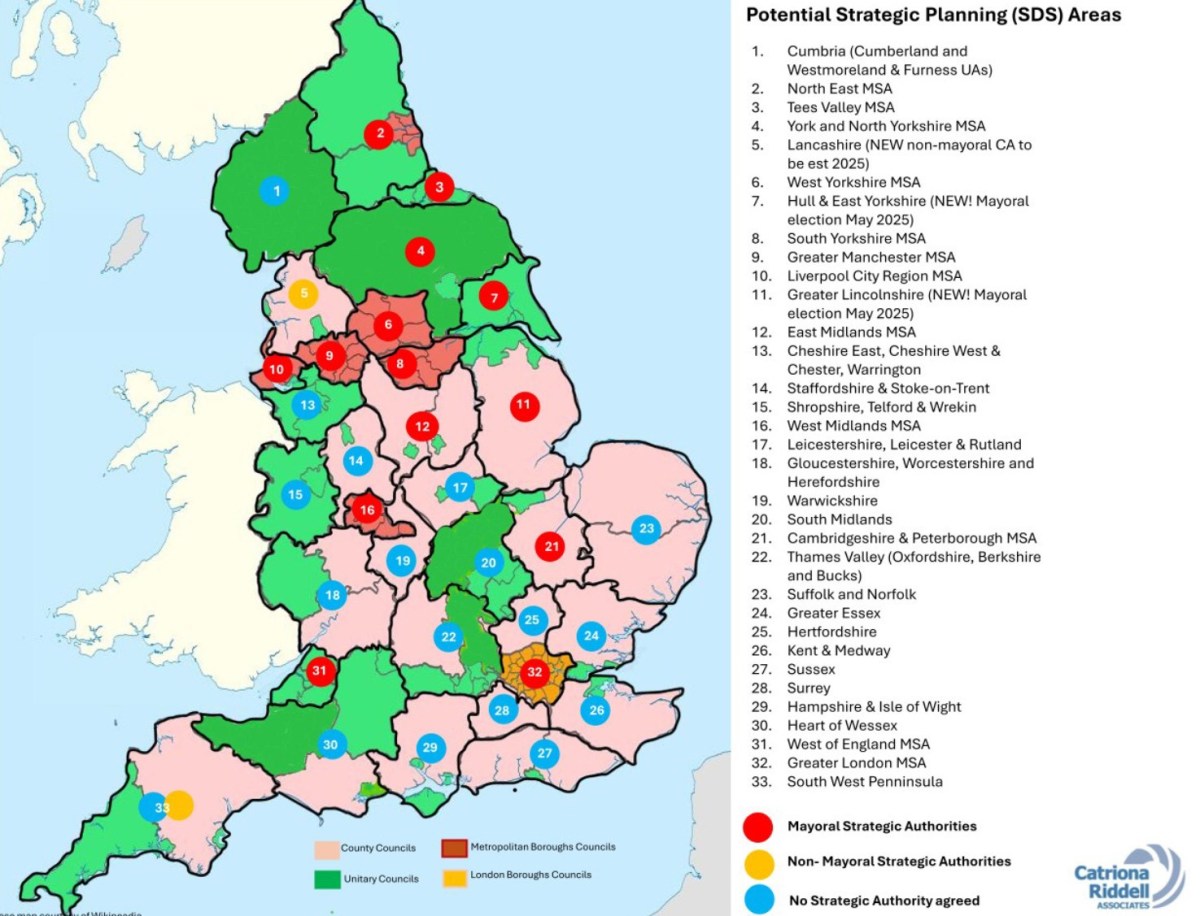
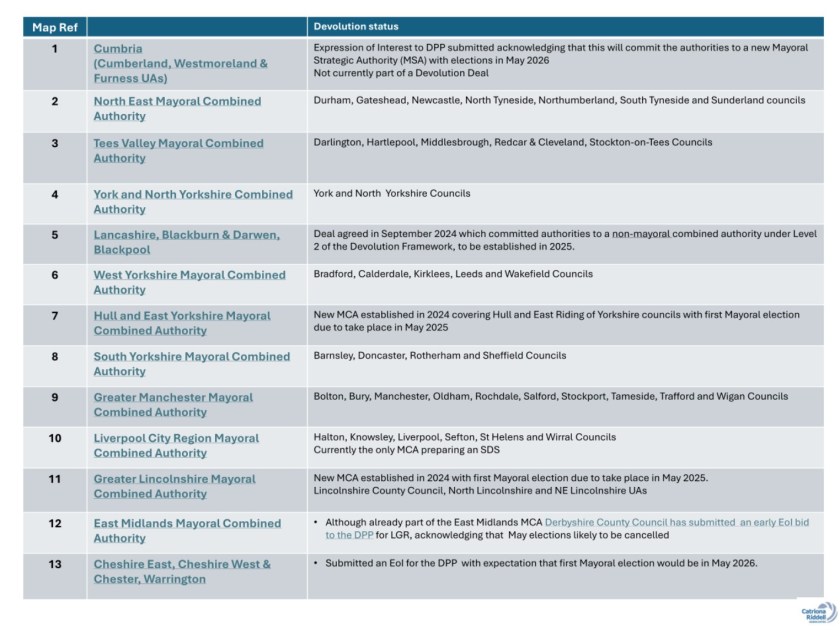
What could this all mean in terms of what the areas will be for SDSs? Catriona Riddell yesterday posted her current understanding as below:

In terms of the move towards unitary authorities, local government minister Jim McMahon wrote to two tier authorities on 16 December 2024:

As set out in the White Paper, new unitary councils must be the right size to achieve efficiencies, improve capacity and withstand financial shocks. For most areas, this will mean creating councils with a population of 500,000 or more. However, there may be exceptions to ensure new structures make sense for an area, including on devolution.”

“We will take a phased approach and expect to deliver new unitary authorities in April 2027 and 2028.”

“I have heard from some areas that the timing of elections affects their planning for devolution, particularly alongside reorganisation. To help manage these demands, alongside our objectives on devolution, and subject to meeting the timetable outlined in this letter, I am minded-to lay secondary legislation to postpone local council elections from May 2025 to May 2026.

However, I will only do this where this will help the area to deliver both reorganisation and devolution to the most ambitious timeframe – either through the Devolution Priority Programme or where reorganisation is necessary to unlock devolution or open up new devolution options.”

“To lay the relevant legislation to postpone elections, I will need a clear commitment to devolution and reorganisation aims from upper-tier councils in an area, including a request from the council/s whose election is to be postponed, on or before Friday 10 January.”

Again, the Local Government Association’s list is helpful – of counties and unitaries which have made requests, involving postponing their election from 2025 to 2026.

Whilst the government’s advice is that none of this should slow down current local plan making it is going to be interesting to see what transpires – and the local political implications more generally of postponed elections (who knows, perhaps the potential for longer term decision making?).

The pace of change ahead of publication of either the Planning and Infrastructure Bill or the English Devolution Bill is certainly impressive.

There’s an interesting quote from Arthur C Clarke about revolution – and possibly it extends to devolution as well:

Every revolutionary idea seems to evoke three stages of reaction. They may be summed up by the phrases: (1) It’s completely impossible. (2) It’s possible, but it’s not worth doing. (3) I said it was a good idea all along.”

Simon Ricketts, 18 January 2025

Personal views, et cetera

Is The London Mayor Doing Enough In Practice To Accelerate Housing Delivery?

Congratulations Sir Sadiq Khan, Mayor of London, and Christopher Katkowski CBE KC on your respective new year’s honours.

CK CBE KC of course led work on a report published in January 2024 for the last government which considered any changes to the London Plan which might facilitate housing delivery on brownfield sites in London. The report lays bare the undersupply of new homes in London, which has not kept pace with increases in jobs, population and housing demand.

Sir SK’s Greater London Authority published on 19 December 2024 Accelerating Housing Delivery: Planning and Housing Practice Note. I summarise the document later in this post and would welcome reactions as to whether the document – non-statutory, intended as practical guidance and a material consideration in the determination of planning applications and, in part, renegotiation of existing section 106 agreements – really goes far enough, given where we currently are.

The need for additional housing in London, at all price points, both subsidised (“affordable”) housing and general market housing, has never been more acute. It is in fact much worse now than when CK CBE KC wrote that report. The statistics back that up, with planning approvals and housing starts both down sharply last year.

Annual housing completions have been falling short of the policy target in the 2021 London Plan of 522,870 net housing completions from (2019/20 -2028/29). Everyone knows that the viability position for developers is increasingly difficult, faced with build cost inflation, high interest rates and the costs and uncertainty of, for example, additional building safety requirements. Similarly everyone knows that there is an absence of registered providers willing to take on the affordable housing, leading to stalled schemes (a national problem – see the HBF’s December 2024 press statement 17,000 Affordable Homes stalled by lack of bids from Housing Associations and accompanying report).

We have the London Plan’s 50% affordable housing requirement – and with a relatively rigid and formulaic system of early stage and late stage viability review mechanisms where that cannot be met (the late stage review not being required where the “fast track” applies, i.e. if the developer commits to at least 35% affordable housing – 50% on industrial or public sector land), all in accordance with London Plan Guidance on affordable housing and on development viability which have remained in draft since May 2023.

Before we look at the practice note, let’s see what some of the evidence is saying, for instance the GLA’s own November 2024 document, Housing in London 2024: The evidence base for the London Housing Strategy (the charts referred to are here):

London is home to both the fastest and slowest-growing local housing stocks in England. The number of homes in Kensington and Chelsea grew by 2% over the last decade, compared to 26% in Tower Hamlets (chart 2.1). Using data on new Energy Performance Certificates to track completions of new homes, it looks like new supply in 2024 is following the trend of 2022 and 2023, two of the lowest years in the last five years (chart 2.2).

The quarterly number of planning approvals is falling, and they are concentrated on fewer, larger sites (chart 2.4).  Increasing construction on small sites might be key to increasing overall delivery, with 65,000 new build homes completed on small sites between 2012/ 13 and 2021/ 22 (chart 2.3). Sales of new market homes in London peaked in 2022 and then fell considerably, partly due to lower demand from Build to Rent (BTR) providers and the end of Help to Buy (chart 2.6). The BTR sector, which completed 44,585 new homes in London between 2009 and 2023 is nevertheless still growing (chart 2.7).

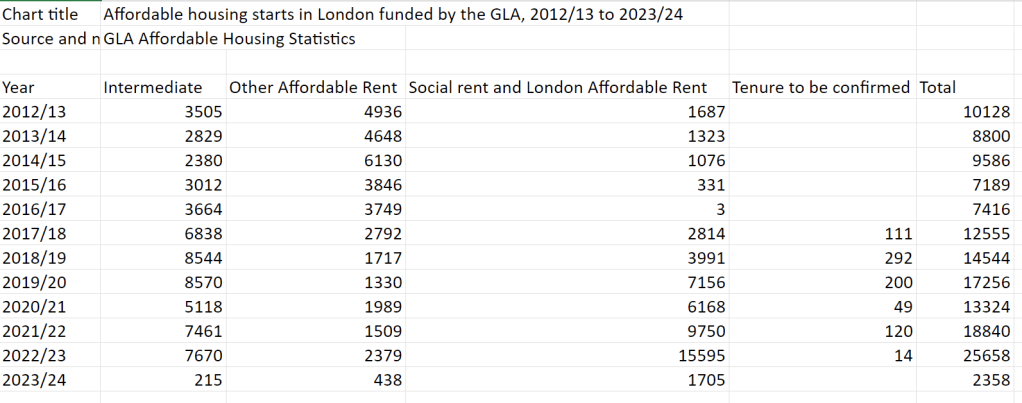
38% of homes and 46% of habitable rooms recommended for approval by the Mayor in 2023 were affordable, with both of these figures a record high (chart 2.5). Affordable housing starts funded by the GLA fell sharply between 2022/ 23 and 2023/ 24 (charts 2.8 and 2.9), as registered providers and local authorities have diverted resources away from new supply in response to increased remediation and refurbishment costs and the costs of adapting to changing regulations. Completions are also down, but not as much. Of the affordable homes started with GLA support in 2023/ 24, 72% were for social rent. Affordable completions from all funding sources also rose to a recent high of 15,768 in 2022/ 23 (chart 2.10), with data for 2023/ 24 not yet available.

Social housing landlords in London owned just under 800,000 affordable homes for rent in 2023, the highest total since 2002 (chart 2.12). Sales of council homes through the Right to Buy (RTB) scheme have been on a downward trend since their peak in the 1980s, totalling 1,080 in 2023/ 24 (chart 2.11).

Council tax data showed that 2.3% of homes in London were empty in 2023, with only 1% empty longer than 6 months (chart 2.13). These are much lower levels than in the 1980s and 90s, when around 5% of homes used to be empty.

1.34 million homes in London, or 36% of its stock were leasehold homes in 2022/ 23, over half of which were privately rented (chart 2.15).  In 2023, there were 22,770 homes in multiple occupation (HMOs) with mandatory licences in London. This is the highest of any region (chart 2.14).”

This is chart 2.8 referred to in that text:

This is an extract from chart 2.4, showing the annualised trend per quarter in the number of new homes approved, and the number of projects:

Ahead of the awaited review of the London Plan, what can be done? The sorts of specific, practical,  issues that currently come up again and again relate to the operation of the viability review mechanisms in particular. Since the new Building Safety Act regime came into force on 1 October 2023 the early stage review mechanism, kicking in if substantial implementation (usually defined as construction of the foundations and ground or first floor) hasn’t taken place within two years of permission, is increasingly unworkable for higher-risk buildings given how long the gateway two stage is taking in practice. The contingent liability that the late stage review mechanism represents is unattractive in principle to funders, which is a big challenge in a weak market.

For measures that could have had an immediate positive impact, what about, for instance, introducing suitable flexibility into the triggering of the early stage review?  Potentially a temporary “holiday” from the late stage review for schemes that committed to proceed to completion within an agreed timescale?  A willingness to accept renegotiation of section 106 agreements on schemes which are now unviable? Some pragmatism as to commuted payments towards off-site delivery where a registered provider cannot be found?

Whilst the document does include some measures which may help at the margins, there’s certainly no “big bang” of that nature. It is in fact curious how little fanfare the practice note has been given. I can’t even find it on the GLA website, let alone any press release. Nor was any formal consultation or indeed feedback invited.

Anthony Lee at BNP Paribas did this good summary on LinkedIn before Christmas but I have seen little else.

I draw out some of the measures as follows:

  • Allowing the fast track threshold to be reduced, both for new and current applications and also for consented schemes, where the tenure split provides proportionately more social rent than the policy requirement, in accordance with a formula that appears to seek to avoid any financial advantage to the developer in so doing – the only advantage being if that unlocks more GLA funding and/or more willingness on the part of registered providers.
  • Estate regeneration schemes will be able to qualify for the “fast track” if at least 50% of the additional housing will be delivered as affordable.
  • The GLA will consider accepting supported housing and accommodation for homeless households, with nomination rights for the relevant borough, as a like for like alternative for intermediate housing, again both for new and current applications and also for consented schemes.
  • The cost of any meanwhile accommodation for homeless households, with nomination rights given to the relevant borough, may be taken into account in the operation of viability review mechanisms.
  • With the late stage review, the developer currently retains 40% of any surplus profit. In certain circumstances this can now increase to 70%.  However, the criteria are tight. “To qualify for this, the application must provide at least 25 per cent onsite affordable housing by habitable room for schemes with a 35 per cent threshold, and 35 per cent onsite for schemes with a 50 per cent threshold, at the relevant local plan tenure split, and be certified as reaching practical completion within three years of the date of this document.” “For larger phased schemes that provide at least 25 per cent affordable housing across the scheme as a whole that are granted planning permission after the date of this practice note, if the initial or a subsequent phase is certified as reaching practical completion within three years of the date of this document, the GLA will consider allowing the applicant to retain 70 per cent of any surplus profit identified in that phase when the late review is undertaken. The relevant phase must include at least 100 residential units.”
  • There is this enigmatic sentence: “The GLA will also work with boroughs to identify sites that have been allocated for development or that have been granted consent but that have not come forward for development for many years, or where limited progress has been made, and will assess the nature of interventions required to facilitate this.”
  • Great flexibility is announced as to the permissible inputs into review mechanisms. The formulae currently focus on changes in gross development value and build costs. “However, in some cases it may be more appropriate to allow for a full viability review to be undertaken which reconsiders all development values and a greater scope of development costs, including professional fees and finance costs.”
  • The Mayor’s housing design guidance should not be applied mechanistically, in relation to, for instance, the reference to the need to submit “fully furnished internal floorplans” and the objective that new homes should be dual aspect.
  • Various grant funding measures but I’ll look to others to comment as to the extent they will move the dial.

Thoughts?

Simon Ricketts, 11 January 2025

Personal views, et cetera
How About A Five Yearly Review Of The Use Classes Order & GPDO, Starting This Year?

Changes in the law relating to e.g. tripe shops, maggot breeding and bone grinding were my special subject as a late 80s young lawyer so please hear me out, because this is all central in my view to thinking with regard to the government’s (currently rather all shades of grey) “brownfield passports” concept (see my 28 September 2024 blog post Brownfield Passports…To What? When? How? ).

Two things I find interesting about the UK (now, for the purposes of this post, English and Welsh) town and country system:

  1. The stability of its underlying structure: Many of the provisions of the Town and Country Planning Act 1947  are there, as the kernel of the current, much amended, 1990 Acts. Compare for instance section 12 of the 1947 Act (defining “development”) with section 55 of the Town and Country Planning Act 1990 or section 13 of the 1947 Act with section 59 of the Town and Country Planning Act 1990 (“development orders”).
  1. The continual sets of amendments, large and small,  that have been made, within that framework, to reflect differing political priories and economic and social pressures. Drafting by committee? What we have now is the almost impenetrable result of many generations of that. It always helps to understand who added, amended or removed what, when and why.

The tension for law makers is always the same: how to retain what works but ensure, without unnecessary complexity, that the system remains fit for purpose.

Maybe nowhere is this more so than in relation to the concepts of use classes (changes of use within a use class not amounting to “development” requiring planning permission) and permitted development (classes of development which have the benefit of automatic, deemed, planning permission).

When I first studied planning law (at bar school in 1984-85: course run by Victor Moore, as of “A Practical Approach To Planning Law”), we were all operating under the Use Classes Order 1972 (which was largely in the same form as the first Use Classes Order in 1950) and under the General Development Order 1977 (again largely in the form of the first General Development Order in 1948). This truly makes me feel old. These were the 1972 Use Classes Order use classes, dominated by all of those special industrial groups, and with those references to tripe shops, cats-meat shops and the like.

The categories of permitted development rights in the 1977 Order will look very familiar:

The brevity of the “changes of use” category, less familiar:

Conservative governments have been responsible for two major revisions of the system.

The first was shortly after I qualified, with the introduction of the (now amended many times) Town and Country Planning (Use Classes) Order 1987 the main functions of which do not nowadays appear very controversial: (1) lumping together office, light industrial and research and development uses within a new use class B1 and (2) abolishing the use classes containing all those old special industrial groups. Alongside this was the Town and Country Planning General Development Order 1988.

That system then survived without major reform for around quarter of a century.

The second set of changes to the system has been the multiple waves of deregulatory changes made between 2013 and 2024, particularly the creation of class E for a wide range of commercial uses in 2020 (see my 24 July 2020 blog post E Is For Economy) and the various new permitted development rights enabling residential conversion and demolition/rebuild in relation to commercial (and in some instances agricultural) buildings. The Town and Country Planning (General Permitted Development) (England) Order 2015 (as amended) is a shape-shifting monster.

The system is in desperate need of reform:

  • what should be the core objectives behind removing the need for planning permission for certain categories of use and works, given the Government’s missions?
  • How can the system operate with simplicity but also appropriate flexibility and reflecting local circumstances where appropriate?
  • What areas of the current system need modernising to reflect current economic or social pressures, priories and ways of living and working?

Depressingly, my 1 July 2016 blog post Time To Review The C Use Classes remains more relevant than ever. It’s still time! The nettle has not been grasped.

As for permitted development rights, perhaps the big political question is whether the concept of automatic planning permission for the conversion of certain types of commercial buildings to residential use should be rejected outright, based on the experience since May 2013, or can be made to work acceptably.

In 2023-24 8,825 of England’s 198,610 new dwelling completions were by way of permitted development rights . Between 2015/16 and 2022/23, 102,830 new homes were delivered by way of permitted development rights, around 6% of new homes. This is a not insignificant contribution, by numbers at least.

To this we add the Government’s drive towards brownfield development in urban areas (that brownfield passports document I mentioned); the extent to which commercial space is surplus to market requirements, and the carbon benefits of finding new uses for existing buildings (although query how this squares with the “demolish commercial and rebuild as residential” permitted development right).

Of course a big problem is that much of the resulting accommodation has not been of a decent standard (see e.g. Research into the quality standard of homes delivered through change of use permitted development rights by Dr Ben Clifford, Dr Patricia Canelas, Dr Jessica Ferm and Dr Nicola Livingstone Bartlett School of Planning, UCL and Professor Alex Lord and Dr Richard Dunning, Department of Geography and Planning, University of Liverpool, July 2020, published by MHCLG in 2020, strangely alongside yet further deregulatory measures). The Town and Country Planning Association is lobbying for a “Healthy Homes Bill”, describing permitted development rights as creating “slums for the future”.

Is there a middle ground? Do permitted development rights have a role in delivering homes, in the quantity needed but also to the necessary quality – decent, healthy?

The previous government consulted on further changes to permitted development rights in February 2024 . The outcome of that process was never published. We await Labour’s next steps.

What went wrong with commercial to residential permitted development rights?

For a start the measure seemed to be seen by ministers as a short-term tactical intervention rather than based on any longer-term strategy or analysis. In May 2013 the right was first introduced (initially just for three years) to allow changes from office use to residential use, the twin objectives being to boost housing and to help regeneration by way of putting vacant or under-utilised office space to productive use. The “prior approval” requirements were minimal, with no minimum space standards, no minimum standards for daylight and no protection in relation to noise, for instance. As is still the case, local planning authorities could not impose requirements as to affordable housing or require contributions towards for instance education or health facilities. Authorities could make “article 4” directions limiting the areas within which the permitted development right would apply but at risk of these being cancelled or amended by the government (as has frequently happened).

The right was extended to shops and to financial and professional services uses in April 2014 and made permanent in Autumn 2015. Adequacy of daylight was introduced as a prior approval requirement in August 2020 and minimum space standards in April 2021. Initially buildings of any size could be converted to residential. A 1,500 sq m cap was introduced in September 2020 (at the same time that there was the separate but related de-regulation measure of gathering together most commercial uses within a single use class, the new class E) and then that cap was removed in March 2024. Similarly, a requirement was also introduced that the building should have been vacant for at least three months before the application was made, only for that also to be removed. Are you keeping up? (Incidentally, I am grateful to my colleague Gregor Donaldson for reminding me of some of these twists and turns).

One might conclude from this chopping and changing that from the outset the process has lacked a proper strategic foundation, core objectives and a commitment to ensure that resulting development is not of poorer quality, or having a free ride at the expense of development achieved by way of the traditional planning application route.  Care is needed with criticism of outcomes: to what extent did these result from the initial wave of conversions, before additional prior approval safeguards had been introduced? Also remember that these developments do have to comply with the Building Regulations and with housing legislation. Not every failing is down to the GPDO.

Before we give up on removing unnecessary matters from the planning application process and on this streamlined route for delivering new accommodation on urban brownfield land, surely there is an urgent need to examine whether the system can indeed ensure, by way of objective criteria, that:

–              (possibly by way of an article 4 direction process following better national guidance and the opportunity for public consultation) development locations are sustainable for their residents, with access to public transport, schools, health and community facilities;

–              schemes should pay their way in terms of affordable housing and other section 106 agreement requirements in the same way as schemes delivered by way of planning application.

But more widely, surely we need to embed a rhythm within government of reviewing the operation of the Use Classes Order and General Permitted Development Order regularly, in an orderly rather than ad hoc way, so as to ensure that we have both a reasonable level of stability but also a proper regular process for reflecting emerging economic, social and indeed technological trends?

Happy new year!

Simon Ricketts, 5 January 2025

Personal views, et cetera