Banner Review Into Legal Challenges of NSIPs

Making the planning system work more effectively should not be party political. So it is at least a good start to see that conservative life peer Charles Banner KC’s Independent review into legal challenges against Nationally Significant Infrastructure Projects (28 October 2024), commissioned by the previous government, has now been published by the current government. There is nothing very radical in it but, when it comes to making the planning system and associated litigation process work better, surely so much comes down to a version of Sir Dave Brailsford’s theory of marginal gains (see for example the undoubted success which was Bridget Rosewell’s review of planning inquiry processes).

LCB (is that yet an acceptable acronym?) had been appointed alongside fellow barrister Nick Grant in March 2024 to “explore whether NSIPs are unduly held up by inappropriate legal challenges, and if so what are the main reasons and how the problem can be effectively resolved, whilst guaranteeing the constitutional right to access of justice and meeting the UK’s international obligations.”

As per the Government’s press statement that accompanies the review, the Ministry of Justice has now separately published a call for evidence, based on his recommendations, ending on 30 December 2024 – “the Government is of the view that further analysis of a broader evidence base is necessary before decisions can be taken on the Review’s recommendations”.

Charlie Banner and Nick Grant had clearly put in the hours. It’s a well-thought through document. The review contains much useful background as to the current position, including analysis of the 34 challenges to DCOs which have been brought (30 of which have challenged the grant of a DCO and of which 4 claims were successful), average timescales for each stage of the process and some of the wider implications arising. This is valuable work – I’ve grumbled previously as to how unnecessarily difficult it can be to extract data like this.

They interviewed over 60 people with experience in the field (I’ll declare an interest as being one of many spoken to. I’m feeling rather guilty now for the whole hour that I took up…).

Ten recommendations are made, which I summarise as follows, adding anything particularly interesting from the Government’s accompanying call for evidence as I go:

Recommendation 1 – For so long as the UK remains a member of the Aarhus Convention, there is no case for amending the rules in relation to cost caps in order to reduce the number of challenges to NSIP.

Views not sought on this option. The call for evidence notes the government’s separate call for evidence seeking views on options to bring the UK’s policies into compliance with its obligation under the access to justice provision of the Aarhus Convention (30 September 2024)

Recommendation 2 – There is no convincing case for amending the rules in relation to standing to reduce the number of challenges to NSIPs.

Views not sought on this option.

Recommendation 3 – The current three bites of the cherry to obtain permission to apply for judicial review is excessive and should be reduced to either two or one: (1) an oral hearing in the High Court with a target timescale of within four weeks of the deadline for filing of acknowledgements of service and (2) consideration on the papers in the Court of Appeal within four weeks of the application for permission to appeal against the refusal of permission to apply for judicial review.

The commentary in the call for evidence document is interesting, pointing at the potential for any such changes to apply to judicial reviews of other planning decisions:

If the proposed change could result in time and cost savings for litigants and the courts, whilst maintaining adequate access to justice, there could be merit in considering this change not only in the context of NSIPs but also for judicial reviews of other planning decisions in general.

The Government is, however, of the view that more evidence is required to inform a decision on the implementation of this proposed change. We would, therefore, welcome views on the expected benefits and potential risks of this change, both in the context of the NSIP regime and in wider judicial review cases.”

Recommendation 4 – There may be a case for raising the permission threshold for judicial review claims challenging DCOs, which could be achieved by amendments to the CPR.

“The Government is of the view that in addition to the practical risks highlighted in the report, there is a more fundamental concern that raising the permission threshold in this way could unduly restrict the right of access to justice…the Government would however welcome views with supporting evidence, where available, on the likely benefits and potential risks of raising the permission threshold as discussed in the report.”


Recommendation 5 – On balance the case has not yet made out for a panel of judges with specialist NSIP experience to be eligible to hear judicial review challenges to DCO decisions.

The call for evidence document notes that there are currently 35 full time High Court judges authorised to consider planning cases, four of whom specialised in planning as practitioners prior to joining the judiciary.

“The Government would welcome views on whether this idea should be taken forward, whilst recognising that the authorisation of judges to hear certain types of case is part of judicial allocation and deployment which is a matter for the judiciary. We would particularly welcome views from members of the judiciary.”

Recommendation 6 – The Civil Procedure Rules should provide that DCO judicial reviews are automatically deemed Significant Planning Court Claims.

(This is important because stricter target timescales apply. All DCO judicial reviews to date have been treated as such – so this should not be controversial…).

“Given the national significance of NSIPs and the complexity of the claims against them, there is a case for formalising the existing practice of designating all judicial review cases concerning DCO decisions as Significant Planning Court Claims. The Government would, however, welcome views on the practical benefits of formalising this existing practice.”

Recommendation 7 – Automatic pre-permission case management conferences should be introduced in relation to judicial review claims challenging DCOs.

Views sought.

Recommendation 8 – Target timescales should be set for the Court of Appeal to  target timescales for determine applications for permission to appeal, and (where permission is granted) thereafter substantive appeals.

“The Government considers that a better understanding of the causes of the current delays at the Court of Appeal and the Supreme Court is needed to determine whether imposing target timescales would help to ensure consistent timely processing of DCO judicial reviews at the appellate courts. In addition, although the report suggests that the relatively limited number of DCO judicial review claims means that these timescales should not be too onerous on the courts, we would welcome views, particularly from the senior judiciary, as to how the introduction of target timescales might affect the operation of the appellate courts.”

(NB somewhat deferential? There are undoubtedly delays at the appeal stages. delays which look to mere mortals to be capable of reduction…)

Recommendation 9 – The President of the Supreme Court should be invited to consider amending the Supreme Court Rules to introduce target timescales for the determination of applications to the Supreme Court for permission to appeal in judicial review challenges to DCOs.

Same commentary as for recommendation 8.

Recommendation 10 – The Planning Court and Court of Appeal should be invited to publish data on a 3 month rolling basis which, at minimum, should indicate the number and percentage of cases which in the last 3 month period have met the target timescales either for NSIP cases specifically or Significant Planning Court cases generally, or both; as well as what the average and maximum turnaround times have been in that period (for both the permission and the substantive stages).

“This recommendation to invite the Planning Court and the Court of Appeal to improve the way they publish data on the progress of DCO judicial reviews and/or planning cases would not directly address the issue of delays, but it could, as the report notes, provide stakeholders with greater transparency and help inform consideration of further procedural reforms. The report also suggests that this could be easily implemented at little or no additional cost. The Government would welcome views on the likely benefits and potential costs of this proposal.”

The Government is also welcoming views as to:

  • The review and its methodology more generally and whether there is indeed a case for streamlining the process for judicial reviews of DCO decisions
  • other possible changes that could help reduce judicial review related delays to the delivery of NSIPs and provide parties greater certainty in the process. Any proposed change must, however, ensure the right of access to justice is maintained in line with the UK’s domestic and international legal obligations.

Simon Ricketts, 28 October 2024

Personal views, et cetera

Table from review
Together In Electric Dreams

We should be constantly pinching ourselves at the good fortune of (1) living in, what was to previous generations, the future, and (2) having been given the privilege and responsibility of in turn helping to shape a small part of the world in which future generations will live and work.

It wasn’t so long ago that the life of a planning lawyer used to entail posting out cheques for copies of local plans and decision notices (having first had various telephone conversations – yes telephone conversations – to work out the price) or, if it was a rush job, turning up at the local authority’s offices to go through the paper files, or (the horror) sit at their microfiche machine. And sometimes we actually had to sit in a library, with books.

The Planning Portal, individual local authority planning portals and the Planning Inspectorate’s Appeals Casework Portal have been a game changer – but we are on the cusp of bigger improvements in terms of efficiency, transparency of information and the potential for better informed public engagement.

Last week at Town Legal we co-hosted a breakfast roundtable discussion with Gordon Ingram and Claire Locke from Vu.City  to discuss digital 3D planning but the discussion went wider to discuss where we are with digital planning data more widely as well as the Planning Inspectorate’s recent guidance as to the use of artificial intelligence. We had a range of participants from the private and public sectors but I was particularly grateful to Nikki Webber, digital planning lead at the City of London who subsequently shared some of the links to resources that I will now use in this post.

There has been discussion about digitising the planning system for so long that there’s a risk of taking it all for granted, or of not focusing on the vision and how achievable it now is. But huge advantages in terms of efficiency, transparency and quality of decision-making surely flow from (and indeed are already starting to flow from):

  • Ensuring that data that enters the planning system is available for wider public use and that common standards are adopted wherever possible
  • Using technology (1) to give decision-makers and the public a better understanding of the policy options before them and the ability to visualise development proposals in context and (2) to enable better and more straight-forward opportunities for the public to express their views, on the basis of a better understanding of the issues

As the old British Rail slogan went, we’re getting there.

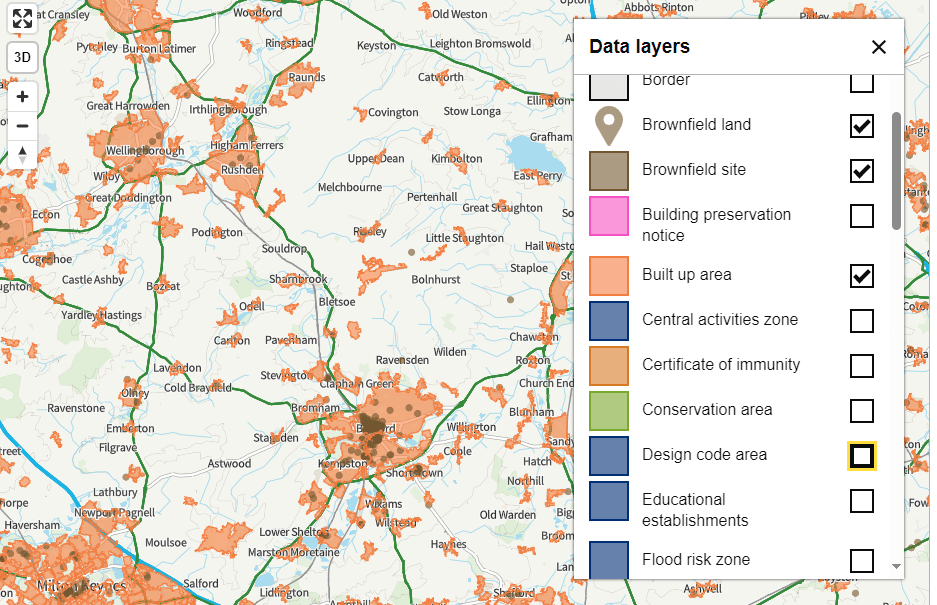
MHCLG’s Digital Planning Programme is doing great, practical, work. Its planning data platform is still at beta testing stage but is already useful, showing planning and housing information provided by local authorities on a single interactive map. It also announced on 18 October 2024 that it is now turning to developing data specifications for planning applications, looking  into “where specifications are required, and define them clearly, taking into account how this data will be used by the planning community. This will build on the work that we have already started, such as the draft specifications for planning applications and decisions , and planning conditions  .”

The legislation required to underpin these advances is taking shape. Part 3, chapter 1 of the Levelling-up and Regeneration Act 2023 deals with planning data. Sections 84, 85, 86 are already in force as of 31 March 2024, by virtue of the Levelling-up and Regeneration Act 2023 (Commencement No. 3 and Transitional and Savings Provision) Regulations 2024 .

Quoting in part from LURA’s explanatory notes:

Section 84 gives the Secretary of State and devolved administrations “the power to regulate the processing of planning data by planning authorities, to create binding “approved data standards” for that processing. It also provides planning authorities with the power to require planning data to be provided to them in accordance with the relevant approved data standards.”

“Example (1):

A planning authority creating their local plan: Currently planning authorities do not follow set standards in how they store or publish local plan information. Through these powers, contributions to the preparation of a local plan and the contents of a local plan will be required to be in accordance with approved data standards. This will render local plan information directly comparable, enabling cross-boundary matters to be dealt with more efficiently as well as the process of updating a local plan as planning authorities will benefit from having easily accessible standardised data.

Example (2):

Central government trying to identify all conservation areas nationally: In the existing system, planning authorities name their conservation areas using different terms (e.g., con area, cons area) making it hard for users of this data, such as central government to identify which areas are not suitable for development and what restrictions are in place. By setting a data standard which will govern the way in which planning authorities must name their conservation areas, and planning authorities publishing this machine-readable data, a national map of conservation areas can be developed which can be used to better safeguard areas of special importance.”

Section 85 allows planning authorities, by published notice, to require a person to provide them with planning data that complies with an approved data standard, that is applicable to that data.

Section 86 allows regulations to be made “requiring a relevant planning authority to make such of its planning data as is specified or described in the regulations available to the public under an approved open licence”.

Whilst these sections are already technically in force, they cannot fully take effect until the government determines what those specific approved data standards will be. Section 87 is also important but not yet in force, which gives the Secretary of State the power to approve software, that is in accordance with data standards, to be used by planning authorities in England. Clearly there is great advantage in consistency of approach as between public authorities as to the software used, so as to ease the user experience and presumably to make providers’ investment in technology more viable but this is to be balanced as against the risks arising from any particular provider being able to exploit a dominant position. Is not a private/public sector approach possibly the most appropriate, as per the Planning Portal (a joint venture between MHCLG and TerraQuest Solutions Limited)?

MHCLG’s Digital Planning Programme has also been funding local authorities’ digital planning projects and its website has links to various case studies. For instance, take a look at Southampton City Council’s work  on increasing accessibility and understanding to improve public engagement, using a Vu.City developed 3D model to help local residents understand what proposals may look like in situ and potentially ease concerns about increased densities. How transformative it would be if local people could see the different options that here might be to accommodate local housing and employment development needs within an area. Or in terms of development management and transparent public engagement, look at London Borough of Camden’s beta testing as to the information it can provide as to major applications in its area (particularly look at the use of images of the proposal and at the “How could this affect you?” section).

With progress of course comes the need for caution. These tools need to be based on accurate information and the risks are accentuated where outputs are the result of modelling and extrapolation of data, rather than taking the form of simply making the raw data more easily available. Any inputs and algorithmic influences need to be capable of being tested. Technology is requiring us all to be additionally cautious in all that we do. In my world for instance, the Law Society has published some useful, detailed, advice as to Generative AI: the essentials  to provide a “broad overview of both the opportunities and risks the legal profession should be aware of to make more informed decisions when deciding whether and how generative AI technologies might be used”. As a firm we now have a policy on the use of AI; no doubt yours does too.

Understanding of the issues has in some ways already moved on greatly since my 27 May 2023 blog post You Can Call Me AI but the risks have increased now that use of Chat GPT and its competitors has become more mainstream. AI is undoubtedly being used by some to generate text for objections to planning applications. I’ve had prospective clients who mention in passing that before asking me the particular question they have looked online and “even Chat GPT didn’t have the answer” (these things are just large language models folks! Would you rely on predictive text as anything more than an occasional short-cut? I don’t like to think about what it must be like to be a GP these days).

Until recently I hadn’t thought about the additional risks arising from generative AI, of false images and documents being relied upon as supposed evidence in planning appeals. So I was pleased to see the Planning Inspectorate’s guidance on Use of artificial intelligence in casework evidence (6 September 2024).

The guidance says:

If you use AI to create or alter any part of your documents, information or data, you should tell us that you have done this when you provide the material to us. You should also tell us what systems or tools you have used, the source of the information that the AI system has based its content on, and what information or material the AI has been used to create or alter.   

In addition, if you have used AI, you should do the following: 

  • Clearly label where you have used AI in the body of the content that AI has created or altered, and clearly state that AI has been used in that content in any references to it elsewhere in your documentation. 
  • Tell us whether any images or video of people, property, objects or places have been created or altered using AI. 
  • Tell us whether any images or video using AI has changed, augmented, or removed parts of the original image or video, and identify which parts of the image or video has been changed (such as adding or removing buildings or infrastructure within an image).  
  • Tell us the date that you used the AI.
  • Declare your responsibility for the factual accuracy of the content. 
  • Declare your use of AI is responsible and lawful. 
  • Declare that you have appropriate permissions to disclose and share any personal information and that its use complies with data protection and copyright legislation.   

AI is defined in the document very loosely: “AI is technology that enables a computer or other machine to exhibit ‘intelligence’ normally associated with humans”.

If I can carp a little, whilst the thrust of the guidance and its intent is all good, are we really clear what is and isn’t AI? What about spell-check and other editing functions, what about the photo editing that goes on within any modern camera? Do you know whether the information you are relying upon has itself been prepared partly with the benefit of any AI tool however defined and if AI has been used on what basis are you confirming that “its use complies with data protection and copyright legislation” given the legal issues currently swirling around that subject as to the material upon which some of these AI models are being trained? Perhaps some examples would be helpful of the practical issues on which PINS is particularly focusing.

Tech isn’t my specialism. Planning and planning law probably isn’t a specialism of those actually developing the technical systems and protocols. But I think we need to make sure that we are all engaging as seamlessly as possible across those professional dividing lines, so that the opportunities to create a better, more efficient, more engaging, possibly even more exciting planning system are fully taken. These are the things that dreams are made of.

Simon Ricketts, 20 October 2024

Personal views, et cetera

Extract from MHCLG’s planning data map

Planning For Industrial Growth & Investment

Sir Keir Starmer’s speech on 14 October 2024 at the international investment summit held at the Guildhall in the City of London generated much media coverage. This blog post is going to look briefly at the references he made in that speech to the planning process.

But first of all, I do draw attention to the important document published by the Government alongside the conference:   Invest 2035: the UK’s modern industrial strategy  (14 October 2024), now being consulted upon until 24 November 2024.

Some snippets:

Eight growth-driving sectors have been identified: Advanced Manufacturing, Clean Energy Industries, Creative Industries, Defence, Digital and Technologies, Financial Services, Life Sciences, and Professional and Business Services.”

A core objective of the Industrial Strategy is unleashing the full potential of our cities and regions. The Industrial Strategy will concentrate efforts on places with the greatest potential for our growth sectors: city regions, high-potential clusters, and strategic industrial sites. The Government is committed to devolving significant powers to Mayoral Combined Authorities across England, giving them the tools they need to grow their sectoral clusters and improve the local business environment through ambitious Local Growth Plans. Partnership with devolved governments will make this a UK-wide effort and support the considerable sectoral strengths of Scotland, Wales, and Northern Ireland.”

The Industrial Strategy and growth-driving Sector Plans will be published alongside the Spending Review in Spring 2025.”

Under the “energy and infrastructure” section:

An effective planning system is a fundamental enabler for business investment in our growth-driving sectors. At the national and regional level, planning constraints hold back growth, including in high-performing life sciences clusters like Cambridge and clean energy industries hubs such as Tees Valley and the North-East. Firms require predictability and efficiency when applying for consent for projects, but this is not being provided by existing processes. Businesses have told us that the planning consent process is too lengthy and uncertain – infrastructure projects spend an average of 65 months in pre-construction phases, the highest among peer countries.”

Targeted, long-term infrastructure investment is a vital catalyst to the success and stability of major city regions and clusters of our growth-driving sectors. Businesses agree that the UK has for too long failed to provide a long-term vision and clear statement of intent to support this. A lack of housing in some places across the UK also prevents labour markets from operating effectively and prevents successful agglomerations. Further, additional data centre capacity and access to fast, secure, and reliable digital connectivity is essential to enabling economic growth and to reap the transformational productivity benefits of digitalisation and the adoption of AI. Continued investment is needed to meet our ambitious targets to bring gigabit-capable broadband to all of the UK, and standalone 5G to all populated areas, by 2030.”

Under a section entitled “Growing high-potential clusters”:

The Industrial Strategy will concentrate efforts on places with the greatest potential for the growth sectors: city regions, high-potential clusters, and strategic industrial sites. The success of the Industrial Strategy’s growth-driving sectors can only be achieved if these clusters reach their full potential, supported through a place-based approach to policy.

Local Growth Plans are a cornerstone of the place-based approach. These locally owned, 10-year strategies will set out how Mayoral Combined Authorities (MCAs) will use their devolved powers and funding to drive growth in their region. They will build on the region’s unique strengths and opportunities to support sectors, identify wider business environment priorities, and provide a framework to unlock private investment. They represent strategic partnerships between central Government and MCAs to identify priorities for growth and will be aligned to the Industrial Strategy.

Alongside this, the Government will explore how to build on existing place-based initiatives to support high-potential clusters and align them behind the Industrial Strategy. This includes considering how the Industrial Strategy can be a ‘lens’ for informing the recommendations for New Towns locations, creating new large-scale settlements in places where high housing demand constrains the growth of high-potential clusters.”

Now to Keir Starmer’s summit speech. I have copied and pasted the passages most relevant to the planning system. (I do apologise that the format of the transcript makes it appear rather lyrical)

Now, I don’t see regulation as good or bad.

That seems simplistic to me.

Some regulation is life-saving…

We have seen that in recent weeks here, with the report on the tragedy of Grenfell Tower.

But across our public sector…

I would say the previous Government hid behind regulators.

Deferred decisions to them because it was either too weak or indecisive…

Or simply not committed enough to growth.

Planning is a very real example of that…

Or – for our friends from across the pond…

‘Permitting’ is a really clear example of that…”

“we’ve also got to look at regulation – across the piece.

And where it is needlessly holding back the investment we need to take our country forward…

Where it is stopping us building the homes…

The data centres, the warehouses, grid connectors, roads,  trainlines, you name it…

Then mark my words – we will get rid of it.

Take the East Anglia 2 wind farm.

A £4 billion investment.

One Gigawatt of clean energy.

An important project – absolutely.

But also the sort of thing a country as committed to clean energy as we are…

Needs to replicate again and again.

Now regulators demanded over four thousand planning documents for that project…

Not 4000 pages – 4000 documents.

And then six weeks after finally receiving planning consent…

It was held up for a further two years by judicial review.

I mean – as an investor…

When you see this inertia…

You just don’t bother do you?

And that – in a nutshell…

Is the biggest supply-side problem we have in our country.

So it’s time to upgrade the regulatory regime…”

Is the focus of his criticism the influence on the planning system of those aspects which are regulated (or at least the subject of oversight) from the likes of the Environment Agency and Natural England, is it the planning system itself, or is it the role of the courts? Or all of the above? I’m not sure that Anglia Two was particularly an example of where the regulatory regime needs to be (or at least can in a straight-forward way be) “upgraded”, but the previous government of course did of course commission Lord Banner KC in March 2024 to lead a review to “explore whether NSIPs are unduly held up by inappropriate legal challenges, and if so what are the main reasons and how the problem can be effectively resolved, whilst guaranteeing the constitutional right to access of justice and meeting the UK’s international obligations.” It would have been better if perhaps the current government had published the report (assuming it is concluded) alongside Monday’s speech because, guess what, it may point to some of the answers. When can we see it?

DCOs authorising construction of the East Anglia ONE North and East Anglia TWO Offshore Wind Farms with associated onshore and offshore development were granted on 31 March 2022, the case for challenge having been found to be arguable. The challenge to those DCOs, brought by a campaign group Substation Action Save East Suffolk Limited was rejected in the High Court on 13 December 2022 (relatively speedy as far as this sort of litigation is concerned – the Planning Court does generally make sure that cases move at a pace). As is often the way, the greater delay then came at Court of Appeal stage, with the Court of Appeal only dismissing the group’s appeal on 17 January 2024. Any planning lawyer will say the same: get the Court of Appeal operating at the pace of the Planning Court. The Court of Appeal’s judgment in R (Substation Action Save East Suffolk Limited) v Secretary of State  (Court of Appeal, 17 January 2024) was summarised by my Town Legal colleague Jack Curnow here.

Some of you will have been at, or heard the subsequent 50 Shades of Planning podcast recording of, our recent Town Legal/Landmark Chambers 100 Days of Labour event. I did ten minutes on what had emerged to that point in relation to commercial and infrastructure development. If only we had waited a week or so! People may find interesting this table of decisions on recovered appeals, call-ins and DCOs (in relation to all types of development) since 4 July 2024, prepared by Town Legal’s Victoria Porter alongside Landmark Chambers’ Edward Arash Abedian, and which shows a 100% approval rate for each to date…

Simon Ricketts, 16 October 2024

Personal views, et cetera

The Guildhall, in the City of London

106 Questions & The Future Of Neighbourhood Planning Ain’t One

I found it surprising and maybe disappointing that the very long list of questions raised by MHCLG in its proposed reforms to the National Planning Policy Framework and other changes to the planning system consultation document (30 July 2024) didn’t include any in relation to neighbourhood planning.

I suppose I shouldn’t be churlish – if it were not for the Localism Act 2011, Duncan Field and I would not have started our L is For Localism blog that year (all posts lost to the ether it seems. Oh well). The blog led to the publication of our Localism and Planning book the next year (don’t buy it – we haven’t updated it). And after we killed the blog around that point, L is for Localism was undoubtedly the blueprint I used when starting up simonicity in 2016.

But, come on, why are we questioning the good sense of the abolition of regional strategies (section 109 of the 2011 Act) and contemplating the reinvention of a strategic level of plan-making, particularly by way of the Government’s promised Devolution Bill, whilst accepting without question the additional “neighbourhood” plan-making tier introduced by way of section 116 of the same Act?

Valid questions to ask might be:

  • On balance, does neighbourhood planning help or hinder the delivery of new housing?
  • On balance, does neighbourhood planning materially improve the quality of new development?
  • Is neighbourhood planning widely seen as giving communities a voice which they would not otherwise have via their borough or district council, or unitary authority?
  • Is the bureaucracy and legalistic processes inherent in neighbourhood planning under the 2011 Act off-putting to communities and/or does it impose material financial burdens and resourcing difficulties for the authorities that have to administer it? Indirectly, does this favour communities with a particular demographic?
  • Are neighbourhood referendum turn-outs indicative of a healthy democratic process?
  • If they are to be retained, should neighbourhood plans remain part of the development plan or, given that they are not tested for soundness as local plans are, should they just be a material consideration in the determination of planning applications?
  • Can respondents point to widespread use (indeed any use) of the community right to build or of neighbourhood development orders?
  • Are neighbourhood forums sufficiently democratic or is there a case for encouraging communities instead to rely on or create parish or town councils if they consider that a neighbourhood tier of governance is desirable in their area?

You may wish to add to this list.

This thinking was sparked by Dan Mitchell posting on LinkedIn about the Perranzabuloe neighbourhood plan referendum in Cornwall this month, where the turn-out was just 7.5%*. Shouldn’t we be asking what low turn-outs like this are telling us and in fact shouldn’t there be a minimum turn-out required in order for the plan to be approved? I’ve been googling around and have found other neighbourhood plan referendums this year with turn-outs of less than 15%. Until now, I had thought that the process of elected police and crime commissioners was the democratic process with which the public is least engaged but even in the Police and Crime Commissioner elections on 2 May 2024, the turn-out in England was 24% . By contrast the turn-out at the 2024 general election was 59.7% and that was the lowest since 2001.

Don’t people know what is going on, or don’t they care? If the former, the system is ripe for abuse by those who do actually vote. If the latter, isn’t this all just a waste of time and money?

Oh I’m going to be attacked for this one but doesn’t someone have to ask these questions?

Simon Ricketts, 12 October 2024

Personal views, et cetera

*After I posted this, Ben Castell pointed out that the turn-out in Perranzabuloe was in fact approaching 15% – the maths on their website appears to be incorrect: “Electorate 5099, ballot papers issued 680, turnout 7.5%”! My core point however remains.