I may have been one of the first to blog on the nutrient neutrality issue in my 29 June 2019 blog post Another Green World: The South Coast Nitrate Crisis
To quote from what I wrote over four years ago:
“I’m not sure that anyone can blame the EU, or lawyers, or local authorities, or developers, but no doubt they will. Rather, the problem arises from the apparent lack of adequate measures to ensure that, by virtue of its nitrate content, sewage generated as a result of new development does not harm the integrity of coastal waters protected as special areas of conservation and special protection areas under the Habitats and Birds Directives. Nitrate enrichment causes green algae, harmful to protected habitats and birds, through a process known as eutrophication. The chickens … are coming home to roost following a lack of priority for too long on the need by the Government and water companies to ensure that we have adequately funded and operated waste water treatment processes”
Of course the issue subsequently spread in terms of geography and by way of concerns as to phosphates as well as nitrates, hence references now to “nutrients”. (There are also related situations in relation to water neutrality in Sussex and in relation to recreational pressures on particular SACs – see my 9 October 2021 blog post Development Embargos: Nitrate, Phosphate & Now Water – and in relation to nitrogen deposition on protected areas caused by traffic, eg see my 8 April 2017 blog post Heffalump Traps: The Ashdown Forest Cases – but the rest of this post focuses on nutrients).
This Government failed for far too long to grasp the nettle and now, when it has, it has been badly stung. Surprise surprise.
My 29 August 2023 blog post The Government’s Big Move On Nutrient Neutrality – Now We Have Seen The Government’s LURB Amendment set out the way in which the Government belatedly looked to neutralise the nutrient neutrality problem for housebuilders and others who are stuck unless and until acceptable strategic or bespoke mitigation solutions are in place, by way of an amendment to the Levelling up and Regeneration Bill. The proposal was to take to remove nutrient pollution, by way of urban waste water, out of the ambit of the “harm to protected sites” integrity test. Subtle it wasn’t.
The Lords report stage debate on what became Amendment 247YYA took place on 13 September 2013. We all know what happened: the amendment was rejected 192 – 161.
As I set out in my 29 August 2023 blog post on the day the amendment was published, on balance I supported it – the need for a solution now is almost overwhelming – but I identified some questions to which the Government needed to be ready with answers.
The brutal reality is that their answers weren’t good enough, particularly on the key question – whether this amounted to a regression from current environmental standards. The day after the amendment was published, the Office Of Environmental Protection sent the Government a letter making clear its expert view that the proposal would indeed amount to regression. Nature conservation bodies rose up as one notwithstanding Therese Coffey’s response (31 August 2023)
This may be a Government that still on paper retains a majority but boy it is on the ropes. The media and public opinion joyfully conflated the nutrient neutrality issue with its justified disgust as to the poor performance of water companies in allowing the discharge of untreated sewage to rivers and coastal waters (and the failure of the Government to hold those companies properly to account). I set out in my 9 September 2023 blog post LURB Lords Latest the kicking that the Government received on the proposal in the Commons on 5 September.
As at 5 September Labour appeared to be sitting on the fence as to whether it would support the proposal but once they came out against it on 12 September 2023 (proposing an alternative amendment which was subsequently withdrawn during the debate without a vote) I would suggest that the writing was on the wall. As a sign perhaps of the Government’s desperation, DLUHC published a late lobbying document in the form of the nutrient neutrality announcement: explanatory paper (11 September 2023).
The Government amendment was rejected 192 votes to 161. And that folks is that. Procedurally it cannot be reintroduced into the Bill when it returns to the Commons. Nor in my view is there time for a fresh Bill.
What lessons to draw?
- The Government moved far too slowly. Clive Betts nailed in it the 5 September 2023 debate: “This is hardly a new problem, is it? The Court decision was in 2018, yet last year we had the levelling-up Bill, which was really a planning Bill with a bit of levelling up added on—no mention of the issue there. In December we had major consultations on changes to the national planning policy framework—no mention of the issue there. The Committee wrote to the Minister and asked how many more consultations on planning issues there would be this year. We were given nine of them—no mention of the issue there. If it is such a serious issue, why has it taken the Government so long to act? It looks like the Government are making it up as they go along. This is a panicked response from the Government to the collapsing numbers of housing starts which the Minister simply wants to do something—anything—about.”
- As a result of moving too slowly, it brought forward a proposal which had not been tested by way of any consultation whatsoever. Nor plainly had it been the subject of any cross-party agreement. Nor it seems had the Office for Environmental Protection been asked to advise ahead of the amendment being tabled, nor indeed Natural England. Indeed Natural England have not made any public statement in support of the proposal! Isn’t this all politics 101?
- There was no clear narrative that explained the precise nature of the eutrophication issue so as to separate it from other justified concerns over water quality.
What now should happen?
- Plainly the Government should re-double its efforts to work with affected authorities and with the water industry to introduce strategic measures to reduce nutrient deposition into watercourses which are protected as SACs and SPAs.
- Plainly it should be working with Natural England to ensure that Natural England is in a position where its advice to authorities can be that, due to its confidence that these reductions will take place within the required timescale, there will not be an adverse effect on the integrity of the relevant SPA/SAC as a result of the particular proposal. With that assurance, and perhaps with guidance that any effects arise largely from occupation rather than construction and that therefore there is a role for planning conditions which at least allow developers to get on with construction if they are prepared to take the risk that reductions will take place in time for occupation, there is no need whatsoever for legislation.
- Other neutrality issues should receive equivalent focus. It’s not all about nutrients.
- Why don’t I finish with a controversial idea? If, in the face of expert advice to the contrary, planning applications are still held up, why doesn’t the Secretary of State call in the relevant application, in which case he becomes the competent authority in place of the local planning authority when it comes to determining whether there is an adverse effect on the integrity of the relevant SPA/SAC?
This coming week’s Lords Built Environment Committee report on the impact of environmental regulations on development will make interesting reading. We haven’t really even started to talk about environmental outcomes reports…
Simon Ricketts, 16 September 2023
Personal views, et cetera
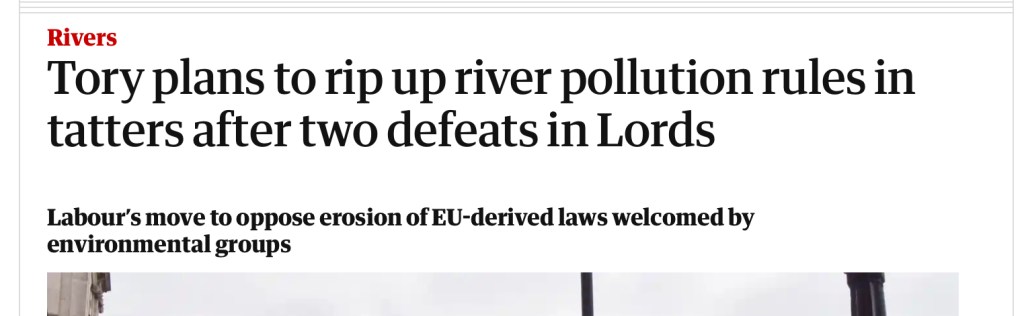
The Guardian, 14 September 2023

 SIMONICITY