No-one embarks lightly on litigation but there have been two striking examples this week of what it can achieve. Sometimes it doesn’t even need a hearing (first example) and sometimes it’s on the final roll of the dice (second example).
Westferry Printworks
The Secretary of State’s decision to grant planning permission, against his inspector’s recommendations, for a large development on Docklands – with the decision issued a day before the developer’s CIL liability would have increased by up to £50m – was an eye opener. I covered it, and Tower Hamlets’ reaction, in my 18 January 2020 blog post Westferry Printworks Decision: LPA Reaction Unprintable.
The Council followed through with its threat of a legal challenge to the decision, as did the Mayor of London.
It was frankly surprising to hear this week that the Secretary of State has consented to judgment. I do not think that the consent order itself, which would set out the reasoning agreed by the parties and sealed by the court, is yet in the public domain but there are these two press statements from those involved:
“The consent order reflects the fact that in pre-action correspondence, the Secretary of State explained that the decision letter was issued on 14 January 2020, rather than the following day, so that it would be issued before Tower Hamlets adopted its new local plan and CIL charging schedule. He accepted that the timing of the decision letter, thereby avoiding a substantial financial liability which would otherwise fall on the developer, would lead the fair minded and informed observer to conclude that there was a real possibility that he was biased in favour of the developer. He accepted that the decision letter was unlawful by reason of apparent bias and should be quashed. The Mayor/GLA’s challenge was therefore academic, but he agreed to pay their costs. “
Those of us not close to what happened can only speculate but why would the Secretary of State cave in rather than face a hearing? Was he worried as to what might be made public in a trawling over of internal correspondence and notes? Echoes of the Mayor’s recent consenting to judgment in the Kensington Forum case (see my 14 March 2020 blog post, London, Friday the 13th).
The appeal will now need to be redetermined and, which is an expensive consequence for the developer of these events, even if the appeal is allowed second time around, the higher CIL figure will be payable.
Dill
I recounted this saga, about a lost pair of urns which were the subject of a listed building enforcement notice, at the time of the Court of Appeal ruling (see my 1 December 2018 blog post Is It A Listed Building? No Statuary Right Of Appeal). I still like the title to the post but the rest of it is now out of date – the effect of the Supreme Court’s ruling in Dill v Secretary of State (Supreme Court, 20 May 2020) was basically to remove the word “no” from my blog post: in defending a listed building enforcement appeal it is now possible to raise the argument that the listed building is not in fact a building (and the court gives some guidance as to what constitutes a “building” for these purposes). See also this excellent summary: Supreme Court rules on the meaning of listed building (39 Essex Chambers, 20 May 2020 – Richard Harwood QC appeared for Mr Dill, instructed by Simon Stanion at Shakespeare Martineau).
Aside from the substantive legal points, which are important, the interesting thing about the case for me is that persistence paid off. The inspector found against him, Singh J at first instance found against him, the Court of Appeal found against him but Mr Dill and his legal team did not give up. The costs of losing would no doubt have been as significant for Mr Dill as the CIL consequences for Tower Hamlets in Westferry.
And whilst the outcome of the case did not remove the spectre for Mr Dill of continued battles – the listed building enforcement notice appeal would now need to redetermined – Lord Carnwath concluded his final judgment before retiring from the Supreme Court with these words:
“I understand that this will be deeply frustrating for Mr Dill. There is as I understand it no suggestion that he acted other than in good faith in disposing of items which he believed to be his own disposable property, and had been so treated by his family for several decades. Since this problem was first drawn to his attention by the local authority in April 2015 he has been attempting to obtain a clear ruling on that issue. On the view I have taken, that opportunity has been wrongly denied to him for five years. Even if his appeal were ultimately to fail, the practicability of restoring the vases to their previous location in the grounds of Idlicote House is uncertain. Accordingly, this court’s formal order for remittal should not prevent the respondents from giving serious consideration to whether in all the circumstances it is fair to Mr Dill or expedient in the public interest to pursue this particular enforcement process any further.”
Concluding thoughts
Well done to the successful claimants and legal teams in both cases. But “snakes and ladders” and “final roll of the dice” analogies are not far off the mark, are they? How to arrive at a system that is more simple and not dependent on expensive, uncertain litigation? Perhaps by reducing the politics (removing the ability for the Secretary of State to recover appeals?), certainly by trying to make sure that legal principles are simpler (if you do the maths, in Dill one inspector and four judges were overruled by five judges, over those narrow “legal exam” questions, following submissions prepared by five barristers and their associated legal teams – the whole process ultimately to be paid for by us, the tax payer, save for those costs which Mr Dill cannot recover).
Validation and determination of applications for planning permission
No changes have been made to the timescales for determining planning applications. Developers are however encouraged to agree extensions of the period for determination. Local authorities have been urged to give priority to validating urgent COVID-19 related applications for planning permission and associated consents.
Publicising applications for planning permission
Temporary regulations (expiring on 31 December 2020) were made and came into force on 14 May to supplement existing publicity arrangements for planning applications, listed building consent applications and environmental statements for EIA development. There is now flexibility to take other reasonable steps to publicise applications and environmental statements if the usual specific requirements cannot be discharged relating to site notices, neighbour notifications, newspaper publicity or availability of hard copy documents. Steps can include the use of social media and electronic communications and they must be “proportionate to the scale and nature of the development”. Guidance has also been issued on this topic.
Planning Conditions
MHCLG has made it clear that planning conditions should not be a barrier to allowing developers and site operators flexibility around construction site working hours to facilitate safe working. Where only short term or modest increases in working hours are required, LPAs are encouraged to use their discretion to not enforce against a breach of working hours conditions. Where longer term measures or other significant changes are required, applications to amend conditions should be made, which LPAs should prioritise and turn around in 10 days. Requests to work up to 9 pm Monday to Saturday should not be refused without very compelling reasons.
Community infrastructure levy
The existing CIL regulations of course allow charging authorities limited flexibility to defer CIL liability. Amendments will be made to the regulations “in due course” to increase flexibility, but that will still depend upon charging authorities deciding to exercise the new discretion available to them. Authorities will be able to defer payments, temporarily disapply late payment interest and provide a discretion to return interest already charged. However, these changes will only apply to small and medium-sized developers with an annual turnover of less than £45 million. It remains to be seen how this limitation will be addressed in the regulations, for example where a special purpose vehicle, potentially offshore, has assumed liability. The new instalment policies for deferred payments will only apply to chargeable development starting after the changes come into effect, but they are anticipated to apply to “phases“ of the development starting after that date. The announcement on 13 May added that “existing flexibilities and the government’s clear intention to legislate should give authorities confidence to use their enforcement powers with discretion and provide some comfort to developers that, where appropriate, they will not be charged extra for matters that were outside of their control.”
Section 106 planning obligations
Local planning authorities are encouraged to consider the deferral of section 106 obligations, e.g. financial payments. This will require variations to existing section agreements and undertakings. Local planning authorities are encouraged generally to take a “pragmatic and proportionate” approach to the enforcement of section 106 planning obligations
PINS issued a further update on 13 May. Site visits are being commenced and PINS is considering whether there are types of cases that can proceed without a site visit. The first digital appeal hearing took place on 11 May as a pilot and PINS is aiming for 20 further examinations, hearings and inquiries in May and June. It is also exploring hybrid options – a mix of in person and by video public/telephone hearings and is considering “social distance” events.
Local Plans
MHCLG is working on ways to address the local plans process in order to meet aspirations to have all local plans in place by 2023. In particular, the use of virtual hearings and written submissions is being considered.
Neighbourhood Plans
Regulation 12 of the Local Government and Police and Crime Commissioner (Coronavirus) (Postponement of Elections and Referendums) (England and Wales) Regulations 2020 prevents any neighbourhood planning referendum from taking place until 6 May 2021. Updated guidance was issued in April allowing neighbourhood plans awaiting referendums to be given significant weight in decision making.
Nationally Significant Infrastructure Projects
The government is working with consenting departments to support the continuation of decision-making to minimise the impact of current restrictions on the consideration of DCO applications and the Planning Inspectorate has updated its guidance.
Compulsory purchase orders
There is now pragmatic advice as to the service of documents. Acquiring authorities are encouraged to allow more time for responses to requests for information about interests in land or submitting objections to CPO. There is also encouragement to authorities to act responsibly regarding business and residential claimants, particularly regarding the timing of vesting orders and payment of compensation, which is particularly relevant when considering evictions. Authorities are reminded of their obligation to make advance payments of compensation in accordance with statutory time limits given cash flow difficulties which claimants may currently face.
Concluding remarks
To my mind, this is all welcome and congratulations are due in particular to the relevant civil servants. Of course, there is more to be resolved, for instance the vexed question of extending time limited planning permissions (see my 4 April 2020 blog post Pause Not Delete: Extending Planning Permissions) as well as the Regulations in relation to CIL, but it is good to see this progress. No wonder MHCLG’s Simon Gallagher was prepared to come on this week’s Have We Got Planning News For You!
“The past exists only in our memories, the future only in our plans. The present is our only reality. The tree that you are aware of intellectually, because of that small time lag, is always in the past and therefore is always unreal. Any intellectually conceived object is always in the past and therefore unreal. Reality is always the moment of vision before the intellectualization takes place. There is no other reality.”
Zen and the Art of Motorcycle Maintenance by Robert M Pirsig is a powerful but infuriating book, part fictionalised roadtrip autobiography, part philosophical discourse. Back when I was prepared to read something I didn’t really understand without first having an engagement letter in place, I absolutely loved it.
The book has become an unlikely cultural icon.
As has the green belt, which might have been treated in the book something like this:
What is the green belt and why do people write it as “the Green Belt”? He explained that the green belt is not singular but plural; it was originally described as a girdle rather than a belt, and is better described as a series of urban containment zones. Much of the land within the green belt is not green; much greenfield land (which can include land which is brown but not brownfield) is not within the green belt, and beyond the green belt was originally white land, which was of course never white. To pronounce land to be green belt is so powerful that many people sense that to refer to it as green belt rather than Green Belt is somehow inadequate or disrespectful, notwithstanding usual grammatical rules (a phenomenon which we also experience with references to Inspectors and Inquiries, and, oddly, Counsel).
How do I find the green belt? He sighed. One cannot find it by looking. Its defining features are present by their absence. Instead its existence can only be determined by opening up the relevant development plan, or rather, because the plan is not a plan, the policies map which is not part of the plan (and indeed the green belt around York is defined by an abolished plan which has no map with defined boundaries). Its quality of openness indeed has been determined by the Supreme Court [proper noun] as a quality which can not necessarily be seen.
He sighed again. Green belt was the yin and new towns were to be the yang.
A local planning authority may only make changes to a green belt boundary if there are “exceptional circumstances” and may only grant planning permission for inappropriate development in the green belt if there are “very special circumstances”. The qualifying adjectives are uncalibrated, so the courts have had to make the best of it (my 27 January 2018 blog post Expletive Deleted: Revising Policy was all about these sorts of linguistic problems). We have of course the Calverton ruling on “exceptional circumstances” and Dove J’s more recent ruling in the Guildford local plan case (covered in episode 6 of Heather Sargent’s planning law video podcast series Planning Law Tea Break and in Zack Simons’ #planoraks blog post Guildford’s Local Plan and “exceptional circumstances” (29 March 2020)).
As Dove J made clear in the Guildford case,
“Exceptional circumstances” is a less demanding test than the development control test for permitting inappropriate development in the Green Belt, which requires “very special circumstances.”
He can only derive this from the policy context though, not the words. Is something exceptional less rare or valuable than something which is very special? My policy test calibrator, part-constructed in the garage, would have a dial to 10. Overcoming a normal presumption is anything over 5. Exceptional is, what, about 7, maybe 8, depending on circumstances? Where do you place very special? 8.5 or 9? Of course this is largely nonsense but people trot out the tests, and understandably ask, as if there is an actual answer.
More basically why don’t we have a formulation such as “wholly exceptional circumstances” rather than “very special circumstances”? After all, we do when it comes to heritage (see the contrast between NPPF paras 194(a) and (b)). Well only because the original 1955 ministerial Circular used the term “very special circumstances”:
“Inside a green belt, approval should not be given, except in very special circumstances, for the construction of new buildings or for the change of use of existing buildings for purposes other than agriculture, sport, cemeteries, institutions standing in extensive grounds, or other uses appropriate to a rural area”.
Slightly embellished (particularly in relation to limited infilling and the redevelopment of previously developed land), this language is still recognisable in NPPF para 145.
There is a second level of uncertainty with the use of these tests: not only is the linguistic calibration imprecise, but it is for the decision maker to determine, with adequate reasoning (which may be very basic and not really susceptible to challenge), whether the circumstances are sufficiently “exceptional” or “special”.
Of course the reality is that the fuzziness is deliberate. It allows decision makers, whether the Government or local planning authorities, some necessary wriggle room.
Some recent decisions on “very special circumstances”:
North of Boroughbridge Road, York – inspector’s decision letter 23 October 2019
In finding “very special circumstances” the inspector appears to have relied upon the fact that the site did not fulfil any of the green belt “purposes”, was identified for release for housing in the emerging local plan and that the site would deliver 266 market and affordable homes. The housing land supply in York is well under 5 years (although of course the tilted balance does not apply in relation to green belt proposals).
Since former planning minister Brandon Lewis’s 17 January 2014 ministerial statement we have been wary about relying solely on housing need:
“I also noted the Secretary of State’s policy position that unmet need, […] for conventional housing, is unlikely to outweigh harm to the green belt and other harm to constitute the “very special circumstances” justifying inappropriate development in the green belt.”
The statement has not formally been revoked, so, back to that deliberate fuzziness, here “unlikely” is still the get out word in that it allows for exceptions (where is “unlikely” on the policy test calibrator?), or identifying something other than solely housing need to throw into the scales to assist the “very special circumstances” argument.
Seashell Trust – Stanley Road, Cheadle Hume, Stockport – Secretary of State’s decision letter 22 April 2020
“The Secretary of State considers the need for the redevelopment of the Special Educational Need school carries substantial weight, the housing benefits overall carry very significant weight, and the provision of employment and community benefits each carry moderate weight.
The Secretary of State considers that the above benefits clearly outweigh the harm to the Green Belt by reason of inappropriateness and any other harm, and so very special circumstances exist to justify this development in the Green Belt.”
Oxford Brookes University – Wheatley Campus, College Close, Wheatley, Oxford – Secretary of State’s decision letter 23 April 2020
“The Secretary of State considers that the significant visual benefit to openness over a wide area of the South Oxfordshire Green Belt [by removal of a tower and other large, unsightly structures on the site] and the delivery of up to 500 houses, 173 of which would be affordable, are both considerations that carry very substantial weight.”
West Midlands Rail Freight Interchange DCO – Secretary of State’s decision letter 4 May 2020
“67. The Secretary of State agrees with the Examining Authority that the strategic benefits of the Proposed Development in contributing to an expanded network of SRFIs would assist in achieving and promoting a modal shift of freight from road to rail, thereby playing an important part in the move to a low carbon economy. These benefits are such that they outweigh the adverse impacts identified in relation to the construction and operation of the Proposed Development (ER 9.3.1).
68. The Secretary of State notes and agrees with the Examining Authority that the national and regional need for the proposed development outweighs any harm. He therefore agrees with the Examining Authority that the very special circumstances needed to justify a grant of development consent have been demonstrated (ER 9.2.4).”
Recommended further media:
⁃ My 30 March 2018 blog post Green Belt Developments (although this was before the Supreme Court overturned the Court of Appeal in the Samuel Smith “openness” case)
⁃ (As always) John Grindrod’s book Outskirts. (Now, Mr Pirsig, that’s how you write a part autobiography, part treatise on the history of the green belt, life and everything.)
As the motivational cliche goes, there is no I in team. That’s as maybe. But, where I = Inquiry, nor is there yet any I on Teams (or on Zoom, on Skype, on BlueJeans, or even on Google Hangouts).
“We are continuing to issue decisions where we can and 1,625 have been issued across all case types since lockdown restrictions started. Not being able to visit sites and hold public events has, however, clearly had an impact on our ability to process cases and the time it is taking to reach a decision.
As explained in our guidance, to limit the spread of the Coronavirus we have postponed site visits up to the middle of May, as well as most hearing and inquiry physical events where these would otherwise have taken place in May. Our case officers have notified parties of event postponement until further notice. We will be issuing updated information on arrangements for postponed events as soon as practicable in line with latest government advice.
We have been able to progress cases where:
• the physical event was concluded prior to lockdown restrictions;
• no physical event is required to make a decision; or
• a physical event is still further in the future and preparatory activity can continue (e.g. via telephone case conferences).
New cases continue to arrive at normal levels and are being registered and processed as far as possible. As at 23 April, there were 9,591 open cases. In the last three weeks we have seen the number of open cases rise by 337.”
(It is encouraging, in passing, to note that appeals are still being made at normal levels – that is our experience too).
The Planning Inspectorate is anxious to reassure that it is moving quickly to catch up:
• “The first fully ‘digital’ hearing is due to take place on 11 May.
• We are preparing for additional cases to be heard by digital hearings/inquiries in May/early June with a view to scaling up digital events further over June/July.
• We are assessing postponed cases to establish whether they can proceed by digital, traditional or a ‘hybrid’ approach, in order to re-arrange these in due course accordingly.
• A trial of ‘virtual site visits’ is underway involving thirteen Inspectors.
• Five local advisory visits have taken place remotely (critical for helping Local Planning Authorities to progress local plans and reduce the length of examinations).”
But is this fast enough? Can more be done? Could we see a leap forward in the way that planning hearings and inquiries are conducted?
After all, the planning inquiry process has been constantly adapting. Planning inquiries were first introduced in the Housing, Town Planning etc Act 1909 to consider objections to town planning schemes. The right to appeal against a planning decision was introduced in the 1932 Act, and the 1947 Act provided that all appeals were to be determined by public inquiry. Weirdly to us now, the procedures followed and the reasoning for decisions was kept secret until changes were made to implement some of the recommendations of the 1957 Franks Committee on Administrative Justice. We still refer to the three Franks Principles, of openness, fairness and impartiality.
This is what was said by the minister of the time in a 1957 Commons debate on the report:
“I must, however, return to a point I made in the opening of my remarks, that we must not complicate the procedures more than we can help. The great majority of objectors and appellants are small people. Quite a few present their own cases without professional assistance and for most people it is essential that the procedure should be simple, intelligible, quick, and cheap, as well as fair.”
Dear reader, of course we did then complicate those procedures, often through changes made with the best of intentions. When I started practice, there was no advance exchange of proofs of evidence. We all read the documents for the first time as they were being read out by the witness. No rebuttal proofs, no laboriously prepared cross-examinations or written closing submissions. Every procedural step that has been introduced, introducing frontloading of appeal preparation and evidence (good), minimising surprises (good), has by a sidewind elongated and complicated the processes (bad). There may now be a much more forensic and detailed examination of the issues, but where have we left those “small people”?
The Planning Bar is obviously at the sharp end of the current slowdown and has been trying to move things along.
It is of course hugely frustrating that the massive improvements to the inquiry appeals system brought about by the Rosewell review (see eg my 25 May 2019 blog post Pace Making: Progress At PINS) have been undone by this pandemic. The Rosewell changes, unlike possibly every previous reform of any aspect of the planning system, did not add complications, but modernised and streamlined it in many ways, with telephone case management conferences and the like now the norm. I assume that everyone saw the interview with Bridget Rosewell on last week’s second episode of Have We Got Planning News For You? Her frustration with the Inspectorate’s present apparent slowness to get virtual hearings and inquiries underway was apparent, talking about the need to “move forward as soon as possible” and extolling the “fairer access” that can be achieved in a “virtual environment”.
We should listen to Bridget.
(Indeed, to go off on a tangent, if I were Secretary of State for the day, I would presently quietly shelve “Planning For The Future” and instead ask Bridget, very nicely, to carry out “Rosewell 2”, this time a review, with similar practical focus, in relation to the planning application process, so as to identify opportunities for simplification and reduction of unnecessary paperwork. Step by step there are surely simple opportunities for improvement. Off the top of my head:
– Recommended word limits for supporting documents such as Planning Statements, Design and Access Statements and Environmental Statements (or application fee linked to size of the documentation)
– Removal of need for multiple hard copies of documents
– Modernisation of publicity requirements
– Recommended word limits for officers’ reports to committee
– Standardisation of wording of planning conditions
– Updated model section 106 agreement template (the Law Society’s current so-called template draft agreement dates from 2010!)
– Updated advice as to the types of application which properly should be dealt with by way of officers’ delegated powers
Do it!)
But of course, moving to virtual appeals, even on a temporary basis, is not easy. The interests of all participants, and potential participants, in the appeals process need to be taken into account. Whilst justice delayed is justice denied, justice has to be both done and be seen to be done.
I was struck by an assertion in the Landmark Chambers paper:
“ It is safe to proceed on the basis of a presumption that every participant in a planning appeal will have reasonable access to a means of participating in a remote hearing session unless they provide evidence to the contrary. Virtually every household has a telephone, and the vast majority of people have access to a computer or mobile device on which video conferencing is possible.”
This isn’t still true for a few members of my own family (well they all have a land line – but certainly couldn’t be expected to follow proceedings on a telephone). And indeed whilst the chattering classes are currently going on about Zoom and the rest of it, I know that many are finding it very difficult to access or be at ease on these platforms, surrounded by us lawyers and others who inevitably spend much of every day now speaking with a variety of people on screen and unwittingly developing new social norms and cues.
Any procedural solution does needs to meet the three principles set out in the paper:
– The common law requirements of fairness;
⁃ Article 6(1) ECHR – the right to a fair trial in civil cases;
⁃ Article 6 of the Aarhus Convention (“public participation in decisions on specific activities”).
But decisions as to procedure also need to have regard to “protected characteristics” under the Equality Act 2010, which of course include age and disability. Bridget is right that virtual hearings and inquiries would allow many to engage with the process who currently cannot, which is great as long as there are protections to make sure that some are not excluded.
In my view this is perfectly achievable for the majority of hearings and inquiries. I accept that (1) the inquiry process is very different from the court process and we cannot simply “read across” and (2) even in relation to the court process, there were some words of warning this week from the Court of Appeal in a family law case, Re A (Children) (Court of Appeal, 30 April 2020) – see paragraphs 49 to 56. However, let’s analyse the real position:
The only parties entitled to appear at a hearing are the appellant, the local planning authority and defined statutory parties. Everyone else is at the discretion of the inspector. As long as the inspector is confident that there is no third party, from whom the inspector feels he or she should hear, and who cannot participate adequately by some remote means, why should not virtual hearings proceed, as long as the proceedings are able to be viewed remotely (perhaps also with a transcript of what is said – not difficult at all – where there is any doubt as to whether there may be interested parties without adequate screen access)?
At inquiries, the parties only entitled to appear are the appellant, local planning authority, defined statutory parties and those who have (at their own request) become rule 6 parties. Again, if all of those parties are in agreement (with possible adverse costs award consequences for those who unreasonably refuse) and as long as the same approach can be taken in relation to other parties, why cannot inquiries proceed?
Site visits are less of a problem, whether accompanied or unaccompanied, and whether in fact still always needed, in the light of visual material now available.
Furthermore, as long as there are indeed adequate protections for those who should be heard at the hearing and genuinely cannot reasonably be expected to participate remotely, the change to a virtual process has the benefit of opening up access to so many other people. And imagine the benefits in future of being able to offer a “virtual” evening session at the next inquiry at your local town hall? That surely would be participative democracy.
Which is a long way of saying: I agree with Bridget.
Five out of five proposals for housing development have been approved by the Secretary of State so far in April 2020, in each instance in accordance with his inspectors’ recommendations.
Chronologically:
1 April – Vauxhall Cross Island, Lambeth
The Secretary of State approved a called in application for “the construction of a mixed-use development comprising two towers of 53 storeys (185m) and 42 storeys (151m), with a connecting podium of 10 storeys (49m), containing office (B1), hotel (C1), residential (C3) and flexible ground floor retail and non-residential institution (A1/A2/A3/A4/D1) uses plus plant, servicing, parking and other ancillary space, the provision of hard and soft landscaping, the creation of a new vehicular access point on Wandsworth Road, a vehicular layby on Parry Street and other works incidental to the development”.
“The proposal would deliver 257 homes onsite, including 23 affordable, alongside a Section 106 payment of £30m for further off-site affordable housing provision. The Secretary of State notes that, citing LB Lambeth’s past record of utilising such payments, the Inspector was satisfied this would deliver a further 54 homes and provide a total of 30% affordable… The Secretary of State notes that a viability assessment demonstrated that this was the maximum amount achievable, and was accepted by LB Lambeth.”
The Secretary of State found that the proposals would be in accordance with the development plan. The market and affordable housing components of the scheme attracted “significant weight in favour. There would also be hotel, office and retail uses in an area identified for all three, alongside a new public square. All of these would contribute to the development plan’s goal of creating a new district centre in Vauxhall. This also attracts substantial weight in favour.”
(Town acted for the applicant).
1 April – Station Road, Long Melford, Suffolk
The Secretary of State allowed an appeal by Gladman Developments Limited for “outline planning permission for the erection of up to 150 dwellings with public open space, landscaping and sustainable drainage system (SuDS), and vehicular access point from Station Road, with all matters reserved except means of access”.
The Secretary of State found that the proposals were not in accordance with the development plan. In terms of other material considerations:
“The site is outside the settlement boundary, and would result in the development of a greenfield site into housing, which would cause visual harm. However, the settlement boundary is out of date, and the visual harm would be confined to the site itself, with limited impact on the wider settlement. This carries moderate weight against the proposal.
The proposal would provide up to 150 new homes, including around 53 affordable homes. Although the local authority can now demonstrate a supply of housing land above 5 years, this figure is a baseline and not a ceiling. Relevant to this appeal, the appellant has demonstrated there is a local need in this settlement, in line with the expectations of the development plan, for both market and affordable housing. The Secretary of State recognises that there is now a five-year supply of housing land supply. However, in the light of the identified local need, and the Government’s objective of significantly boosting the supply of homes (Framework paragraph 59), he considers that the housing delivery should carry significant weight. The proposal would provide land for a new early years centre, which attracts significant weight in favour. There would be economic benefits provided by the construction of the homes and from the new residents, which attract moderate weight. Improvements to existing public rights of way, public space and play areas, and biodiversity benefits each attract moderate weight in favour. Improvements to bus stops and footway connections attract limited weight in favour.”
7 April – Barbrook Lane, Tiptree, Colchester
The Secretary of State allowed an appeal by Gladman Developments Limited (again) for “outline planning permission for the development of up to 200 dwellings (including 30% affordable housing), provision of 0.6ha of land safeguarded for school expansion, new car parking facility, introduction of structural planting and landscaping and sustainable drainage system (SuDS), informal public open space, children’s play area, demolition of 97 Barbrook Lane to form vehicular access from Barbrook Lane, with all matters to be reserved except for access”.
The Secretary of State found that the proposals were not in accordance with the development plan. In terms of other material considerations:
“As the local authority are unable to demonstrate a five-year supply of housing land, paragraph 11(d) of the Framework indicates that planning permission should be granted unless: (i) the application of policies in the Framework that protect areas or assets of particular importance provides a clear reason for refusing the development proposed; or (ii) any adverse impacts of doing so significantly and demonstrably outweigh the benefits, when assessed against policies in the Framework taken as a whole.
The proposal is an undeveloped agricultural site outside the settlement boundary, and the rural character of the site would change. This carries moderate weight against the proposal.
The proposal would provide up to 200 dwellings, with 30% affordable, helping the local planning authority achieve a five-year supply of housing land. This attracts significant weight in favour of the proposal. The proposal includes informal open space and safeguarded land for a school expansion, which carry limited weight. Although the site would change from rural to a housing estate, there would be little wider impact on the setting of the village as the site is well-screened. The scale of the proposal would not harm or prejudice local services, highways or residential amenity, and the site represents a sustainable location for access to jobs and services.
The Secretary of State considers that there are no protective policies which provide a clear reason for refusing the development proposed. The Secretary of State considers that the adverse impacts of the proposal do not significantly and demonstrably outweigh the benefits.”
22 April – Stanley Road, Cheadle Hume, Stockport
The Secretary of State allowed an appeal by the Seashell Trust “for the erection of a new school with associated kitchen and dining facilities, swimming and hydrotherapy facilities, infrastructure, drop-off parking, access, landscaping and ancillary works; the demolition of the Chadderton building, Orchard/Wainwright/Hydrotherapy/Care block, Dockray building, part of existing college, 1 Scout Hut and 1 garage block, and erection of new campus facilities (Use Class D1/D2 – Reception, Family Assessment Units, Family Support Services/Administration/Training/Storage Facility Sports Hall and Pavilion) with associated infrastructure, parking, landscaping and ancillary works; and up to 325 dwellings (Use Class C3) in northern fields with associated infrastructure, parking, access, landscaping and ancillary works”.
The site is in the green belt and the Secretary of State found that the proposals were not in accordance with the development plan. However, these were his overall conclusions:
“As Stockport Borough Council cannot demonstrate a five year housing land supply, paragraph 11(d) of the Framework indicates that planning permission should be granted unless: (i) the application of policies in the Framework that protect areas or assets of particular importance provides a clear reason for refusing the development proposed; or (ii) any adverse impacts of doing so significantly and demonstrably outweigh the benefits, when assessed against policies in the Framework taken as a whole.
The Secretary of State considers that the harm to the Green Belt carries substantial weight, the ‘less than substantial’ harm to the setting of the listed building carries great weight and harm to the landscape carries moderate weight. The Secretary of State considers the proposal will harm agricultural land, habitat, non-designated heritage assets and demand for mainstream school places and attributes very limited weight to each of these harms.
The Secretary of State considers the need for the redevelopment of the Special Educational Need school carries substantial weight, the housing benefits overall carry very significant weight, and the provision of employment and community benefits each carry moderate weight.
The Secretary of State considers that the above benefits clearly outweigh the harm to the Green Belt by reason of inappropriateness and any other harm, and so very special circumstances exist to justify this development in the Green Belt. In the light of his conclusion on this and the heritage test is paragraph 18 above, the Secretary of State considers that there are no protective policies which provide a clear reason for refusing the development proposed and further considers that the adverse impacts do not significantly and demonstrably outweigh the benefits, when assessed against the policies in the Framework taken as a whole. Paragraph 11(d) of the Framework therefore indicates that planning permission should be granted.”
Paul Tucker QC led the case for the appellant and this is a statement on the decision published by Kings Chambers.
23 April – Wheatley Campus, College Close, Wheatley, Oxford
The Secretary of State allowed an appeal by Oxford Brookes University for outline planning permission for “demolition of all existing structures and redevelopment of the site with up to 500 dwellings and associated works including; engineering operations, including site clearance, remediation, remodelling and deposition of inert fill material arising from demolition on site; installation of new and modification of existing services and utilities; construction of foul and surface water drainage systems, including SuDS; creation of noise mitigation bund and fencing; creation of public open space, leisure, sport and recreation facilities including equipped play areas; ecological mitigation works; construction of a building for community/sport use and associated car parking; construction of internal estate roads, private drives and other highways infrastructure and construction of pedestrian footpaths”.
Again this is a green belt site. Whilst the Secretary of State agreed with the inspector that the appeal should be allowed, he differed as to his reasoning. I set out the Secretary of Statement’s application of the planning balance and overall conclusions as follows:
“For the reasons given above, the Secretary of State considers that the appeal scheme is in accordance with the following policies of the development plan: CS Policy CSEN2, LP Policy GB4. He has identified an overall benefit to heritage assets, so has found no conflict with heritage policies CSEN3, CON5 and CON11. He has found no conflict with CS Policy CSEN1 or LP Policies G2, C4 and C9 insofar as they seek to protect the district’s countryside and settlements from adverse development. While he has found conflict with policies CSS1 and CSH1 regarding the amount and spatial distribution of housing, he has found these policies to be out of date. He has therefore concluded that the appeal scheme is in accordance with the development plan overall. He has gone on to consider whether there are material considerations which indicate that the proposal should be determined other than in accordance with the development plan.
At IR13.118, the Inspector, having concluded that the proposed development would not conflict with the development plan, states that it should be approved without delay in accordance with paragraph 11c) of the Framework. The Secretary of State disagrees. Paragraph 11 c) of the Framework refers to “development proposals that accord with an up-to-date development plan”. As the Secretary of State has concluded that the policies which are most important for determining this appeal are out-of-date, he considers that paragraph 11 c) of the Framework does not apply.
Paragraph 11(d) of the Framework indicates that planning permission should be granted unless: (i) the application of policies in the Framework that protect areas or assets of particular importance provides a clear reason for refusing the development proposed; or (ii) any adverse impacts of doing so significantly and demonstrably outweigh the benefits, when assessed against policies in the Framework taken as a whole.
The Secretary of State considers the harm to the Green Belt on that part of the site where development is considered inappropriate carries substantial weight.
The Secretary of State considers that the significant visual benefit to openness over a wide area of the South Oxfordshire Green Belt and the delivery of up to 500 houses, 173 of which would be affordable, are both considerations that carry very substantial weight.
The Secretary of State considers that the economic benefits of the scheme should be afforded significant weight.
The Secretary of State has considered the development in terms of its impact on heritage assets and on accessibility and considers that both offer benefits that should be afforded significant weight.
The net benefit to biodiversity that would be delivered by the scheme is a consideration of moderate weight, and the reinvestment of the proceeds arising from the sale of the land into the education sector should be afforded significant weight.
Given his findings in this letter, the Secretary of State considers that the proposal meets the emerging Neighbourhood Plan site-specific development principles in respect of Green Belt, affordable housing and accessibility, and public open space.
Having concluded at paragraph 39 of this letter that very special circumstances exist the Secretary of State considers that there are no policies in the Framework that protect areas or assets of particular importance that provide a clear reason for refusing the development proposed. He also concludes that any adverse impacts of granting permission do not significantly and demonstrably outweigh the benefits, when assessed against policies in the Framework taken as a whole.”
Chris Young QC led the case for the appellant and this is a statement on the decision published by No 5 Chambers.
Quite a month so far!
Two quick plugs:
⁃ If on Thursday you watched the first Planning In Brief web event hosted by Charlie Banner QC, Chris Young QC, Sasha White QC, Paul Tucker QC and Town’s Mary Cook you would have heard some discussion about the Seashell Trust decision. I wouldn’t be surprised to hear some coverage of the Oxford Brookes decision this coming week. Another reason to make the charity donation and tune in.
⁃ Do subscribe to Town Legal’s weekly, comprehensive, inquiry appeal decisions updates. Subscriptions to this and our other update services are still free.
The Clap for Our Carers phenomenon reflects heartfelt gratitude for what is currently being done, for all of us, by NHS staff, carers and others carrying out essential services. But clapping is glib. Many of us no doubt feel uneasy. After all many or most of those to whom we owe so much:
⁃ are in jobs in the public sector, or are employed by companies contracted to the public sector, and have seen particular and significant pressure on their incomes for many years;
⁃ are doing those jobs in the absence of adequate facilities and equipment, due to longstanding restrictions on public spending, lack of investment at necessary levels and/or a lack of organisational foresight;
⁃ are not UK nationals and have had to suffer an increasingly hostile environment, catalysed by Brexit;
⁃ due to the loss over time of traditional indentured accommodation and massive house price inflation, particularly in London, have found themselves unable to live in decent accommodation convenient to their work, despite often needing to work at unsocial times or being “on call”.
Plainly there will be a reckoning on many fronts when this immediate crisis is over but will one consequence be a fresh focus on the role of key worker affordable housing?
The NPPF affordable housing definition includes housing for “essential local workers” but, whilst many individual local authorities and registered providers may still prioritise some applications from local key workers, variously defined, there has been no central Government encouragement, let alone funding, for key worker accommodation for many years.
In fact the background to the demise of any focus on accommodation for key workers is well described in a November 2019 presciently topical Policy Exchange paper, Revitalising Key Worker Housing by Jack Airey (now of course a No 10 policy advisor) and Sir Robin Wales (previously leader, and then mayor, of Newham Council).
Back in 2000, the Blair Government launched the Starter Home Initiative, which aimed to provide low cost home ownership for key workers, primarily nurses, teachers and police officers.
The then housing minister Tony McNulty, responded to a question in the Commons as to what progress had been made on providing key workers with affordable housing in central London:
“The Government recognise the importance of affordable housing for key workers in London in maintaining balanced and successful communities.
£146 million of the £250 million Starter Homes Initiative has been allocated to London schemes and will help around 4,600 key workers to realise their aspirations of home ownership. We hope that the initiative will act as a catalyst, and encourage other innovative approaches to housing key workers.
The NHS in London is providing 2,000 units of affordable rental accommodation for health staff in the three years up to June 2003.”
However, as summarised in this 2004 Guardian article:
“Uptake was slow and the help available often failed to keep pace with rapidly rising property prices. As it was confined to just nurses, teachers and police officers, it was also criticised as too narrowly focused.
In March 2004, the government devoted more resources to the problem and replaced the SHI with a £690m programme called Key Worker Living (KWL). Under the new scheme, eligibility for assistance was broadened to include social workers, fire-fighters, and prison and probation service staff.
The type of housing assistance offered under KWL was also expanded to include ‘intermediate’ rented housing – priced at levels above those of traditional social housing, but still below market rates.”
As described by Shelter, four products were available to key workers under KWL
⁃ equity (“Homebuy”) loans of up to £50,000 to buy a home;
⁃ higher-value equity loans up to £100,000 for a small group of London school teachers with the potential to become leaders in their field;
⁃ shared-ownership of newly built properties; and
⁃ intermediate renting at subsidised levels
Until April 2008, KWL leases contained a clawback provision where the beneficiary ceased to be a key worker.
In the affordable housing reforms, and grant cut backs, following the global financial crisis and the 2010 general election, there was no longer any specific key worker housing “pathway” promoted or funded by Government. The focus has instead been on “affordability” judged by reference to rental/income levels and without reference to the applicant’s occupation. Responsibility for affordable housing in London transferred to the Mayor in April 2012 and since his election in 2016 Sadiq Khan has pursued a specific approach, driven by the obvious concern that the Government’s definition of “affordable rent”, based on discount to market value, does not necessarily enable local housing needs in London properly to be met. On London’s Dave Hill has written a good explainer, What are London ‘affordable’ homes and who can afford them? (17th December 2018), subtitled “An attempt to explain the almost unexplainable”.
The specific challenges faced in London have been covered well in papers such as these:
Back in December 2019 the Mayor promised a consultation in intermediate housing during the course of 2020 “which will seek views on a range of issues, including how we can ensure that key workers benefit from intermediate housing in the capital”.
From a national perspective, we did see reference to key workers in the Government’s February 2020 consultation document on its proposed First Homes programme, “prioritised for first-time buyers, serving members and veterans of the Armed Forces, and key workers, such as nurses, police and teachers” (see my 29 February 2019) blog post (perhaps the Policy Exchange influence there, in the light of its December 2019 report?), but what is the Government’s stance more generally as to whether key workers should be given priority in relation to particular forms of affordable housing?
And indeed (the point at which the nice ideas start to stall), how do you even define “key workers”? The “essential workers” definition may be appropriate for the purposes of the current Covid-19 crisis but would not necessarily be appropriate in the longer term – it is in some instances potentially too narrow and in other respects too wide.
The difficulty is possibly rooted in an uncomfortable fundamental truth. In a functioning market-based economy, who isn’t a key worker? The problem is rather that there are many people, some skilled some unskilled, carrying out relatively poorly paid roles, without which society certainly couldn’t function, and who cannot secure adequate, suitable and convenient accommodation due to the disparity between what they earn and the cost of renting or owning property.
The “correct” longer term solution is plainly a twofold one of significantly raising those earning levels (which is not going to be easy as presumably we enter another economically challenging period) and of reducing, or at least stabilising, property costs (also not easy, given lack of supply). We will only ever paper over part of the problem of inadequate salary levels by requiring developers to subsidise the affordability gap.
But in an imperfect world of course we do need an “incorrect” shorter term solution, which surely must be to ensure that those in defined categories of occupation are now given proper priority when it comes to affordable housing tenures of all kinds, and that developers who are prepared to make a meaningful commitment in that respect (particularly if supported by employers of key workers) are not faced with an overly restrictive application of local affordable housing policies until such time as those policies catch up.
Our carers (widely defined) certainly deserve a lot more than a badge at the end of this.
Simon Ricketts, 18 April 2020
Personal views, et cetera
NB Thank you to my Town colleague Lida Nguyen for some background research.
Miles Gibson rightly spotted, in his good CBRE piece Community Infrastructure Levy – ten years old, but COVID-19 is its biggest test (7 April 2020), that the Community Infrastructure Levy Regulations came into force just over ten years ago, on 6 April 2010. (And who better to point it out, given that until 2011 Miles led on CIL at the Department of Communities and Local Government?).
Of course, after the regulations were brought into force, there was then a pause caused by the 6 May 2010 general election. Would the incoming coalition government scrap, or at least amend and rebadge, the system? In the end the system survived and, according to wikipedia at least, the London Borough of Redbridge was the first to adopt a CIL charging schedule, on 1 January 2012.
So CIL didn’t live through the global financial crisis, or previous recessions, as we have done. I have written before about the inherent inflexibility of the mechanism but, as Miles acknowledges in his piece, the current economic conditions are going to prove the big test for the levy.
He says “CIL’s inflexibility could prove its downfall if the forthcoming downturn is anything other than a short sharp shock. COVID-19 has created the biggest test which CIL has yet faced. If the downturn is lengthy, local authorities may need to hurriedly cut CIL rates to help return development to viability. Or, press the pause button on introducing CIL altogether.”
This may all be so, but there are also other, more nuanced steps which charging authorities could also be taking, with the encouragement of MHCLG, one would hope. For instance:
⁃ The switching on, within charging authorities, of the ability to apply for exceptional circumstances relief – and if there isn’t sufficient movement on this I would argue for its automatic national application by way of a change to the regulations. Whilst ECR is a cumbersome process, and there are state aid considerations to be borne in mind, if these aren’t “exceptional circumstances” what are? And I suspect that the application of ECR will be more palatable than the reintroduction of section 106BA, which enabled developers to reduce or remove section 106 affordable housing obligations on the grounds of viability.
⁃ The introduction of instalment schemes for payment (currently discretionary) and the review of existing instalment schemes to push back timescales.
“Where development has already commenced, CIL demand notices will shortly be re-issued to allow for a 3 month extension to the next instalment due date and to subsequent outstanding instalments. This position will be reviewed towards the end of June and any further extension to instalment payment periods will be communicated. It will take time for notices to be prepared and issued, but this work will be prioritised.
An individual, case by case review of late payment interest and surcharges will be made and a pragmatic approach adopted to support customers in these circumstances.
CIL debt recovery will largely be paused for 3 months and will be reviewed towards the end of June 2020 with a view to extending this position if required.”
Are there any examples of other charging authorities taking an equivalent stance? Clearly there are risks in such an approach and I would be cautious as to the extent that, for example, a funder with millions of pounds at stake, could rely on such a commitment. It is unfortunate that the Regulations are so inflexible as to lead to such sticking-plaster solutions.
Stepping back, unless authorities are now going to move very quickly to propose reduced charging rates and take positive steps in relation to instalment policies and ECR, wouldn’t a solution in current circumstances be for the Government to legislate so as to allow authorities, both in relation to existing permissions and permissions which have not yet been issued, either to (1) defer payment of CIL for a defined period or (2) allow an emergency discount of say 50% to be applied, conditional upon development being commenced within a defined period of time and then completed within a defined period (the period to be agreed with the authority having regard to its projected build programme and if the deadline is missed there would be clawback)? To reduce the extent that the authority is as a consequence unable to deliver essential infrastructure, the Government would need to make additional funding available, because after all the economic and social benefits of ensuring that development gets started again will be immense.
I don’t have the answers – I would welcome your much better ones (except “abolish CIL” – let’s be practical). However, I do know that (1) CIL is a massive, inflexible, cash drain for any development early in its implementation and (2) some additional flexibility would surely reduce the risk that many development projects will remain on hold even once normal life starts to return around us all.
This post focuses on another specific, urgent, issue. I assume that there is a large measure of consensus that deadlines for commencement of development under planning permissions (and equivalent deadlines other related consents) should be “on pause” for at least the duration of this present lockdown and its eventual gradual unwinding. Otherwise either applicants are going to need to embark on expensive lengthy and time-consuming (for everyone) applications for a fresh planning permission in due course (with a further hiatus on any construction in the meantime) or contractors are going to be out there doing unnecessary implementation works just to keep the existing planning permission alive.
(Some of you at this point will take the opportunity to have a swipe at applicants who have left it until near the deadline before implementing a permission or before submitting applications reserved matters approval, but these are old arguments which I have addressed before).
The current law
My 16 July blog post Unpacking UseItOrLoseIt considered the law on time limited planning permissions and the amendment that was made to section 73 by way of the Planning and Compulsory Purchase Act 2004 so as to prevent section 73 being used to extend the life of planning permissions.
In the wake of the 2008 global financial crisis, a procedure was allowed for, by way of the Town and Country Planning (General Development Procedure) (Amendment No. 3) (England) Order 2009, which sidestepped section 73 and provided for a simplified procedure for grant of a “replacement planning permission” for planning applications made for a planning permission to replace an extant permission, granted on or before 1st October 2009, for development which has not yet begun, with a new planning permission subject to a new time limit. For such applications, the requirement to provide a design and access statement was disapplied, consultation requirements were modified and plans and drawings did not have to be provided. Guidance was provided in the Government’s Greater Flexibility for Planning Permissions document.
As explained in the explanatory memorandum to the subsequent Development Management Procedure Order 2010:
“7.6 In 2009, the Department became aware of a reduction in the implementation rate of major schemes that already have planning permission. If large numbers of permissions are not implemented and subsequently lapse, this could delay economic recovery. Developers would have to make new planning applications for those schemes, which could lead to delay and additional costs. Furthermore, local planning authorities could find themselves dealing with a sudden upsurge in applications as the economy moves out of recession.
7.7 Following calls from the Local Government Association, the Confederation of British Industry and the British Property Federation, SI 2009/2261 amended the GDPO to introduce a new power to allow the time limits for implementation of existing planning permissions to be extended. The amendment enabled existing planning permissions to be replaced before expiring, in order to allow a longer period for implementation (although the previous planning permission is not revoked, rather a new permission granted subject to a new time limit). For this new kind of application, the requirement for design and access statements was removed, and the requirements for consultation were modified. SI 2009/2262 made associated amendments to the Listed Buildings Regulations to allow the provisions to apply to linked applications for listed building and conservation area consents.”
The procedure was extended for a final year in 2012 (the impact assessment is interesting to look back to and compare with current circumstances).
The legislative options
It seems to me that there are two basic approaches which might be taken:
The “automatic” extension option
The Government could look to achieve an automatic extension, for a defined period in relation to all planning permissions – in relation to the deadline for implementation and possibly also any deadline for submission of reserved matters applications in relation to outline planning permissions – with the extension potentially only available where the deadline is going to expire within a defined period of time.
Surely, such a change would require primary legislation, to amend the operation of sections 91 and 92 of the Town and Country Planning Act 1990. The Coronavirus Act would have been a useful vehicle but possibly moved too quickly through its legislative changes for this potential measure to jump aboard in the way that was achieved with the provisions enabling local authorities to hold meetings remotely.
Such an approach has in fact been taken in Scotland, as explained in the Scottish Government’s Chief Planner letter dated 3 April 2020:
“Some planning permissions will be due to expire over the coming weeks and months and, for various reasons caused by current restrictions, there will be difficulties in commencing development or carrying out necessary processes, such as the submission of applications for approval of matters specified in conditions, before deadlines pass.
The duration of planning permission is set out in primary legislation. Recognising that activity is likely to slow considerably over coming months, we included provisions in the Coronavirus (Scotland) Bill which will extend the duration of all planning permissions which are due to expire during an ‘emergency period’ of 6 months, so that the relevant permission or time limit shall not lapse for a period of 12 months from the date those provisions come into force.”
“The coronavirus outbreak will affect the ability of both planning authorities and applicants to deal with planning permissions which are due to expire. Planning permissions can broadly be separated into two categories: full planning permission and planning permission in principle.
When planning permission is granted applicants have a period of 3 years to commence development (authorities can provide for a longer period). If development is not commenced then that permission lapses and a new planning application is required. Planning permission in principle also requires the approval of conditions before development can proceed.
It is expected that the current restrictions on movement and potential continuation of social distancing and self-isolation will mean that applicants may be unable to satisfy the conditions attached to their planning permission or to commence development due to the shutdown of non- essential construction.
Policy objectives
The aim is to ensure that where a full planning permission or planning permission in principle would expire then that permission should not lapse for a period of 12 months from the date on which the provisions come into force, irrespective of that development having not been commenced. The permission would only lapse if development has not commenced before the end of the 12-month period.
In relation to applications for approval of conditions, if the last date for making an application for an approval is within the emergency period then the time limit for making such an application is to the end of the 12-month period.
Necessity and urgency
It is important that when the current restrictions on movement are relaxed, developers are able to pick up where they left off, continuing with construction and having a pipeline of sites ready to move onto once current sites are completed. It is also important to reduce the burden on planning authorities who may otherwise be inundated with new applications to obtain a new permission.
Consultation
The expiry of planning permission is an issue which has been raised by industry representatives who had expressed concerns about the ability of applicants to submit required information, apply to amend a condition to in effect get a new permission or commence development. Engagement at official level has also been undertaken with Heads of Planning, Scotland, Society of Local Authority Chief Executives, Society of Local Authority Lawyers and Administrators and the Convention of Scottish Local Authorities. Those consulted understood and appreciated the reasons for taking this action and were supportive of this intervention being time restricted.
Alternative approaches
No alternative to primary legislation is possible, and no powers exist which would allow these changes to be made in this way.”
I can only think of one way of achieving an automatic extension without primary legislation. What about creating a new permitted development right to carry out development within x months of the expiry of planning permission for development, subject to the expiry being before a specified date? There may be issues in relation to EIA development but is this a runner? Standard conditions applicable to any such PD right would need to secure the continued effect of any conditions attached to the original planning permission and somehow ensure that any existing section 106 planning obligations continue to apply.
The “enabling individual extensions” option
The alternative approach that the Government could take would be to find a way of enabling individual applications to be made that can be dealt with by authorities more simply than a fresh application for planning permission (which for a major application is a six or even seven figure sum investment, appalling as that figure is). In my view that would be less helpful than the Scotland-style automatic extension – this is not like the 2008 global economic crisis – all development is currently affected. A “pause” on time limits across the board is surely cleaner and would avoid a mass of individual applications. However, the “enabling individual extensions” option may be a quicker fix.
The “enabling individual extensions” options might include:
⁃ reintroducing the “replacement planning permissions” route exactly as per the 2009 statutory instrument, backed by appropriate guidance
⁃ (I appreciate this may jar but bear with me, we need to be creative) use of section 96A, given that there is no express prohibition (as there is with section 73) on the use of the non-material amendments procedure to vary time limits on planning permissions. Plainly, in normal circumstances, the extension of a time limit on a planning permission would be material, but could the Government, with proper justification, issue guidance that in the current exceptional circumstances, subject to consideration by the relevant local planning authority of individual circumstances when an application is made, it considers that in principle an extension of time for a period not exceeding, say, the current lockdown period, could be regarded as “non material”? I have re-read R (Fulford Parish Council) v City of York Council (Court of Appeal, 30 July 2019) and don’t immediately see that such an approach would be inconsistent with the approach that the Court of Appeal took to section 96A in that case.
⁃ (More cumbersome but surely legally achievable) the use of local planning authorities’ powers in section 97 of the Town and Country Planning Act 1990 to modify planning permissions where they consider it expedient.
What have I missed? I’m hoping that, like its predecessor, this blog post will very soon be past its sell by date.
Things are moving fast. My blog post last week was titled What To Do? This week focuses on the solutions that we are seeing already coming forward in the face of local planning authorities’ practical inability at present to hold “normal” planning committee meetings.
It’s not straightforward because obviously any solution isn’t just about the law at all, but about the individual authority’s organisational priorities, operational resilience and access to technology.
I referred in last week’s blog post to the letter dated 17 March 2020 to MHCLG from ADSO (Association of Democratic Services Officers) & LLG (Lawyers in Local Government):
“We have advised local authorities to hold only essential meetings and with the minimum number of people attending to satisfy a quorum. Where possible, Councils should be using urgency powers within their Constitutions to take decisions outside of public meetings. This will be possible in most instances but not in others. For example, Schedule 12 of the Local Government Act 1972 requires Councils to hold an Annual meeting during March, April or May depending on whether it is an election year or not. As you will be aware, important business is conducted at these meetings including the election of Mayor/Chairman of the Council and appointments to Committees etc to enable decision-making processes to function effectively.
Paragraph 39 of Schedule 12 to the Local Government Act 1972 states that any decision taken at a local authority meeting (including committees and sub committees) shall be decided by a majority of those present and voting. This means that it is impossible to have a meeting unless a quorum is present in the room. Whilst the law permits other members to join the meeting virtually, they cannot vote. This will become increasingly more difficult as further restrictions on peoples’ movements are imposed. For example, a high proportion of councillors are over 70 years of age and could be prevented from attending even essential meetings if currently publicised Government measures are imposed for that age group. We appreciate that this will require an amendment to the Local Government Act 1972, but we feel it essential to ensure continuity in local authority decision making and the provision of essential services. An alternative could be that local authority members could be counted as being present in a meeting if they are in a location where they can hear the conversation in the meeting room and persons present in the room can hear what they are saying.”
In order to enable “virtual” council meetings, an amendment was introduced to the Coronavirus Bill on 23 March 2020 before it was enacted as the Coronavirus Act 2020 on 25 March 2020. In consequence, section 78 of the Act includes a delegated power enabling the Secretary of State to make regulations relating to:
(a) requirements to hold local authority meetings;
(b) the times at or by which, periods within which, or frequency with which, local authority meetings are to be held;
(c) the places at which local authority meetings are to be held;
(d) the manner in which persons may attend, speak at, vote in, or otherwise participate in, local authority meetings;
(e) public admission and access to local authority meetings;
(f) the places at which, and manner in which, documents relating to local authority meetings are to be open to inspection by, or otherwise available to, members of the public.
In relation to (d) above, Section 78(2) of the Act enables provision to be made in the regulations for persons to attend, speak at, vote in, or otherwise participate in, local authority meetings without all of the persons, or without any of the persons, being together in the same place (i.e. remotely).
Section 78(3) of the Act provides that the special arrangements for Local Authority Meetings to be enacted in the regulations will only apply to meetings to be held before 7 May 2021.
Section 78(13) provides that the regulations to be made under this delegated power are to be subject to the ‘negative resolution procedure’. Under the negative procedure, the regulations become law on the day that the Secretary of State signs them and remain law unless a motion to reject it is agreed by either House of Parliament within 40 sitting days (highly unlikely in practice). Such regulations can also be laid when Parliament is not sitting (handy given that Parliament is currently prorogued until 21 April 2020).
So far so good but obviously (1) regulations are needed and (2) unless the regulations specifically provide (which I would not anticipate) they will not override each authority’s individual constitution which sets out the necessary procedures within that authority as to for instance the holding of meetings and the extent of officers’ delegated powers. Each constitution sets out the procedure to be followed for its amendment.
There are legal risks in any “short cuts” in decision making, where the procedure followed does not comply with legislative requirements, the authority’s own required processes as set out in its constitution or is in breach of wider administrative law requirements. There was an interesting discussion on this tension during today’s 50 Shades of Planning podcast episode Planning and Coronavirus (28 March 2020) featuring Anna Rose (Planning Advisory Service), Jonathan Easton (Kings Chambers) and Stefan Webb (FutureGov) – participants in the process may presently be “nice” in the face of the present Covid-19 crisis but what about in several months’ time when decisions are being crawled over, for instance by objectors?
Ahead of the implementation of the legislation, and after an initial wave of cancelled committee meetings, we are seeing authorities arrive at practical solutions. For instance:
“The power to decide on major Manchester planning applications has now been delegated to council chief executive Joanne Roney, alongside chair of the planning committee Cllr Basil Curley and deputy chair Cllr Nasrin Ali.
The trio will decide whether to consent or refuse proposals for schemes based on recommendations from the director of planning, Julie Roscoe.
The delegation of power was confirmed at the council’s full meeting on Wednesday.
A report to the meeting called for authority to be given to the chief executive to enable her to determine any planning application, listed building consent or tree preservation order which would otherwise have been decided by a planning committee.”
“Brighton and Hove City Council’s three party leaders agreed one councillor from each of the Labour, Green and Conservative groups will make urgent decisions rather than leave them to officers.
Three councillors sitting as the Planning Committee on Monday, 23 March, agreed to create the urgency sub-committee to decide on any major developments that need a decision during the Coronavirus (Covid19) pandemic emergency.”
For those concerned as to the implications of decisions being left within a small caucus of members, Luton Borough Council has an approach (recounted by David Gurtler on twitter) whereby four members are physically present, with officers presenting virtually and with other members able to log in and participate in the debate (although not vote).
These options seem pretty practical to me. Concerns have been expressed as to whether options such as these constrain the ability for the public to participate. In my view, this concern is overdone. Participation amounts to (1) having the papers in advance (2) being present in order to hear what is said and (3) (subject to what is provided for in the individual authority’s constitution) being allowed to speak. The papers will still be available in advance. If meetings are available on webcast, as many have been for some time, the second concern is addressed. The right to speak is already tightly constrained, invariably with requirements as to advance notification and strict time limits for a presentation and the relevant individual (whether applicant, supporter or objector) could easily join remotely by telephone or web link to say his or her piece in exactly the same way as if present. As for the presentation of schemes to committee and the ability for members to understand the implications of a proposal without the need for a site visit, the possibilities of technological solutions such as Vucity are almost boundless.
Of course, there is no reason why less controversial applications should not be determined by delegated powers as indeed most already are – see my 14 January 2017 blog post The Rest Of The Iceberg: Delegated Decisions.
Various authorities are looking to focus on the use of delegated powers, with additional oversight/ sign-off at chief executive and/or committee chair level. See this statement by Wychavon District Council, for instance:
“Planning Committee meetings have been cancelled for the foreseeable future. To make sure planning decisions can continue to be made at the current time, we will be using emergency decision making powers, as delegated within our constitution to the Managing Director, Deputy Managing Director, Planning Committee Chair or Vice-Chair.
These individuals will work with planning officers to make what would have been Planning Committee decisions. We are working to minimise the overall level of applications that are required to be considered by the Planning Committee in accordance with the Council’s constitution regarding delegated powers.
Officers will not be carrying out site visits at this time. Instead we will be requesting applicants provide photographic and/or video evidence as may be necessary. If insufficient evidence is made available to allow officers to adequately assess the applications, we will seek to agree extensions of time with applicants, to deal with their planning applications. Officers will not themselves be placing site notices at this time, but will ask applicants to display these and provide evidence to confirm this.”
All of this chimes with the advice in Steve Quartermain’s final chief planners letter (24 March 2020):
“It is important that authorities continue to provide the best service possible in these stretching times and prioritise decision-making to ensure the planning system continues to function, especially where this will support the local economy.
We ask you to take an innovative approach, using all options available to you to continue your service. We recognise that face-to-face events and meetings may have to be cancelled but we encourage you to explore every opportunity to use technology to ensure that discussions and consultations can go ahead. We also encourage you to consider delegating committee decisions where appropriate. The Government has confirmed that it will introduce legislation to allow council committee meetings to be held virtually for a temporary period, which we expect will allow planning committees to continue.
We encourage you to be pragmatic and continue, as much as possible, to work proactively with applicants and others, where necessary agreeing extended periods for making decisions.”
One side effect of this period has been to jolt many of us finally into more modern and efficient ways of working and communicating. As a result of new processes having to be used, it could well be that the planning committee process, and indeed local democratic process more generally, will also operate rather differently in the longer term and for the better – perhaps a wider cross-section of the community might even be prepared to play a role as elected councillors if fewer hours needed to be spent physically in the council chamber and committee rooms?
Simon Ricketts, 28 March 2020
Personal views, et cetera
With thanks to Michael Gallimore (who will spot that I cut and pasted passages from a client note that he prepared earlier in the week), Rebecca Craig and Safiyah Islam.
When, as it will, this current terrible phase of the Covid-19 pandemic passes, what needs to be done to ensure that we catch up on efforts to provide housing and resume economic activity?
The main purpose of this blog post, into which a number of my partners at Town have contributed their thoughts (although all errors and omissions are mine), is to try to answer that question.
But first, what is presently being done to make sure that our system continues to operate, efficiently but fairly?
It is encouraging to see the great efforts being made by many local planning authorities to keep going with decision making, by way of innovative approaches to decision making and greater use of officers’ delegated powers, and the commitment of so many officers and members, continuing to work from home against a background of other domestic pressures and technological constraints. It will be excellent to see proactive moves by authorities to amend their constitutions, with necessary safeguards such as chief executive oversight, where there are specific rules against certain categories of application being dealt with other than by committee. Some of the options are set out in a piece by barrister Jonathan Easton, Local authority decision making in a time of crises, 19 March 2020. The Government has also confirmed that it “will consider bringing forward legislation to allow council committee meetings to be held virtually for a temporary period” (Robert Jenrick reaffirms support for councils in their coronavirus response, MHCLG press release, 16 March 2020); the Association of Democratic Services Officers and Lawyers in Local Government wrote jointly to the Secretary of State on 17 March 2020 setting out the full extent of changes that would be needed for local government decision making to function properly during this period of social distancing. The quicker the better please!
It is frustrating after the resounding success of the Rosewell reforms to see planning appeal inquiries, as well as informal hearings and local plan examinations, postponed as a result of the virus (see Coronavirus (COVID-19) – Planning Inspectorate guidance – updated 18 March 2020) – but of course the reason is plain. So far the postponements only relate to those scheduled up to 23 April but surely this will roll forward in due course. The Bar has made much of discussions with the Planning Inspectorate for greater use of video conferencing – which is the stock in trade for all of us at the moment – microsoft teams, zoom, you name it, we’re all on it! But keeping the professionals communicating with the inspector in a structured way is one thing – what about the “public” element of a public inquiry? [subsequent addition to blog post: see this subsequent excellent Landmark Chambers paper Fairness and public participation in video or telephone hearings for planning appeals during the COVID-19 crisis]. For all but the most controversial or complex appeals (so perhaps not those which have been recovered by the Secretary of State), should appellants be given the option of having their appeals determined by written representations, even if until now the appeal has been identified as appropriate for a hearing or inquiry?
The courts have also been quick to consider how to respond. An update from the Lord Chief Justice on 17 March 2020 spoke of the “urgent need to increase the use of telephone and video technology immediately to hold remote hearings where possible”, the “considerable flexibility” provided for in the Civil Procedure Rules and the courts’ “immediate aim is to maintain a service to the public, ensure as many hearings in all jurisdictions can proceed and continue to deal with all urgent matters”. Indeed, colleagues had an early taste of this on 19 March, with Deputy High Court Judge Alice Robinson handing down judgment from open court in a section 288 challenge (following a hearing earlier in the week), with the advocates and parties at the other end of the telephone. Clause 53 and Schedule 24 of the Coronavirus Bill (introduced into the House of Commons on 19 March 2020) proposes greater flexibility in relation to the use of live video and audio links, with appropriate protections, for a temporary period of two years (whoch period may be shortened or extended). I also recommend this excellent piece, Tim Buley QC shares his thoughts on the Public law courts during the coronavirus crisis, which pulls together much of what is currently being done, or contemplated.
Some ideas, looking ahead
Just a week or so ago seems like an age away. The Secretary of State set out a range of proposals for further reform of the planning system in his Planning for the future document (12 March 2020). He announced:
“In the Spring, we will publish a bold and ambitious Planning White Paper. It will propose measures to accelerate planning. It will maximise the potential of new technologies to modernise the system. It will make it easier for communities to understand the planning system and play a role in decisions that affect them. Together, the measures it puts forward will set out a pathway to a new English planning system which is fit for the future”.
That talk of a “new English planning system” seemed to herald some of the thinking from the Policy Exchange’s paper Rethinking the Planning System for the 21st Century (27 January 2020) and, after all, its co-author Jack Airey is now a 10 Downing Street advisor. I wrote a critique of the paper in the Estates Gazette (Let’s rethink the rethink, 5 March 2020) but perhaps I was being a little premature. Because maybe, once all this subsides, it is time to look at for instance:
⁃ the potential for more of a zoning-style approach, which could begin to be introduced fairly simply by placing a proper duty on authorities to prepare brownfield land registers (as well as making it mandatory for local authorities to import into their registers all sites identified by the Government in its promised national brownfield sites map) and then increasing the scope for use of the ‘permission in principle’ procedure e.g. by allowing it to be used for more than just housing-led development and allowing permission in principle to be established through site allocations in a local plan.
⁃ greater use, this time with better safeguards against abuse, of permitted development rights. After all, setting aside the problems caused by that lack of appropriate safeguards, since the permitted development right to convert offices to residential was initially introduced for a temporary three year period from May 2013 (following an initial announcement in the March 2011 budget), many thousands of new homes have been created at much greater speed than traditional planning application routes would have achieved. Desperate times call for desperate measures. Planning For The Future announces that the Government will introduce “new permitted development rights for building upwards on existing buildings by summer 2020, including to extend residential blocks by up to two storeys and to deliver new and bigger homes. We will also consult on the detail of a new permitted development right to allow vacant commercial buildings, industrial buildings and residential blocks to be demolished and replaced with well-designed new residential units which meet natural light standards.” Devil’s question: if we are to have permitted development rights to demolish and rebuild, why not go further and have permitted rights, with equivalent safeguards, to carry out residential development on already cleared brownfield land (as an alternative to the enhanced brownfield land register/permission in principle proposal above)?
Surely, all these ideas will need to be considered, against the backdrop of months of lost housing delivery and a severe knock to economic confidence.
But I would suggest that, ahead of that promised White Paper, which will surely now slip considerably, there are a number of shorter-term measures to make adjustments in order to make up for the time that has been lost as a result of this crisis. In considering these, I recognise the inevitable tension between on the one hand measures that seek to “put on hold” aspects of our system, particularly time limits, and on the other hand measures to keep the system moving.
We need to learn from recent history. In the wake of the global financial crisis, on 1 October 2009 the Government introduced a temporary measure “to make it easier for developers and local planning authorities to keep planning permissions alive for longer during the economic downturn so that they can more quickly be implemented when economic conditions improve.” Guidance as to the operation of the provisions was set out in Greater flexibility for planning permissions (23 November 2009, amended 1 October 2010 and eventually withdrawn 7 March 2014). (The same document gave guidance as to the operation of the helpful section 96A non-material amendments procedure, introduced at the same time.)
We urgently need an equivalent measure reintroduced or, perhaps more simply, an automatic six months’ extension to all planning permission time limit conditions. After all there is already a year’s automatic extension under section 91 (3A) of the Town and Country Planning Act 1990 where a planning permission is subject to judicial review proceedings. The thinking should extend to other fixed deadlines, for instance in relation to the implementation of compulsory purchase orders and NSIPs.
There are various section 106 obligations which provide for ongoing financial contributions or measures with significant ongoing costs, not linked to progress with stages of development. The Government should surely provide firm guidance to authorities that they must readily agree to the renegotiation of such provisions to take into account the current standstill period if the evidence is, for any specific development, that this is necessary and justified.
In London, there is a particular issue with the early stage viability review mechanism required by the Mayor. The review is triggered if “substantial implementation” (usually development above ground floor level) has not happened within two years of planning permission being issued. Surely we should be avoiding the unnecessary bureaucracy inherent in that process where we can and for most major schemes the 24 months’ deadline is challenging even with a fully deployed design and construction team. Again, boroughs and the Mayor should surely be urged to agree to vary such arrangements so as to allow for an appropriate extension, whether it turns out to be three months, six months, or longer. Flexibility is also urgently needed with agreements that are currently being negotiated and we have been considering various potential drafting options so as to secure that outcome.
Publicity and consultation arrangements for planning applications need to be adapted to fit this world of social distancing and self-isolation: much of this can occur anyway through innovative use social media and other online consultation tools but there should be a temporary lifting of legislative requirements which will currently serve little purpose and may prove difficult to fulfil, such as the deposit of physical copies of Environmental Statements in the community (under Regulation 23 of the Town and Country Planning (Environmental Impact Assessment) Regulations 2017) and the erection of site notices under Article 15 of the Development Management Procedure Order.
Any such proposal would need underwriting from the Government but, as part of any planned economic bounce-back, should there be a year’s window within which schemes can commence free from CIL or with a significant deferment of payments (subject to clawback unless the chargeable development is completed within a specified number of years)? Should the three years period for the “in use” exemption be extended (surely the answer is yes)?
Given the disruption and in some cases the reduction in the capability of local authorities to determine planning applications and in light of the current postponement of hearings and inquiries by PINS there must also be a case for easing the burden on the current system and deferring costs for applicants and would-be appellants by introducing a temporary extension of the statutory period for determination of planning applications and the time limit for appealing against refusal or deemed refusal of planning permission under Articles 34 and 37 of the Development Management Procedure Order.
There will surely need to be adjustments to the operation of the housing delivery test so as not to unfairly penalise authorities facing, for no fault of their own, a slow down in housing starts.
Some have called for the Government to suspend litigation deadlines and limitation periods for the duration of the crisis. It is difficult to see how an across the board standstill would not cause substantial injustices, but should the usual judicial review and statutory challenge periods be extended in relation to decisions taken after a specified date, or perhaps for a temporary period to extend the deadline to three months?
Finally, taking into account the consequences of its social distancing measures, the Government has already announced on 17 March 2020 that permitted development rights will be extended for a period of 12 months to allow the temporary change of use of pubs, bars and restaurants to hot-food take aways; one can readily see that further temporary extensions of permitted development rights might be necessary – e.g. change of use of offices, industrial buildings or warehouses to use for the sale of food and other convenience goods and change of use of hotels and hostels to hospitals or healthcare centres. Planning law will need to be nimble.
It’s times like these we learn to live again.
Simon Ricketts, 21 March 2020
Personal views, et cetera
With thanks to my partners and colleagues at Town. If any of these ideas chime with other organisations’ thoughts, please speak to any of us.


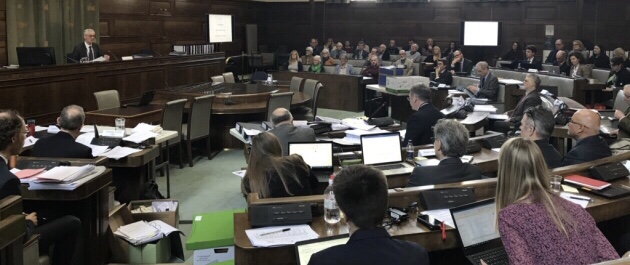





 SIMONICITY